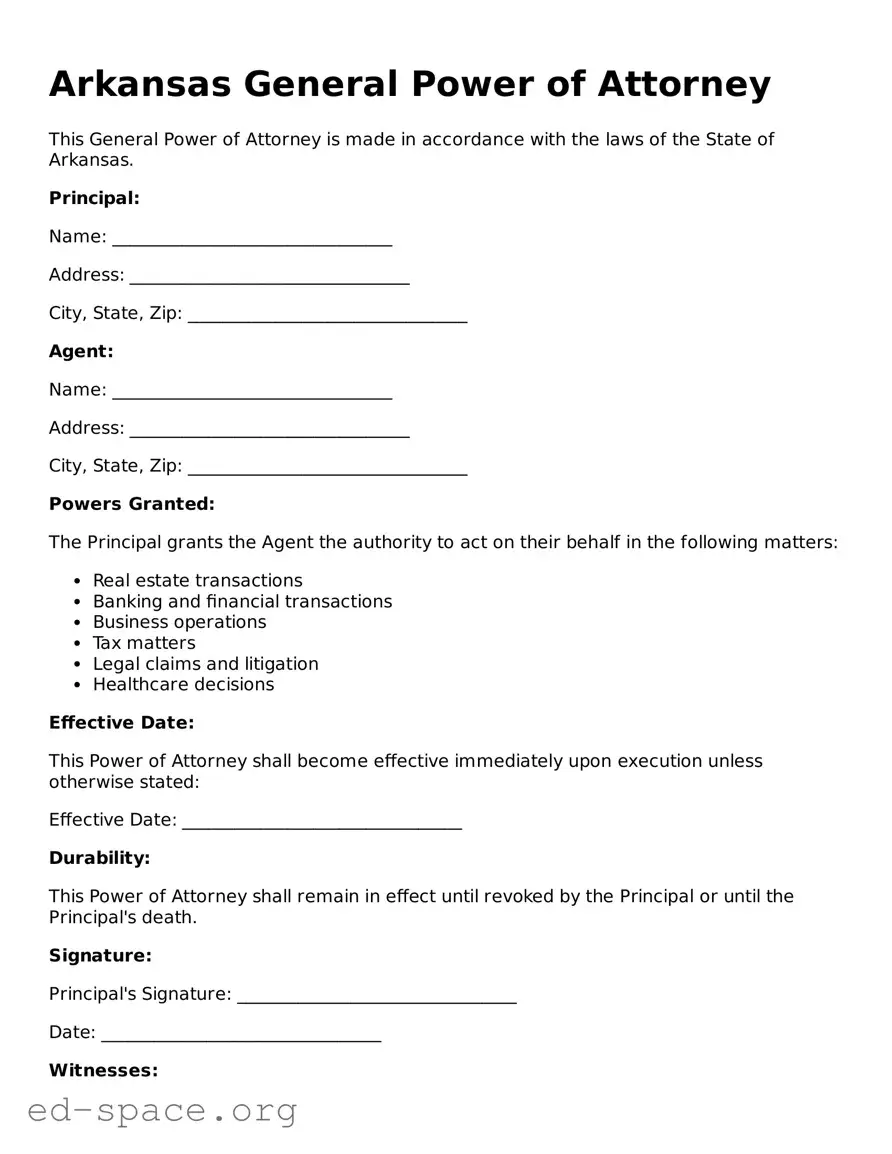
The Arkansas General Power of Attorney form is a crucial legal document that empowers an individual, known as the agent or attorney-in-fact, to make decisions on behalf of another person, referred to as the principal. This form is particularly valuable in situations where the principal is unable to manage their own affairs due to illness, absence, or incapacity. It covers a broad range of responsibilities, allowing the agent to handle financial transactions, manage real estate, and make healthcare decisions, among other duties. Importantly, the powers granted can be tailored to meet specific needs, ensuring that the principal's preferences are respected. Understanding the nuances of this form is essential, as it includes provisions for revocation, duration, and limitations on authority. Properly executing the Arkansas General Power of Attorney can safeguard the principal's interests and ensure that their wishes are carried out effectively, making it a vital tool for estate planning and personal management.
Arkansas General Power of Attorney
This General Power of Attorney is made in accordance with the laws of the State of Arkansas.
Principal:
Name: ________________________________
Address: ________________________________
City, State, Zip: ________________________________
Agent:
Name: ________________________________
Address: ________________________________
City, State, Zip: ________________________________
Powers Granted:
The Principal grants the Agent the authority to act on their behalf in the following matters:
Effective Date:
This Power of Attorney shall become effective immediately upon execution unless otherwise stated:
Effective Date: ________________________________
Durability:
This Power of Attorney shall remain in effect until revoked by the Principal or until the Principal's death.
Signature:
Principal's Signature: ________________________________
Date: ________________________________
Witnesses:
Signature of Witness 1: ________________________________
Name of Witness 1: ________________________________
Signature of Witness 2: ________________________________
Name of Witness 2: ________________________________
Notarization:
State of Arkansas
County of ________________________________
Subscribed and sworn before me on this _____ day of ____________, 20__.
Notary Public: ________________________________
My Commission Expires: ________________________________
| Fact Name | Description |
|---|---|
| Definition | The Arkansas General Power of Attorney form allows an individual to designate another person to manage their financial and legal affairs. |
| Governing Law | This form is governed by the Arkansas Code Annotated, Title 28, Chapter 68. |
| Durability | The General Power of Attorney can be made durable, meaning it remains effective even if the principal becomes incapacitated. |
| Revocation | The principal can revoke the power of attorney at any time, as long as they are competent to do so. |
| Notarization Requirement | For the form to be valid, it must be signed in the presence of a notary public. |
Filling out the Arkansas General Power of Attorney form is an important step in ensuring that your financial and legal matters can be managed by someone you trust. After completing the form, you will need to sign it in front of a notary public to make it legally binding. Here’s how to fill out the form step by step.
Once you have completed these steps, your General Power of Attorney will be ready for use. Make sure to keep a copy for your records and provide one to your Agent. This ensures that they can act on your behalf whenever necessary.
What is a General Power of Attorney in Arkansas?
A General Power of Attorney is a legal document that allows one person, known as the principal, to appoint another person, called the agent, to make decisions on their behalf. This can include managing financial matters, handling real estate transactions, or dealing with other personal affairs. The agent has broad authority to act for the principal, which is why it is important to choose someone trustworthy.
How do I create a General Power of Attorney in Arkansas?
To create a General Power of Attorney in Arkansas, you need to fill out a specific form that outlines the powers you wish to grant to your agent. It is crucial to ensure that the document is signed in front of a notary public. This notarization helps confirm the identity of the principal and the authenticity of the document. Once completed, the form should be kept in a safe place, and copies should be provided to the agent and any relevant institutions.
Can I revoke a General Power of Attorney in Arkansas?
Yes, you can revoke a General Power of Attorney at any time as long as you are mentally competent. To revoke it, you should create a written notice stating your intention to cancel the document. It is advisable to notify your agent and any institutions that may have a copy of the original Power of Attorney. Additionally, destroying the original document can help prevent any confusion.
What happens if the principal becomes incapacitated?
If the principal becomes incapacitated, the General Power of Attorney typically remains in effect unless it specifically states otherwise. However, if the principal is unable to make decisions, it may be necessary to have a court appoint a guardian or conservator. This can lead to complications, which is why some individuals choose to set up a Durable Power of Attorney that continues even if the principal becomes incapacitated.
Is a General Power of Attorney valid in other states?
A General Power of Attorney created in Arkansas may be recognized in other states, but laws can vary. It is important to check the specific requirements of the state where the document will be used. Some states may require additional forms or notarization. Consulting with an attorney in the relevant state can provide clarity and ensure that the document is valid and effective.
Not specifying the powers granted: Individuals often forget to clearly outline the specific powers they wish to grant to the agent. This can lead to confusion and limit the agent's ability to act effectively.
Failing to date the document: Some people neglect to include the date on the General Power of Attorney form. Without a date, it may be difficult to determine the validity of the document.
Not signing in the correct places: It is crucial to ensure that all required signatures are provided. A common mistake is overlooking the need for both the principal's signature and the agent's acknowledgment.
Ignoring witness or notary requirements: Depending on the situation, some individuals may not realize that their General Power of Attorney needs to be witnessed or notarized to be legally binding.
Using outdated forms: People sometimes use older versions of the General Power of Attorney form that may not comply with current Arkansas laws. Always check for the most recent version.
Not discussing the decision with the agent: Failing to communicate with the designated agent can lead to misunderstandings about their responsibilities and the principal's wishes.
When creating a General Power of Attorney in Arkansas, there are several other forms and documents that may be necessary or beneficial to ensure your wishes are clearly communicated and legally recognized. Each of these documents serves a unique purpose and can help provide clarity in various situations.
Having these documents in place alongside your General Power of Attorney can provide a comprehensive approach to managing your affairs. It ensures that your wishes are respected and that your appointed agents have the necessary authority to act on your behalf in various situations.
The General Power of Attorney (GPOA) form is an important legal document that allows one person to act on behalf of another in various matters. While the GPOA has its specific functions, it shares similarities with several other documents. Here’s a list of nine documents that are comparable to the General Power of Attorney:
Each of these documents serves a unique purpose but shares the fundamental principle of granting authority to another individual to act on behalf of someone else.
Filling out a General Power of Attorney form in Arkansas is an important step that requires careful attention. Here are some essential dos and don'ts to guide you through the process.
By following these guidelines, you can ensure that your General Power of Attorney form is completed correctly and serves its intended purpose. Remember, this document is a significant part of your estate planning and should reflect your wishes accurately.
Many individuals have misconceptions about the Arkansas General Power of Attorney form. Understanding these misconceptions can help clarify its purpose and use. Below is a list of ten common misunderstandings.
Clarifying these misconceptions can help individuals make informed decisions regarding the Arkansas General Power of Attorney form and its implications.
Filling out and using the Arkansas General Power of Attorney form is an important step in ensuring that your financial and legal matters are handled according to your wishes. Here are some key takeaways to keep in mind:
Taking these steps will help you create a General Power of Attorney that effectively protects your interests and provides peace of mind.