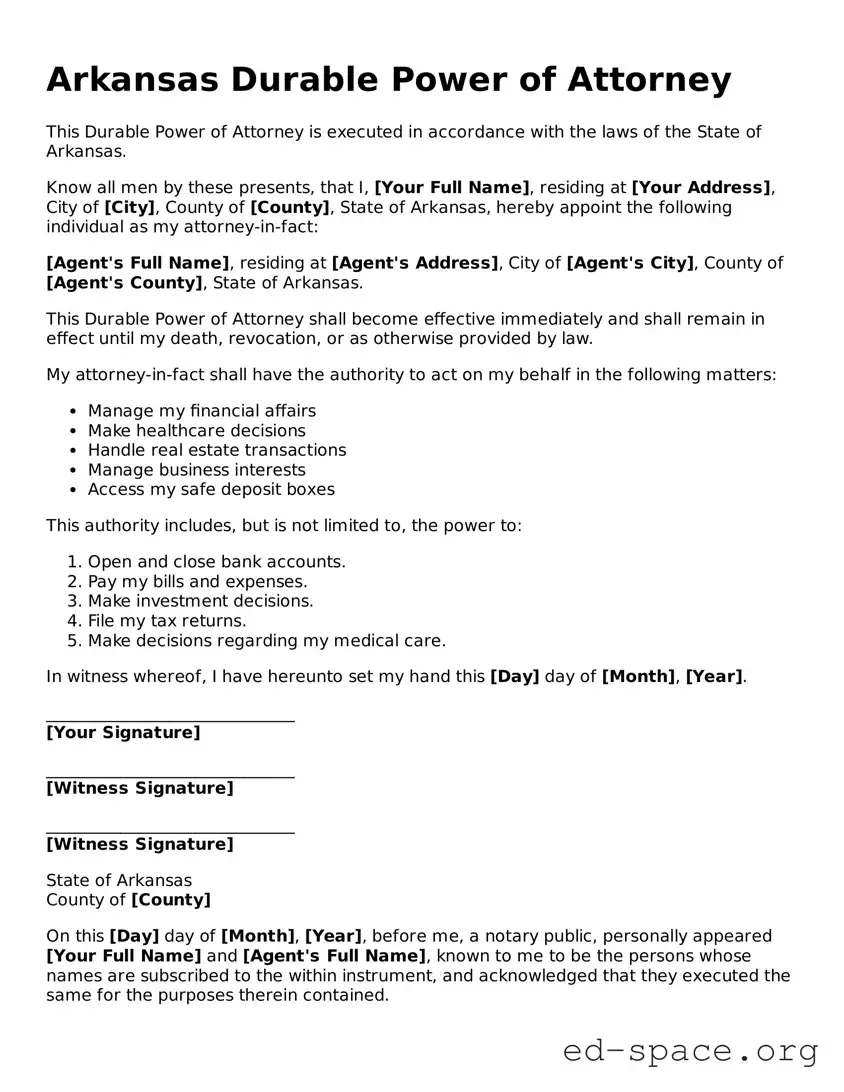
The Arkansas Durable Power of Attorney form serves as a crucial tool for individuals seeking to ensure their financial and medical decisions are managed according to their wishes, even if they become unable to communicate those wishes themselves. This legal document allows a person, known as the principal, to designate another individual, called an agent or attorney-in-fact, to make decisions on their behalf. The form can cover a wide range of powers, including handling bank transactions, managing real estate, and making healthcare decisions. Importantly, it remains effective even if the principal becomes incapacitated, which distinguishes it from other types of power of attorney forms. By completing this document, individuals can provide peace of mind for themselves and their loved ones, knowing that their affairs will be handled by a trusted person. The process of creating a Durable Power of Attorney in Arkansas is straightforward, but it is essential to ensure that the form is filled out correctly and complies with state laws to be valid and enforceable.
Arkansas Durable Power of Attorney
This Durable Power of Attorney is executed in accordance with the laws of the State of Arkansas.
Know all men by these presents, that I, [Your Full Name], residing at [Your Address], City of [City], County of [County], State of Arkansas, hereby appoint the following individual as my attorney-in-fact:
[Agent's Full Name], residing at [Agent's Address], City of [Agent's City], County of [Agent's County], State of Arkansas.
This Durable Power of Attorney shall become effective immediately and shall remain in effect until my death, revocation, or as otherwise provided by law.
My attorney-in-fact shall have the authority to act on my behalf in the following matters:
This authority includes, but is not limited to, the power to:
In witness whereof, I have hereunto set my hand this [Day] day of [Month], [Year].
______________________________
[Your Signature]
______________________________
[Witness Signature]
______________________________
[Witness Signature]
State of Arkansas
County of [County]
On this [Day] day of [Month], [Year], before me, a notary public, personally appeared [Your Full Name] and [Agent's Full Name], known to me to be the persons whose names are subscribed to the within instrument, and acknowledged that they executed the same for the purposes therein contained.
In witness whereof, I have hereunto set my hand and affixed my official seal the day and year first above written.
______________________________
[Notary Public Signature]
My commission expires: [Expiration Date]
| Fact Name | Description |
|---|---|
| Definition | A Durable Power of Attorney in Arkansas allows an individual (the principal) to designate another person (the agent) to make decisions on their behalf, even if they become incapacitated. |
| Governing Law | The Durable Power of Attorney in Arkansas is governed by the Arkansas Code Annotated, specifically Title 28, Chapter 68. |
| Durability | This type of power of attorney remains effective until revoked by the principal or until the principal's death, ensuring that the agent can act during periods of incapacity. |
| Agent's Authority | The agent can be granted broad or limited powers, depending on the principal's preferences, which should be clearly outlined in the document. |
| Execution Requirements | To be valid, the Durable Power of Attorney must be signed by the principal and acknowledged before a notary public or signed in the presence of two witnesses. |
| Revocation | The principal can revoke the Durable Power of Attorney at any time, provided they are still competent to make decisions. |
| Limitations | While the agent has significant authority, they cannot make decisions regarding the principal’s health care unless specifically granted that power in the document. |
| Importance of Clarity | It is crucial for the principal to clearly outline the scope of authority granted to the agent to prevent misunderstandings and potential disputes. |
Filling out the Arkansas Durable Power of Attorney form is a straightforward process. Once completed, this document allows you to designate someone to make decisions on your behalf when you are unable to do so. Follow these steps to ensure the form is filled out correctly.
What is a Durable Power of Attorney in Arkansas?
A Durable Power of Attorney is a legal document that allows one person to appoint another to make decisions on their behalf. This authority remains in effect even if the person who created the document becomes incapacitated. It is particularly useful for managing financial matters and health care decisions.
Why would I need a Durable Power of Attorney?
Having a Durable Power of Attorney ensures that someone you trust can make important decisions for you if you are unable to do so. This can include managing your finances, paying bills, or making medical decisions. It provides peace of mind knowing that your affairs will be handled according to your wishes.
Who can be designated as an agent in a Durable Power of Attorney?
You can designate anyone you trust as your agent, often referred to as an attorney-in-fact. This can be a family member, friend, or a professional such as an attorney or accountant. It’s essential to choose someone responsible and reliable, as they will have significant authority over your affairs.
How do I create a Durable Power of Attorney in Arkansas?
To create a Durable Power of Attorney in Arkansas, you must complete the appropriate form, which includes your name, the agent’s name, and the specific powers you wish to grant. You must sign the document in front of a notary public to make it legally binding. It’s advisable to consult with a legal professional to ensure everything is correctly filled out.
Can I revoke a Durable Power of Attorney?
Yes, you can revoke a Durable Power of Attorney at any time as long as you are competent. To do so, you should create a written revocation document and notify your agent and any institutions that were relying on the original document. This helps prevent any confusion regarding your wishes.
What powers can I grant to my agent?
You can grant your agent a wide range of powers, including managing bank accounts, buying or selling property, handling investments, and making healthcare decisions. You can specify which powers you want to grant or limit certain actions to ensure your preferences are respected.
Does a Durable Power of Attorney need to be filed with the court?
No, a Durable Power of Attorney does not need to be filed with the court in Arkansas. However, it is important to keep the document in a safe place and provide copies to your agent and any relevant institutions, such as banks or healthcare providers.
What happens if I do not have a Durable Power of Attorney?
If you do not have a Durable Power of Attorney and become incapacitated, your family may need to go through a court process to appoint a guardian or conservator to manage your affairs. This process can be time-consuming and may not reflect your wishes, making it essential to have a Durable Power of Attorney in place.
Can I use a Durable Power of Attorney created in another state in Arkansas?
Yes, a Durable Power of Attorney created in another state can be valid in Arkansas, provided it meets the legal requirements of Arkansas law. However, it is wise to consult with a legal professional to ensure that the document is enforceable and covers all necessary powers.
Is a Durable Power of Attorney the same as a regular Power of Attorney?
No, a Durable Power of Attorney differs from a regular Power of Attorney in that it remains effective even if you become incapacitated. A regular Power of Attorney typically becomes invalid if the principal loses the ability to make decisions. The durable version is specifically designed to address this issue.
Not specifying the powers granted: Individuals often forget to clearly outline the specific powers they wish to grant to their agent. This can lead to confusion and potential disputes later on.
Failing to date the document: Omitting the date can create ambiguity about when the Durable Power of Attorney becomes effective. This mistake may complicate matters when the document is needed.
Neglecting to sign in front of a notary: Many people overlook the requirement for notarization. Without a notary's signature, the document may not be considered valid.
Choosing the wrong agent: Selecting someone who lacks the necessary skills or trustworthiness can lead to mismanagement of affairs. It is crucial to choose an agent who will act in the principal's best interest.
Not discussing the decision with the agent: Failing to communicate intentions and expectations with the chosen agent can lead to misunderstandings. Open dialogue is essential for a smooth process.
Forgetting to review and update the document: Life circumstances change. Individuals often neglect to revisit their Durable Power of Attorney, which can render the document outdated.
Ignoring state-specific requirements: Each state has its own rules regarding Durable Power of Attorney forms. Not adhering to Arkansas's specific requirements can invalidate the document.
The Arkansas Durable Power of Attorney form is a crucial document that allows an individual to designate another person to make decisions on their behalf in financial or legal matters. Alongside this form, several other documents are commonly utilized to ensure comprehensive legal planning and protection. Below is a list of these essential documents.
Each of these documents plays a vital role in ensuring that an individual's wishes are honored and that their affairs are managed according to their preferences. It is important to consider these forms in conjunction with the Arkansas Durable Power of Attorney to create a comprehensive plan for both health and financial matters.
When filling out the Arkansas Durable Power of Attorney form, it’s essential to proceed with care. Here are some key dos and don’ts to ensure the process goes smoothly.
By following these guidelines, you can create a Durable Power of Attorney that reflects your wishes and protects your interests.
Understanding the Arkansas Durable Power of Attorney form is crucial for effective estate planning. However, several misconceptions can lead to confusion. Below is a list of common misunderstandings about this important legal document.
This form can also cover healthcare decisions, allowing an agent to make medical choices on behalf of the principal.
While some choose to appoint attorneys, anyone over 18 who is trustworthy can serve as an agent.
It can be set to become effective immediately or only upon the principal's incapacitation, depending on the principal's wishes.
The principal retains the right to revoke or change the Durable Power of Attorney at any time as long as they are competent.
Anyone, regardless of age, can benefit from having a Durable Power of Attorney in place for unexpected situations.
A Durable Power of Attorney remains in effect even if the principal becomes incapacitated, unlike a regular Power of Attorney.
Amendments can be made, and the document can be revoked at any time while the principal is still competent.
The agent must act in the best interest of the principal and within the limits set by the Durable Power of Attorney.
This document is generally recognized across states, but it's essential to check local laws for specific requirements.
In Arkansas, the Durable Power of Attorney must be signed in the presence of a notary public or two witnesses to be valid.
By addressing these misconceptions, individuals can better understand the importance and functionality of the Arkansas Durable Power of Attorney form.
Filling out and utilizing the Arkansas Durable Power of Attorney form is a significant step in planning for the future. Here are some key takeaways to consider: