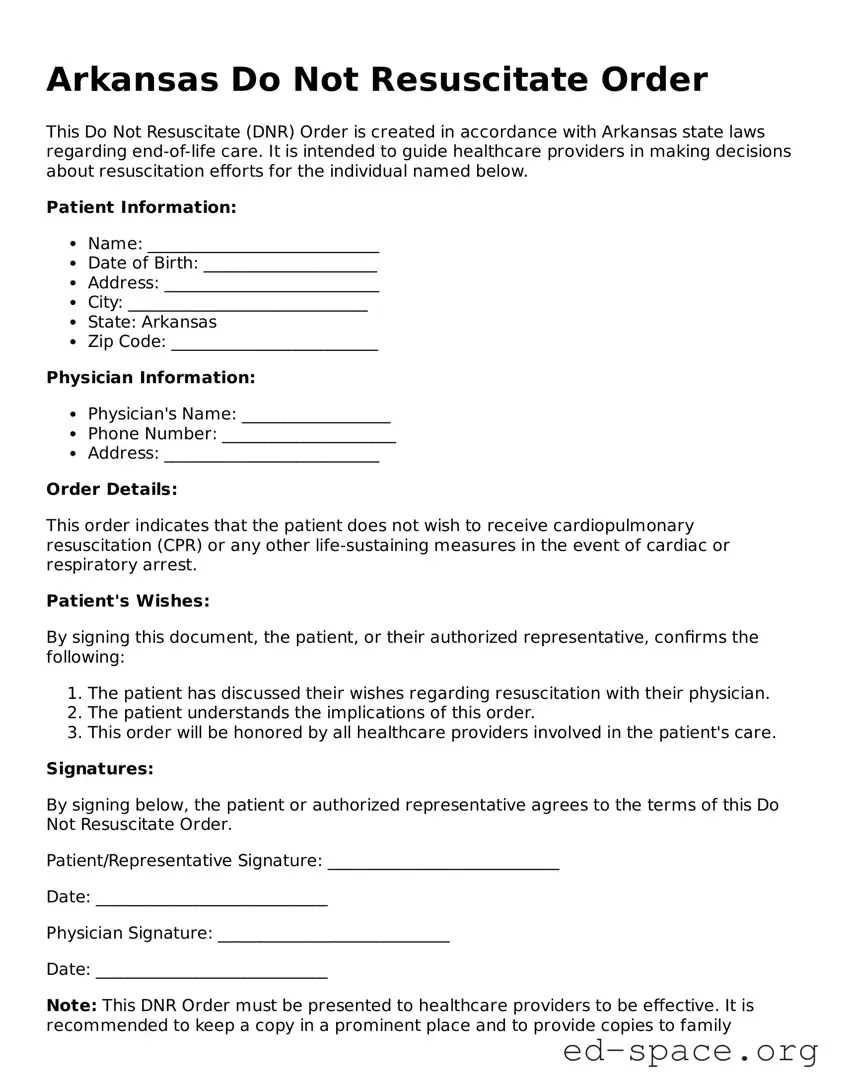
In Arkansas, the Do Not Resuscitate (DNR) Order form serves a crucial role in healthcare decision-making for individuals who wish to express their preferences regarding resuscitation efforts in the event of a medical emergency. This legally binding document allows patients to communicate their wishes clearly, ensuring that healthcare providers respect their choices regarding life-sustaining treatments. The form must be completed and signed by a physician, and it requires the patient or their legal representative to provide informed consent. It is essential for the DNR Order to be easily accessible to medical personnel, especially in emergency situations, so that the patient's wishes can be honored without delay. Additionally, the form includes specific guidelines about its validity, as well as the rights of patients and their families to revoke the order at any time. Understanding the implications and requirements of the DNR Order form is vital for individuals and families navigating end-of-life care decisions, as it empowers them to take control of their healthcare preferences while ensuring their values are respected in critical moments.
Arkansas Do Not Resuscitate Order
This Do Not Resuscitate (DNR) Order is created in accordance with Arkansas state laws regarding end-of-life care. It is intended to guide healthcare providers in making decisions about resuscitation efforts for the individual named below.
Patient Information:
Physician Information:
Order Details:
This order indicates that the patient does not wish to receive cardiopulmonary resuscitation (CPR) or any other life-sustaining measures in the event of cardiac or respiratory arrest.
Patient's Wishes:
By signing this document, the patient, or their authorized representative, confirms the following:
Signatures:
By signing below, the patient or authorized representative agrees to the terms of this Do Not Resuscitate Order.
Patient/Representative Signature: ____________________________
Date: ____________________________
Physician Signature: ____________________________
Date: ____________________________
Note: This DNR Order must be presented to healthcare providers to be effective. It is recommended to keep a copy in a prominent place and to provide copies to family members and caregivers.
| Fact Name | Description |
|---|---|
| Definition | The Arkansas Do Not Resuscitate (DNR) Order form allows individuals to express their wishes regarding resuscitation efforts in the event of a medical emergency. |
| Governing Law | The DNR Order in Arkansas is governed by the Arkansas Code Annotated § 20-10-1201 et seq. |
| Eligibility | Any adult individual who is capable of making healthcare decisions can complete a DNR Order form. |
| Signature Requirements | The form must be signed by the individual or their legal representative, and it should be witnessed by two individuals or notarized. |
| Revocation | Individuals have the right to revoke a DNR Order at any time, and this can be done verbally or in writing. |
Completing the Arkansas Do Not Resuscitate Order form is a straightforward process that requires careful attention to detail. This document serves as a legal directive regarding medical treatment preferences. Follow the steps below to ensure accurate completion of the form.
After completing the form, it is essential to distribute copies to relevant medical personnel. This ensures that your preferences are known and respected in medical situations where resuscitation may be considered.
What is a Do Not Resuscitate (DNR) Order in Arkansas?
A Do Not Resuscitate Order is a legal document that allows individuals to refuse cardiopulmonary resuscitation (CPR) and other life-saving measures in the event of cardiac arrest or respiratory failure. In Arkansas, this order must be completed by a physician and signed by the patient or their legal representative.
Who can request a DNR Order?
Any adult who is capable of making their own medical decisions can request a DNR Order. Additionally, a legal representative, such as a healthcare proxy or power of attorney, may also request this order on behalf of an individual who is unable to make decisions.
How is a DNR Order created in Arkansas?
To create a DNR Order, the patient must discuss their wishes with a physician. The physician will then complete the official DNR form, which must be signed by both the physician and the patient or their legal representative. It is important that the form is filled out correctly to ensure its validity.
Where should the DNR Order be kept?
The DNR Order should be kept in a location that is easily accessible to medical personnel, such as on the refrigerator, in a medical file, or with the individual at all times. It is advisable to inform family members and caregivers about the location of the document.
Can a DNR Order be revoked?
Yes, a DNR Order can be revoked at any time by the patient or their legal representative. To revoke the order, the individual should inform their healthcare provider and remove or destroy the DNR form. It is important to ensure that all relevant parties are informed of the revocation.
Does a DNR Order apply outside of a hospital setting?
In Arkansas, a DNR Order is generally applicable in both hospital and out-of-hospital settings. However, it is important to confirm that emergency medical services (EMS) are aware of the DNR Order and understand its terms, especially in non-hospital environments.
What happens if a DNR Order is not honored?
If a DNR Order is not honored, it may lead to unnecessary resuscitation efforts, which can cause distress to the patient and their family. In such cases, legal action may be considered, as failing to comply with a valid DNR Order can be viewed as a violation of the patient's rights.
Are there any specific requirements for the DNR form in Arkansas?
The DNR form in Arkansas must include the patient's name, the physician's name, and the signatures of both parties. It should also clearly state the patient's wishes regarding resuscitation. The form must comply with state regulations to be considered valid.
Can family members override a DNR Order?
Family members cannot override a DNR Order that has been properly executed by the patient and their physician. However, if the patient is unable to communicate, family members may be consulted about the patient's wishes, but the legally binding DNR remains in effect.
How can I obtain a DNR Order form in Arkansas?
A DNR Order form can be obtained from healthcare providers, hospitals, or the Arkansas Department of Health. It is advisable to consult with a physician to ensure that the form is completed correctly and reflects the individual's wishes accurately.
Failing to include the patient's full legal name. This is essential for identification.
Not providing the date of birth. This information helps confirm the patient's identity.
Leaving the signature section blank. A signature is necessary for the order to be valid.
Not having the form signed by a licensed physician. A physician's signature is crucial for legal acceptance.
Omitting the patient's medical history. Relevant medical information should be included to support the decision.
Using outdated forms. Ensure that the most current version of the DNR order is being used.
Failing to discuss the DNR order with family members. Communication can prevent confusion and ensure everyone is informed.
Not keeping copies of the completed form. It is wise to retain copies for personal records and to share with healthcare providers.
Neglecting to update the form if the patient's wishes change. Regular reviews are important to reflect current preferences.
Not understanding the implications of the DNR order. It is important to fully comprehend what a DNR means for treatment options.
In Arkansas, the Do Not Resuscitate (DNR) Order form is an essential document for individuals who wish to refuse resuscitation efforts in the event of a medical emergency. However, several other forms and documents often accompany the DNR to ensure comprehensive healthcare planning and decision-making. Below is a list of these important documents.
These documents work together to ensure that individuals' healthcare wishes are respected and upheld. They provide clarity for medical professionals and loved ones during critical moments, allowing for decisions that align with the individual’s values and desires.
The Do Not Resuscitate (DNR) Order form is an important document that outlines a patient's wishes regarding resuscitation efforts in case of a medical emergency. Several other documents share similarities with the DNR Order form, each serving a unique purpose in healthcare decision-making. Here’s a list of eight documents that are similar to the DNR Order form:
Understanding these documents can help ensure that patients' wishes are respected and honored during critical medical situations. It is crucial to discuss these options with healthcare providers and loved ones to create a clear plan that reflects individual preferences.
When filling out the Arkansas Do Not Resuscitate Order form, it is important to follow specific guidelines to ensure the document is valid and accurately reflects the wishes of the individual. Below are four things to do and four things to avoid.
Things You Should Do:
Things You Shouldn't Do:
Understanding the Arkansas Do Not Resuscitate (DNR) Order form can be challenging. Here are ten common misconceptions about the DNR form, along with clarifications to help clear up confusion.
This is not true. A DNR order specifically addresses resuscitation efforts in the event of cardiac arrest. Other medical treatments can still be provided as needed.
While many people with terminal illnesses choose to have a DNR order, it is not limited to them. Anyone can request a DNR based on their personal health care preferences.
This is incorrect. Individuals can revoke or modify their DNR order at any time as long as they are competent to do so.
A DNR order is valid in various settings, including homes, nursing facilities, and other health care environments, as long as it is properly documented.
Generally, a DNR order made by a competent individual must be respected by medical personnel. Family members cannot override it unless they have legal authority.
Completing a DNR order does not require legal assistance. Patients can fill out the form themselves, although they may choose to consult with a healthcare provider.
While both documents relate to end-of-life decisions, a DNR specifically addresses resuscitation efforts, whereas a living will outlines broader health care preferences.
DNR orders can be requested by individuals of any age who wish to express their preferences regarding resuscitation.
A DNR order does not ensure a peaceful death. It simply means that resuscitation efforts will not be made if the heart stops or breathing ceases.
Medical professionals will continue to provide care and comfort measures. The DNR order only affects resuscitation efforts in case of cardiac arrest.
Being informed about these misconceptions can help individuals make better decisions regarding their health care preferences. It is important to discuss these matters with a healthcare provider to ensure that wishes are clearly understood and documented.
Filling out and using the Arkansas Do Not Resuscitate (DNR) Order form is a significant step in ensuring that your healthcare preferences are respected. Here are key takeaways to consider:
By following these key points, you can ensure that your DNR order is properly filled out and respected when the time comes.