Homepage Free Divorce Settlement Agreement Form for Arkansas
Content Overview

When navigating the complexities of divorce in Arkansas, understanding the Divorce Settlement Agreement form is crucial for both parties involved. This form serves as a binding document that outlines the terms agreed upon during the divorce process, addressing key issues such as property division, child custody, and financial responsibilities. It provides a clear framework for how assets will be distributed, ensuring that both parties have a mutual understanding of their rights and obligations. Additionally, the agreement can specify arrangements for child support and visitation, which are vital for the well-being of any children involved. By clearly detailing these aspects, the Divorce Settlement Agreement helps to minimize future disputes and provides a sense of closure for both individuals. Properly completing this form is not just a procedural step; it is a significant part of the divorce process that can impact one's financial stability and familial relationships for years to come.

Document Preview

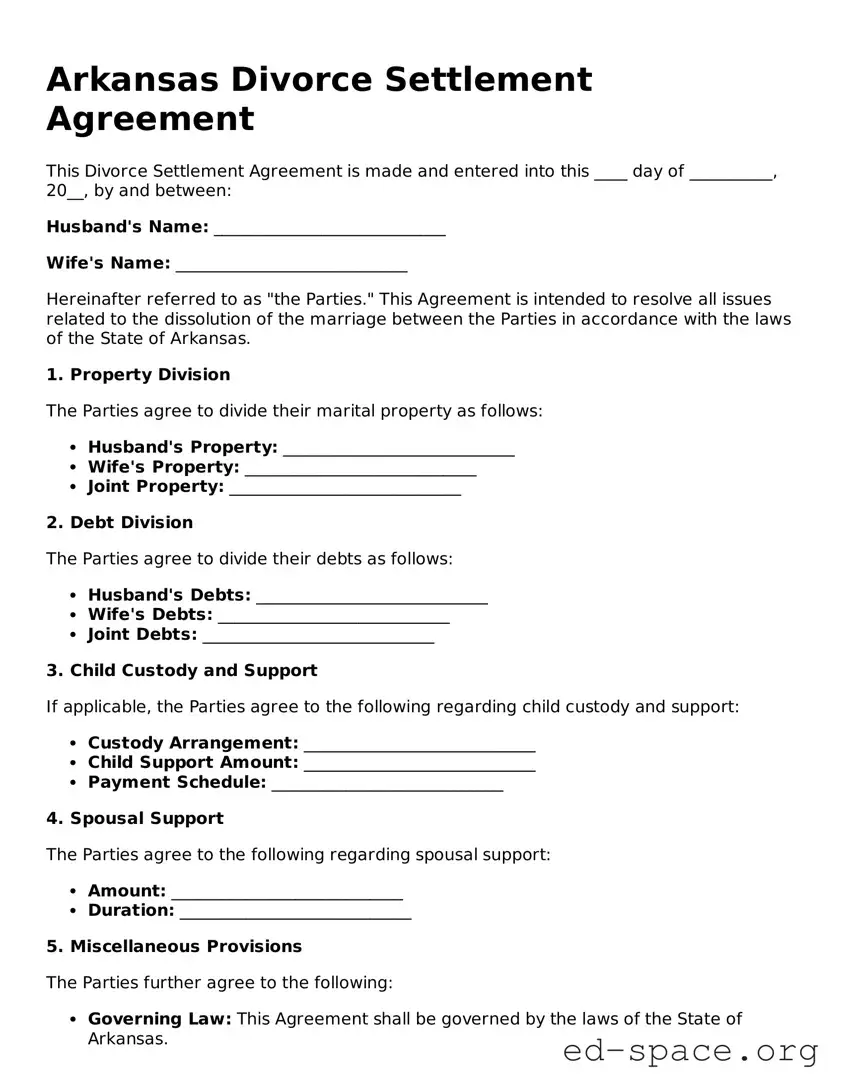
Arkansas Divorce Settlement Agreement

This Divorce Settlement Agreement is made and entered into this ____ day of __________, 20__, by and between:

Husband's Name: ____________________________

Wife's Name: ____________________________

Hereinafter referred to as "the Parties." This Agreement is intended to resolve all issues related to the dissolution of the marriage between the Parties in accordance with the laws of the State of Arkansas.

1. Property Division

The Parties agree to divide their marital property as follows:

  • Husband's Property: ____________________________
  • Wife's Property: ____________________________
  • Joint Property: ____________________________

2. Debt Division

The Parties agree to divide their debts as follows:

  • Husband's Debts: ____________________________
  • Wife's Debts: ____________________________
  • Joint Debts: ____________________________

3. Child Custody and Support

If applicable, the Parties agree to the following regarding child custody and support:

  • Custody Arrangement: ____________________________
  • Child Support Amount: ____________________________
  • Payment Schedule: ____________________________

4. Spousal Support

The Parties agree to the following regarding spousal support:

  • Amount: ____________________________
  • Duration: ____________________________

5. Miscellaneous Provisions

The Parties further agree to the following:

  • Governing Law: This Agreement shall be governed by the laws of the State of Arkansas.
  • Modification: Any changes to this Agreement must be made in writing and signed by both Parties.
  • Entire Agreement: This document constitutes the entire agreement between the Parties.

IN WITNESS WHEREOF, the Parties have executed this Divorce Settlement Agreement as of the date first above written.

Husband's Signature: ____________________________

Date: ____________________________

Wife's Signature: ____________________________

Date: ____________________________

PDF Form Details

Fact Name Details
Governing Law The Arkansas Divorce Settlement Agreement is governed by Arkansas law, specifically Title 9, Chapter 12 of the Arkansas Code.
Purpose This form is used to outline the terms of a divorce settlement between spouses, including asset division and child custody arrangements.
Mutual Agreement Both parties must agree to the terms laid out in the settlement agreement for it to be valid and enforceable.
Filing Requirements The completed agreement must be filed with the court as part of the divorce proceedings.
Modification Once finalized, the agreement can only be modified by mutual consent of both parties and approval from the court.
Legal Representation While not required, it is advisable for both parties to seek legal counsel to ensure their rights are protected.
Confidentiality The terms of the agreement may be kept confidential, but court filings generally become public records.

Arkansas Divorce Settlement Agreement: Usage Guidelines

After obtaining the Arkansas Divorce Settlement Agreement form, you will need to complete it accurately to ensure all necessary information is included. This will help facilitate the divorce process and outline the terms agreed upon by both parties.

  1. Begin by entering your full name and your spouse's full name at the top of the form.
  2. Provide the date of your marriage and the date of separation.
  3. Fill in your current address and your spouse's current address.
  4. List any children from the marriage, including their names and birthdates.
  5. Detail the division of property, including real estate, vehicles, and personal belongings.
  6. Specify any debts that need to be divided between you and your spouse.
  7. Outline any child custody arrangements and visitation schedules.
  8. Include any child support or spousal support agreements.
  9. Sign and date the form at the bottom, along with your spouse’s signature.

Once the form is filled out, both parties should review it for accuracy. After ensuring all information is correct, the next step is to file the completed form with the appropriate court.

Your Questions, Answered

What is the Arkansas Divorce Settlement Agreement form?

The Arkansas Divorce Settlement Agreement form is a legal document that outlines the terms agreed upon by both spouses during a divorce. It covers important aspects such as property division, child custody, visitation rights, and spousal support. Completing this form is essential for ensuring that both parties understand their rights and responsibilities moving forward.

Who needs to fill out the Divorce Settlement Agreement form?

How do I submit the Divorce Settlement Agreement form?

Can the Divorce Settlement Agreement be modified after submission?

What happens if we cannot agree on the terms?

Common mistakes

  1. Incomplete Information: One of the most common mistakes is leaving sections blank. Every part of the form must be filled out completely. Missing information can lead to delays in the divorce process.

  2. Incorrect Spelling of Names: Spelling errors in names can create confusion and may require additional paperwork to correct. Double-check the spelling of both parties’ names, as well as any children involved.

  3. Failure to Disclose Assets: Omitting assets or debts can result in legal consequences. It’s important to provide a full and honest account of all financial matters to ensure a fair settlement.

  4. Not Considering Future Needs: Some individuals focus solely on the present and overlook future financial needs. Think about how the settlement will affect long-term financial stability, especially regarding child support and alimony.

  5. Ignoring State Guidelines: Each state has its own laws regarding divorce settlements. Familiarize yourself with Arkansas laws to ensure compliance and avoid mistakes that could invalidate the agreement.

  6. Not Having a Witness: Some may forget to have the agreement signed in front of a witness. This step can be crucial for the document's validity, so ensure a witness is present during signing.

  7. Rushing the Process: Filling out the form in haste often leads to errors. Take your time to review each section carefully. A thorough review can prevent mistakes that might complicate the divorce proceedings.

Documents used along the form

When navigating the process of divorce in Arkansas, several important documents accompany the Divorce Settlement Agreement. Each of these forms serves a specific purpose and helps ensure that both parties understand their rights and responsibilities. Below is a list of commonly used forms that may be necessary during this process.

  • Petition for Divorce: This document initiates the divorce process. It outlines the grounds for divorce and provides the court with necessary information about the marriage, such as the date of marriage and any children involved.
  • Summons: Issued by the court, the summons notifies the other spouse that a divorce action has been filed. It includes information about how long they have to respond and the consequences of not doing so.
  • Child Custody Agreement: If children are involved, this agreement details the arrangements for custody, visitation, and decision-making responsibilities. It aims to prioritize the best interests of the children.
  • Child Support Worksheet: This form calculates the amount of child support one parent may owe to the other. It considers income, expenses, and other factors to determine a fair support amount.
  • Property Settlement Agreement: This document outlines how marital property and debts will be divided between the spouses. It helps to ensure that both parties understand their financial obligations after the divorce.
  • Affidavit of Financial Means: This affidavit provides the court with a detailed overview of each spouse's financial situation, including income, expenses, assets, and liabilities. It assists in making informed decisions regarding support and property division.
  • Final Judgment of Divorce: This is the court's official decree that finalizes the divorce. It includes the terms of the settlement agreement, custody arrangements, and any other relevant orders.

Understanding these documents can significantly ease the divorce process. Each form plays a vital role in ensuring that both parties are treated fairly and that all necessary legal requirements are met. It's advisable to consult with a legal professional to navigate these forms effectively.

Similar forms

  • Separation Agreement: This document outlines the terms of a couple's separation before divorce. It covers issues like property division and child custody, similar to a Divorce Settlement Agreement.
  • Child Custody Agreement: This focuses specifically on the care and living arrangements for children. Like a Divorce Settlement Agreement, it aims to provide clarity and stability for families.
  • Property Settlement Agreement: This is a legal document detailing how property and assets will be divided. It shares similarities with a Divorce Settlement Agreement in its focus on equitable distribution.
  • Spousal Support Agreement: This document outlines the financial support one spouse will provide to the other after separation. It often accompanies a Divorce Settlement Agreement, addressing financial matters.
  • Pre-Nuptial Agreement: Created before marriage, this document details how assets will be handled in case of divorce. It serves a similar purpose by clarifying expectations and responsibilities.
  • Post-Nuptial Agreement: Similar to a pre-nuptial agreement, this is made after marriage and addresses asset division and support in the event of divorce. It can complement a Divorce Settlement Agreement.
  • Child Support Agreement: This outlines the financial support one parent will provide for their children. Like a Divorce Settlement Agreement, it aims to ensure children's needs are met after separation.
  • Mutual Release Agreement: This document releases both parties from future claims against each other. It can be part of a Divorce Settlement Agreement, helping to finalize all legal matters.
  • Final Judgment of Divorce: This is the court's official decision to end a marriage. It often incorporates the terms of a Divorce Settlement Agreement, making it enforceable by law.
  • Marital Settlement Agreement: This is a comprehensive document that addresses all aspects of a divorce, including custody, support, and asset division. It is very similar to a Divorce Settlement Agreement in scope.

Dos and Don'ts

When filling out the Arkansas Divorce Settlement Agreement form, it is important to approach the process with care and attention to detail. Here are some essential dos and don'ts to consider:

  • Do read the instructions carefully before starting the form.
  • Do ensure all information is accurate and up-to-date.
  • Do provide complete financial disclosures to avoid future disputes.
  • Do consult with a legal professional if you have any questions.
  • Don't leave any sections blank; incomplete forms can delay the process.
  • Don't rush through the form; take your time to review each section.

By following these guidelines, you can help ensure that your Divorce Settlement Agreement is filled out correctly and efficiently.

Misconceptions

Understanding the Arkansas Divorce Settlement Agreement form is crucial for anyone going through a divorce. However, several misconceptions can lead to confusion. Here are seven common misconceptions:

  1. It’s only for couples with children. Many believe that a Divorce Settlement Agreement is necessary only for those with kids. In reality, it applies to all divorcing couples, regardless of whether children are involved.
  2. It’s not legally binding. Some think that this agreement is just a formality. In truth, once signed and approved by the court, it becomes a legally binding document.
  3. It can be completed without legal help. While it is possible to fill out the form without an attorney, seeking legal advice can ensure that all aspects are addressed properly and protect your interests.
  4. All assets must be divided equally. Many assume that assets must be split 50/50. However, Arkansas follows equitable distribution, meaning assets are divided fairly but not necessarily equally.
  5. It’s only about property division. Some people think the agreement only covers how property is divided. In fact, it can also address alimony, debt responsibility, and other important issues.
  6. Once filed, it cannot be changed. There is a belief that once the agreement is submitted, it’s set in stone. Modifications can be made if both parties agree and the court approves the changes.
  7. It’s a quick process. Many underestimate the time it takes to complete the agreement. Depending on the complexity of the case, it can take time to negotiate and finalize the terms.

Being aware of these misconceptions can help individuals navigate the divorce process more effectively. Proper understanding leads to better decisions and outcomes.

Key takeaways

Filling out and using the Arkansas Divorce Settlement Agreement form is a crucial step in the divorce process. Here are some key takeaways to keep in mind:

  1. Understand the Purpose: This form outlines the terms of your divorce, including asset division, child custody, and support obligations. It serves as a binding agreement between both parties.
  2. Complete All Sections: Ensure that every section of the form is filled out completely and accurately. Missing information can lead to delays or complications in the divorce process.
  3. Be Clear and Specific: When detailing terms, clarity is essential. Use precise language to avoid misunderstandings later on.
  4. Review with Legal Counsel: Before submitting the form, consider having it reviewed by a legal professional. They can provide insights and ensure that your rights are protected.
  5. File with the Court: After completing the form, it must be filed with the appropriate court. Make sure to follow local rules and deadlines to avoid any issues.

Following these guidelines will help ensure that the process goes smoothly and that both parties understand their rights and responsibilities.