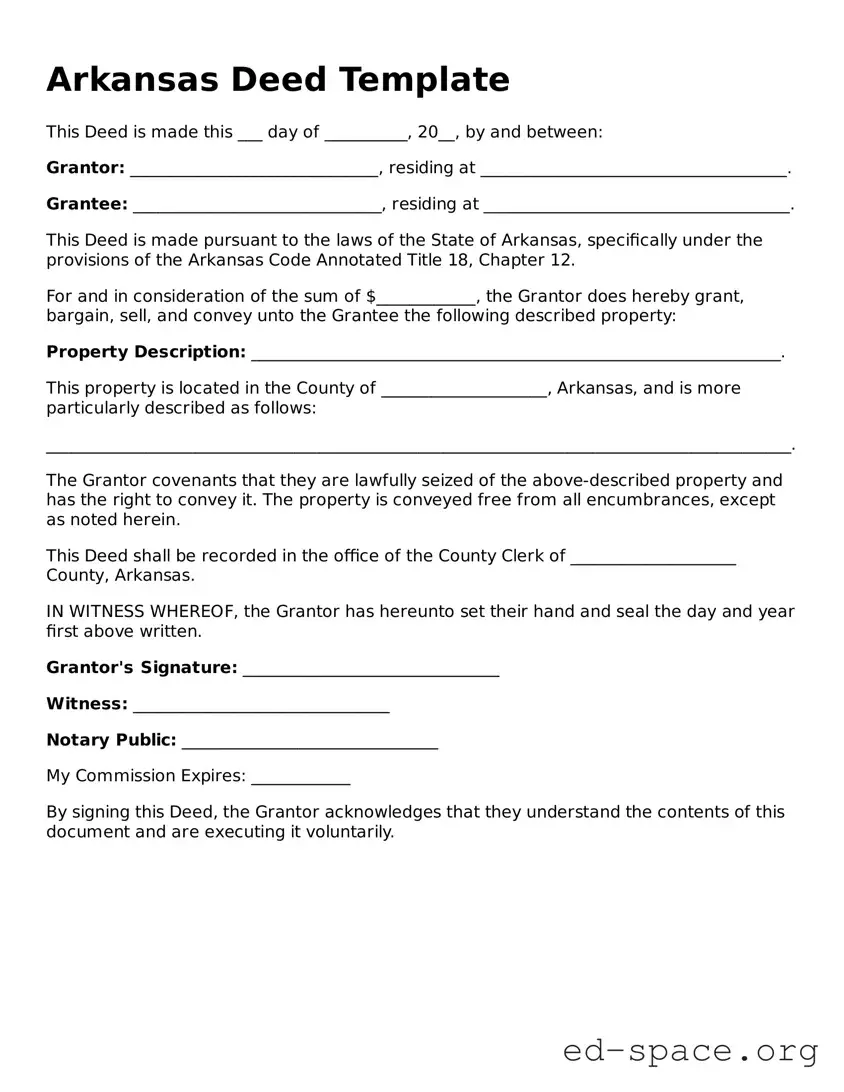
When it comes to transferring property ownership in Arkansas, the Arkansas Deed form plays a crucial role in ensuring that the process is clear and legally binding. This essential document outlines the specifics of the transaction, including the names of the parties involved, a detailed description of the property being transferred, and the terms of the conveyance. It serves as a formal record of the transfer, providing evidence of ownership and protecting the rights of both the grantor and the grantee. Additionally, the Arkansas Deed form may vary depending on the type of deed being executed, such as a warranty deed or a quitclaim deed, each serving different purposes and offering varying levels of protection. Understanding the components of this form, from the legal descriptions to the signatures required, is vital for anyone involved in real estate transactions in the state. By ensuring that the deed is properly filled out and filed with the appropriate county office, individuals can avoid potential disputes and ensure a smooth transition of property ownership.
Arkansas Deed Template
This Deed is made this ___ day of __________, 20__, by and between:
Grantor: ______________________________, residing at _____________________________________.
Grantee: ______________________________, residing at _____________________________________.
This Deed is made pursuant to the laws of the State of Arkansas, specifically under the provisions of the Arkansas Code Annotated Title 18, Chapter 12.
For and in consideration of the sum of $____________, the Grantor does hereby grant, bargain, sell, and convey unto the Grantee the following described property:
Property Description: ________________________________________________________________.
This property is located in the County of ____________________, Arkansas, and is more particularly described as follows:
__________________________________________________________________________________________.
The Grantor covenants that they are lawfully seized of the above-described property and has the right to convey it. The property is conveyed free from all encumbrances, except as noted herein.
This Deed shall be recorded in the office of the County Clerk of ____________________ County, Arkansas.
IN WITNESS WHEREOF, the Grantor has hereunto set their hand and seal the day and year first above written.
Grantor's Signature: _______________________________
Witness: _______________________________
Notary Public: _______________________________
My Commission Expires: ____________
By signing this Deed, the Grantor acknowledges that they understand the contents of this document and are executing it voluntarily.
| Fact Name | Details |
|---|---|
| Governing Law | The Arkansas Deed form is governed by the Arkansas Code Annotated, Title 18, Chapter 12. |
| Types of Deeds | Common types include Warranty Deed, Quitclaim Deed, and Special Warranty Deed. |
| Required Signatures | The deed must be signed by the grantor (seller) and acknowledged before a notary public. |
| Recording | To be effective against third parties, the deed should be recorded in the county where the property is located. |
| Consideration | The deed must state the consideration (payment) involved in the transaction. |
| Legal Description | A complete legal description of the property must be included in the deed. |
| Transfer Tax | Arkansas imposes a transfer tax on the sale of real estate, which must be paid upon recording. |
| Validity | The deed must meet all statutory requirements to be considered valid and enforceable. |
Once you have the Arkansas Deed form in hand, you'll need to fill it out carefully to ensure all necessary information is included. This form will require details about the property and the parties involved in the transaction. Follow these steps to complete the form accurately.
After completing the form, review it for accuracy. Ensure all signatures and notary stamps are in place before submitting it to the appropriate county office for recording.
What is an Arkansas Deed form?
An Arkansas Deed form is a legal document used to transfer ownership of real property from one party to another within the state of Arkansas. It outlines the details of the transaction, including the names of the parties involved, a description of the property, and any conditions or restrictions associated with the transfer.
What types of Deeds are available in Arkansas?
In Arkansas, there are several types of Deeds, including Warranty Deeds, Quitclaim Deeds, and Special Warranty Deeds. A Warranty Deed guarantees that the seller holds clear title to the property and has the right to sell it. A Quitclaim Deed transfers whatever interest the seller has in the property, without any guarantees. A Special Warranty Deed provides limited warranties, covering only the time the seller owned the property.
How do I fill out an Arkansas Deed form?
To fill out an Arkansas Deed form, start by entering the names and addresses of both the grantor (seller) and grantee (buyer). Next, provide a legal description of the property being transferred. This description should be precise and may include lot numbers, block numbers, and subdivision names. Finally, include the date of the transaction and any necessary signatures, along with notarization if required.
Is notarization required for an Arkansas Deed?
Yes, notarization is typically required for an Arkansas Deed. The signatures of both the grantor and grantee must be acknowledged by a notary public to ensure the authenticity of the document. This step helps prevent fraud and ensures that the deed is legally binding.
Where do I file an Arkansas Deed?
Once completed and notarized, the Arkansas Deed must be filed with the county clerk's office in the county where the property is located. This filing makes the transfer of ownership public and protects the rights of the new owner.
Are there any fees associated with filing an Arkansas Deed?
Yes, there are typically fees associated with filing an Arkansas Deed. These fees vary by county, so it is advisable to check with the local county clerk's office for the exact amount. Additionally, there may be recording fees based on the length of the document and the number of pages.
What information must be included in an Arkansas Deed?
An Arkansas Deed must include specific information such as the names and addresses of the grantor and grantee, a legal description of the property, the date of the transaction, and the signatures of both parties. It may also include any warranties or covenants associated with the property transfer.
Can I use a template for an Arkansas Deed?
Using a template for an Arkansas Deed can be helpful, especially for those unfamiliar with legal documents. However, it is important to ensure that the template complies with Arkansas laws and includes all necessary information. Consulting with a legal professional may be beneficial to ensure accuracy and completeness.
What happens if I don’t file the Deed?
If you do not file the Deed, the transfer of ownership may not be recognized by the state or other parties. This can lead to disputes regarding property rights and ownership. It is crucial to file the Deed promptly to protect your interests and ensure legal recognition of the property transfer.
Can I revoke or change an Arkansas Deed after it is filed?
Revoking or changing an Arkansas Deed after it has been filed is possible, but it typically requires a new legal document. This may involve creating a new Deed to transfer ownership back to the original grantor or to a new grantee. It is advisable to consult a legal professional for guidance on the correct process to ensure compliance with state laws.
Failing to include accurate property descriptions. Many individuals overlook the importance of providing a complete and precise description of the property being transferred. This can lead to confusion and potential legal disputes.
Not properly identifying the parties involved. It’s essential to ensure that all names are spelled correctly and that the correct legal names are used. Any discrepancies can complicate the transfer process.
Neglecting to have the deed notarized. A notarized deed is often required for it to be legally recognized. Skipping this step can invalidate the deed and hinder the transfer of ownership.
Using outdated or incorrect forms. Laws and requirements can change, so it’s crucial to ensure that the most current version of the deed form is being used. Outdated forms may not meet legal standards.
Overlooking the need for additional documentation. In some cases, supporting documents such as tax certificates or surveys may be necessary. Failing to provide these can delay the process.
When completing a property transaction in Arkansas, several additional forms and documents may be necessary alongside the Arkansas Deed form. Each of these documents serves a specific purpose in the transfer of property ownership and ensures compliance with state regulations. Below is a list of commonly used forms.
Understanding these documents can facilitate a smoother transaction and help all parties involved meet their legal obligations. Each form plays a role in ensuring transparency and protecting the interests of both buyers and sellers in the property transfer process.
The Deed form is a crucial document in property transactions, but it shares similarities with several other legal documents. Here are ten documents that are comparable to the Deed form, along with a brief explanation of how they relate:
When filling out the Arkansas Deed form, it is important to follow certain guidelines to ensure accuracy and compliance. Below are ten things you should and shouldn't do.
Understanding the Arkansas Deed form can be challenging, especially with the various misconceptions that exist. Here are six common myths about the Arkansas Deed form, along with clarifications to help you navigate this important document.
By understanding these misconceptions, you can approach the Arkansas Deed form with greater confidence and ensure that your property transactions are handled correctly.
When filling out and using the Arkansas Deed form, it is essential to understand the following key points:
Understanding these key takeaways can help ensure a smoother experience when completing and using the Arkansas Deed form.