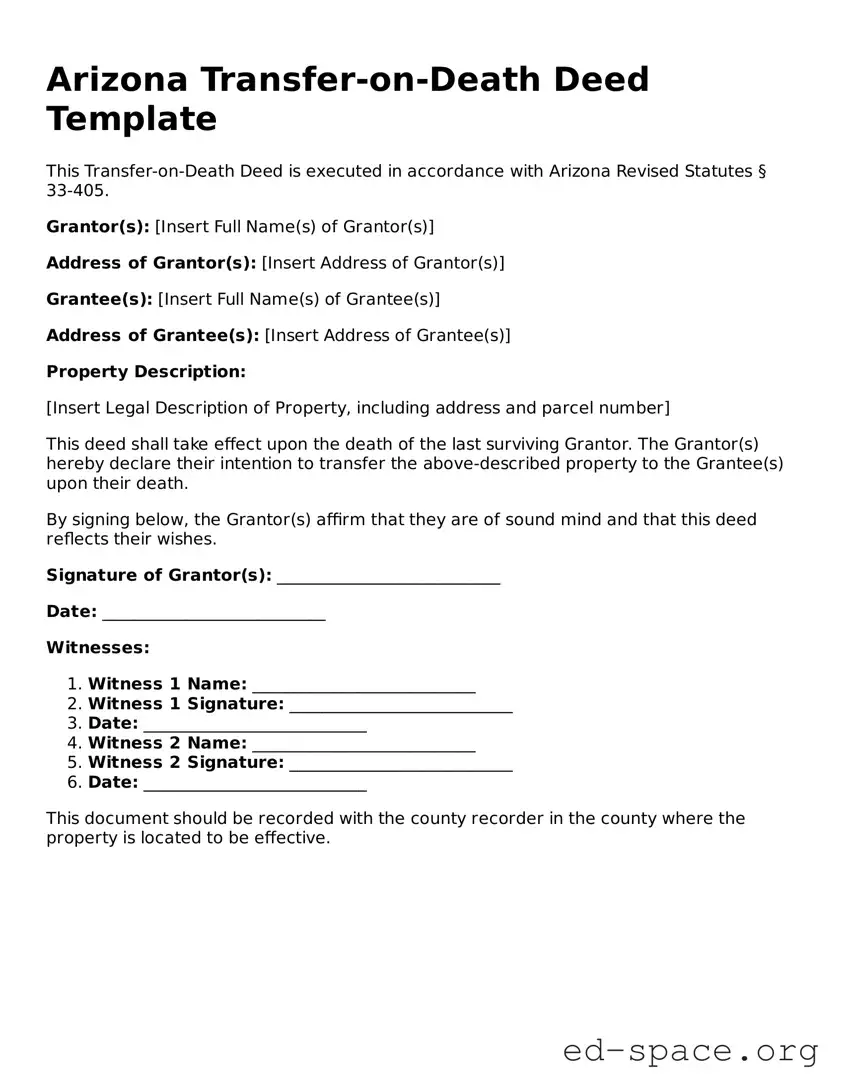
The Arizona Transfer-on-Death Deed (TOD) form offers a streamlined approach for property owners to transfer their real estate to designated beneficiaries upon their death, bypassing the often lengthy probate process. This form allows individuals to maintain full control of their property during their lifetime while ensuring a smooth transition of ownership after they pass away. Importantly, the TOD deed must be properly executed and recorded to be effective, which means that attention to detail is crucial. Beneficiaries named in the deed will receive the property automatically, without the need for court involvement, making this an attractive option for many. Additionally, property owners can revoke or change the deed at any time before their death, providing flexibility in estate planning. Understanding the nuances of this form is essential for anyone considering its use, as it can significantly impact the management and distribution of assets in the future.
Arizona Transfer-on-Death Deed Template
This Transfer-on-Death Deed is executed in accordance with Arizona Revised Statutes § 33-405.
Grantor(s): [Insert Full Name(s) of Grantor(s)]
Address of Grantor(s): [Insert Address of Grantor(s)]
Grantee(s): [Insert Full Name(s) of Grantee(s)]
Address of Grantee(s): [Insert Address of Grantee(s)]
Property Description:
[Insert Legal Description of Property, including address and parcel number]
This deed shall take effect upon the death of the last surviving Grantor. The Grantor(s) hereby declare their intention to transfer the above-described property to the Grantee(s) upon their death.
By signing below, the Grantor(s) affirm that they are of sound mind and that this deed reflects their wishes.
Signature of Grantor(s): ___________________________
Date: ___________________________
Witnesses:
This document should be recorded with the county recorder in the county where the property is located to be effective.
| Fact Name | Description |
|---|---|
| Definition | The Arizona Transfer-on-Death Deed allows property owners to designate a beneficiary who will receive the property upon the owner's death without going through probate. |
| Governing Law | This deed is governed by Arizona Revised Statutes, specifically ARS § 33-405. |
| Eligibility | Any individual who owns real property in Arizona can execute a Transfer-on-Death Deed. |
| Revocation | The property owner can revoke or change the beneficiary at any time before their death, ensuring flexibility in estate planning. |
| Filing Requirements | The deed must be recorded with the county recorder's office in the county where the property is located to be effective. |
| Beneficiary Rights | Beneficiaries do not have any rights to the property while the owner is still alive; the owner retains full control. |
| Tax Implications | Transfer-on-Death Deeds do not trigger gift taxes at the time of transfer; however, beneficiaries may be subject to estate taxes depending on the total estate value. |
Filling out the Arizona Transfer-on-Death Deed form is a straightforward process. Once completed, you can ensure that your property is transferred to your designated beneficiary upon your passing without going through probate.
What is a Transfer-on-Death Deed in Arizona?
A Transfer-on-Death Deed (TOD Deed) is a legal document that allows property owners in Arizona to designate a beneficiary who will receive the property upon the owner's death. This deed enables the transfer of real estate without the need for probate, simplifying the process for heirs.
Who can create a Transfer-on-Death Deed?
Any individual who is the legal owner of real property in Arizona can create a Transfer-on-Death Deed. This includes sole owners, joint tenants, and tenants in common. However, the deed must be executed according to Arizona law to be valid.
How do I complete a Transfer-on-Death Deed?
To complete a TOD Deed, you must fill out the form with accurate information about the property and the beneficiary. This includes the legal description of the property and the full name of the beneficiary. After completing the form, it must be signed in front of a notary public and recorded with the county recorder's office.
Is a Transfer-on-Death Deed revocable?
Yes, a Transfer-on-Death Deed is revocable. The property owner can change or revoke the deed at any time before their death. This can be done by executing a new deed or by formally revoking the existing one and recording it with the county recorder.
What happens if the beneficiary predeceases the property owner?
If the designated beneficiary dies before the property owner, the Transfer-on-Death Deed becomes ineffective for that beneficiary. The property owner can choose to name a new beneficiary or allow the property to pass according to their will or Arizona intestacy laws if no new beneficiary is designated.
Are there any tax implications with a Transfer-on-Death Deed?
Generally, a Transfer-on-Death Deed does not trigger any immediate tax consequences for the property owner. However, the beneficiary may be subject to capital gains taxes when they sell the property. It is advisable to consult with a tax professional for specific guidance.
Can a Transfer-on-Death Deed be used for all types of property?
In Arizona, a Transfer-on-Death Deed can only be used for real property, such as residential homes, commercial properties, and land. It cannot be used for personal property, bank accounts, or other assets.
Do I need an attorney to create a Transfer-on-Death Deed?
While it is not legally required to have an attorney to create a Transfer-on-Death Deed, consulting with one can be beneficial. An attorney can ensure that the deed complies with state laws and can help address any specific concerns or complexities related to your property or estate planning needs.
How does a Transfer-on-Death Deed affect creditors?
A Transfer-on-Death Deed does not protect the property from creditors. If the property owner has outstanding debts, creditors may still pursue claims against the estate. The property may need to be sold to satisfy those debts before the beneficiary receives it.
Where can I find a Transfer-on-Death Deed form in Arizona?
Transfer-on-Death Deed forms can be obtained from various sources, including the Arizona Secretary of State’s website, county recorder’s offices, or legal document services. Ensure you are using the most current version of the form to comply with state requirements.
Not including the legal description of the property. This is essential to identify the property accurately.
Failing to sign the deed. Without a signature, the deed is not valid.
Not having the deed notarized. A notary public must witness the signing to ensure its legality.
Incorrectly listing beneficiaries. Make sure names are spelled correctly and that all intended beneficiaries are included.
Using outdated forms. Always check for the most current version of the Transfer-on-Death Deed form.
Overlooking the need for witnesses. Some jurisdictions require witnesses to sign the deed.
Not recording the deed. Failing to file it with the county recorder can lead to complications.
Assuming the deed automatically transfers the property. Understand that it only takes effect upon the owner’s death.
Neglecting to consult with an attorney. Legal advice can help avoid mistakes and ensure compliance with state laws.
When preparing a Transfer-on-Death Deed in Arizona, it is often beneficial to consider additional documents that may assist in the overall estate planning process. These forms can help clarify intentions, provide necessary legal protections, and streamline the transfer of assets. Below is a list of commonly used documents that complement the Transfer-on-Death Deed.
Each of these documents plays a vital role in ensuring that your wishes are respected and that your loved ones are cared for after your passing. It is essential to consider how they work together with the Transfer-on-Death Deed to create a comprehensive estate plan that reflects your values and intentions.
The Transfer-on-Death Deed (TOD Deed) allows individuals to designate beneficiaries who will receive property upon their death without going through probate. There are several other documents that serve similar purposes in estate planning. Below is a list of eight documents that share similarities with the Transfer-on-Death Deed:
When filling out the Arizona Transfer-on-Death Deed form, it’s crucial to follow specific guidelines to ensure that the deed is valid and serves its intended purpose. Here’s a list of things you should and shouldn't do:
Understanding the Arizona Transfer-on-Death Deed can help individuals make informed decisions about their estate planning. However, several misconceptions persist. Here are nine common misunderstandings:
Many believe that using a Transfer-on-Death Deed makes a will unnecessary. In reality, while this deed allows for the direct transfer of property upon death, a will is still important for addressing other assets and wishes.
This deed can be used by anyone, regardless of marital status. Single individuals, partners, and even friends can utilize this form to designate beneficiaries.
Only the property specifically named in the Transfer-on-Death Deed avoids probate. Other assets not covered by the deed may still go through the probate process.
Contrary to popular belief, a Transfer-on-Death Deed can be revoked or modified at any time before the owner's death, provided the proper procedures are followed.
Generally, beneficiaries do not owe taxes on the property until they sell it. The tax implications can depend on various factors, including the property's value at the time of transfer.
This deed specifically applies to real property, not personal property or other types of assets. Understanding the limitations is crucial for effective estate planning.
Transfer-on-Death Deeds are not recognized in every state, and laws can vary significantly. Arizona has its own specific regulations that differ from those in other states.
While it is important to record the deed to ensure its validity, it must be done during the owner's lifetime. Failing to record it can lead to complications for the beneficiaries.
While the deed is a powerful tool, it may not guarantee a smooth transfer. Issues such as disputes among heirs or changes in beneficiary status can complicate the process.
Clarifying these misconceptions can help individuals better navigate their estate planning options and ensure their wishes are honored after their passing.
Filling out and using the Arizona Transfer-on-Death Deed form can be a straightforward process if you keep a few key points in mind. Here are some important takeaways:
By following these guidelines, you can effectively use the Transfer-on-Death Deed to manage your estate planning in Arizona.