In the state of Arizona, the Small Estate Affidavit serves as a vital tool for individuals seeking to simplify the process of settling a deceased person's estate, particularly when the total value of the estate is relatively modest. This form allows heirs and beneficiaries to claim property without the need for a lengthy probate process, which can often be both time-consuming and costly. To utilize the Small Estate Affidavit, the estate must meet specific criteria, including a maximum value threshold, which, as of recent updates, is set at $100,000 for personal property and $75,000 for real property. The affidavit must be completed and signed by the person entitled to inherit, affirming their relationship to the deceased and their right to the assets in question. Additionally, the form requires a declaration that the deceased has not left behind a will, or if there is a will, it must be stated that the estate is still eligible for the affidavit process. This streamlined approach not only alleviates the burden on the court system but also provides a straightforward pathway for heirs to access their inheritance in a timely manner, ensuring that the deceased's wishes can be honored with minimal delay.
Arizona Small Estate Affidavit Template
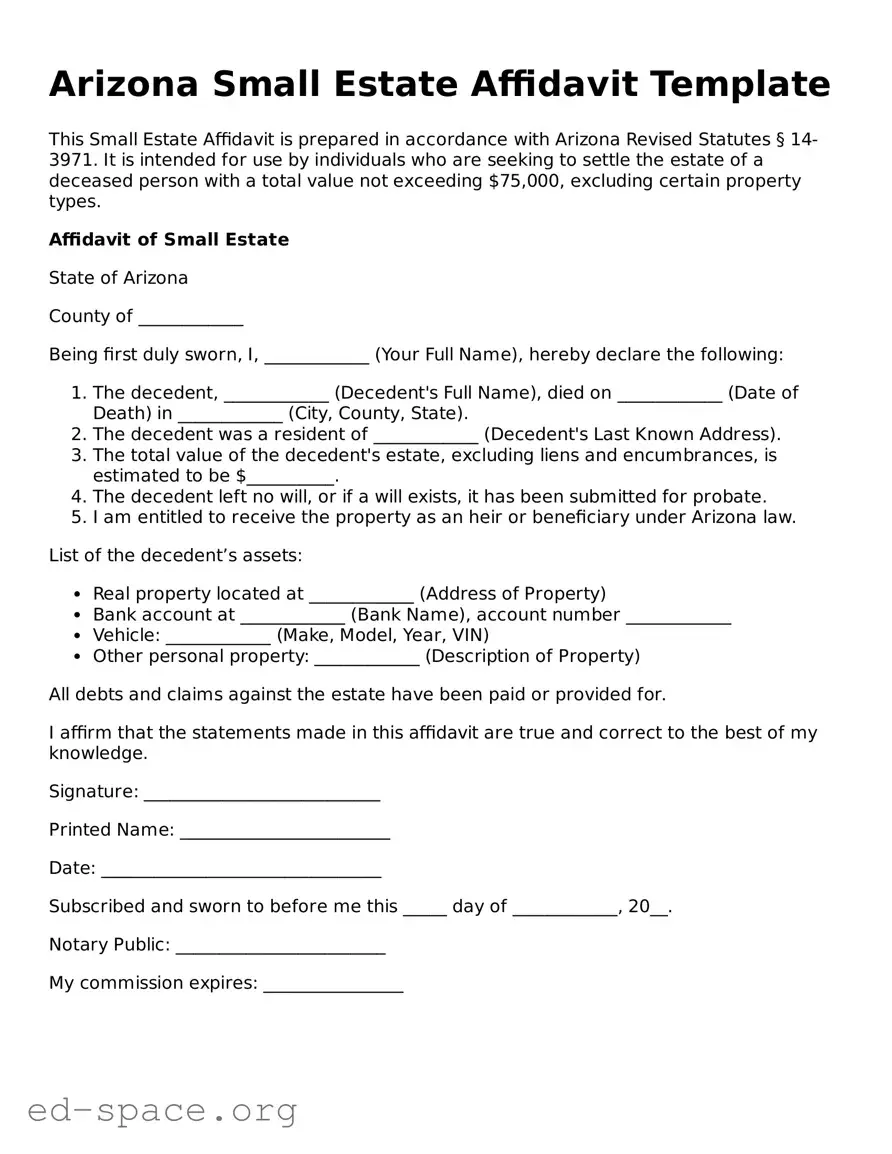
This Small Estate Affidavit is prepared in accordance with Arizona Revised Statutes § 14-3971. It is intended for use by individuals who are seeking to settle the estate of a deceased person with a total value not exceeding $75,000, excluding certain property types.
Affidavit of Small Estate
State of Arizona
County of ____________
Being first duly sworn, I, ____________ (Your Full Name), hereby declare the following:
List of the decedent’s assets:
All debts and claims against the estate have been paid or provided for.
I affirm that the statements made in this affidavit are true and correct to the best of my knowledge.
Signature: ___________________________
Printed Name: ________________________
Date: ________________________________
Subscribed and sworn to before me this _____ day of ____________, 20__.
Notary Public: ________________________
My commission expires: ________________
| Fact Name | Description |
|---|---|
| Purpose | The Arizona Small Estate Affidavit allows individuals to claim assets of a deceased person without going through formal probate. |
| Eligibility | This form is applicable when the total value of the deceased's estate is $75,000 or less, excluding real property. |
| Governing Law | The use of the Small Estate Affidavit is governed by Arizona Revised Statutes § 14-3971. |
| Required Information | The affidavit must include details such as the decedent's name, date of death, and a list of assets to be transferred. |
| Filing Process | The completed affidavit should be presented to the financial institutions or entities holding the deceased's assets for transfer. |
After you have gathered the necessary information, you are ready to fill out the Arizona Small Estate Affidavit form. This document allows you to claim assets of a deceased person without going through a lengthy probate process. Follow the steps below to complete the form accurately.
Once the form is filled out and submitted, the next steps involve waiting for the court to process the affidavit. You may need to provide additional information if requested. Stay organized and keep track of any correspondence related to the process.
What is the Arizona Small Estate Affidavit form?
The Arizona Small Estate Affidavit is a legal document that allows individuals to claim the assets of a deceased person without going through the formal probate process. This form is typically used when the total value of the deceased's estate is below a certain threshold, which, as of 2023, is $75,000 for personal property and $100,000 for real property. This streamlined process can save time and reduce costs for heirs and beneficiaries.
Who can use the Small Estate Affidavit in Arizona?
Generally, the Small Estate Affidavit can be used by individuals who are entitled to inherit from the deceased. This includes spouses, children, parents, and other close relatives. However, it is important that the person filing the affidavit is not a creditor of the deceased and that they are legally entitled to the assets being claimed.
What assets can be claimed using the Small Estate Affidavit?
The affidavit can be used to claim various types of assets, including bank accounts, vehicles, and personal property. However, it cannot be used for real estate unless the total value of the estate meets the specified threshold. If the estate includes real property, the affidavit must be filed with the county recorder's office where the property is located.
How do I complete the Small Estate Affidavit?
To complete the Small Estate Affidavit, you will need to provide information about the deceased, including their name, date of death, and details about the assets being claimed. It's essential to accurately list all assets and their values. The form must be signed in front of a notary public, and any required supporting documents should be attached, such as a death certificate or proof of relationship to the deceased.
Is there a fee associated with filing the Small Estate Affidavit?
How long does it take to process the Small Estate Affidavit?
The processing time for a Small Estate Affidavit can vary depending on the county and the specific circumstances of the estate. Once filed, the affidavit allows heirs to access the deceased's assets relatively quickly, often within a few weeks. However, it's important to ensure that all information is accurate and complete to avoid delays.
Incorrect Value Estimation: Many individuals underestimate or overestimate the total value of the estate. It’s crucial to provide an accurate assessment to avoid complications.
Missing Signatures: Failing to obtain all necessary signatures can lead to delays. Ensure that everyone who needs to sign the affidavit does so.
Not Including All Assets: Some people forget to list all assets, such as bank accounts or personal property. Every asset must be accounted for to ensure a smooth process.
Using Outdated Forms: Using an old version of the Small Estate Affidavit can cause issues. Always check for the most recent form to ensure compliance.
Inaccurate Information: Providing incorrect names, addresses, or other details can lead to legal challenges. Double-check all information before submission.
Neglecting to Notarize: Some individuals forget to have the affidavit notarized. Notarization is often a requirement and must not be overlooked.
Omitting Debts: Failing to disclose any debts associated with the estate can create problems. It’s essential to be transparent about all financial obligations.
Ignoring State Requirements: Each state has specific requirements for small estate affidavits. Familiarize yourself with Arizona’s rules to avoid mistakes.
Filing in the Wrong Court: Submitting the affidavit to the incorrect court can delay the process. Ensure you know the proper jurisdiction for filing.
Not Seeking Legal Advice: Some individuals attempt to complete the form without professional guidance. Consulting with a legal expert can help navigate potential pitfalls.
When dealing with small estates in Arizona, the Small Estate Affidavit is a crucial document. However, several other forms and documents may be needed to ensure a smooth process. Here’s a list of some commonly used documents that often accompany the Small Estate Affidavit.
Each of these documents plays a vital role in the process of settling a small estate in Arizona. Having them prepared and organized can help streamline the proceedings and ensure compliance with state laws.
The Small Estate Affidavit form is a useful document for settling the affairs of a deceased person with limited assets. It shares similarities with several other documents used in estate management. Here are four documents that are similar to the Small Estate Affidavit:
When filling out the Arizona Small Estate Affidavit form, there are important guidelines to follow. Here’s a list of what you should and shouldn’t do:
The Arizona Small Estate Affidavit is a valuable tool for individuals dealing with the estate of a deceased person. However, several misconceptions often arise regarding its use and implications. Below is a list of ten common misconceptions, along with explanations to clarify the facts.
This is not true. The Small Estate Affidavit is designed for smaller estates, specifically those valued at $75,000 or less in personal property, excluding real estate. It is intended to simplify the process for smaller estates.
While it is advisable to have agreement among heirs, it is not a legal requirement. The affidavit can be used by a single heir who is entitled to the property, provided they meet the necessary criteria.
This is a misconception. The affidavit can only be used for personal property, such as bank accounts, vehicles, and personal belongings. Real estate cannot be transferred using this form.
While it simplifies the process, using the Small Estate Affidavit does not eliminate all legal requirements. The affidavit must still be filed with the appropriate court, and the estate may still be subject to certain legal obligations.
This is misleading. The affidavit should be filed after the death of the individual but within a reasonable time frame. Delays may complicate the process or raise questions about the estate's management.
This is not entirely accurate. The person filing the affidavit must be an heir or a person entitled to the property. Additionally, they must meet specific legal requirements to ensure the affidavit is valid.
While the affidavit facilitates the transfer process, it does not guarantee that all claims against the estate have been resolved. Creditors may still come forward, and the estate must address these claims.
This is a significant misunderstanding. A Small Estate Affidavit is a tool for transferring property after death, while a Will outlines how a person wishes their assets to be distributed. They serve different purposes in estate planning.
While some individuals may feel comfortable filing the affidavit on their own, seeking legal advice can be beneficial. A legal professional can provide guidance and ensure that all requirements are met, minimizing potential issues.
This is a misconception. Filing the affidavit allows for the transfer of assets, but it does not automatically close the estate. The estate may still need to be formally closed through the court system after all debts and claims are resolved.
Understanding these misconceptions can help individuals navigate the complexities of estate management more effectively. It is always wise to seek clarity and assistance when dealing with legal matters related to estates.
When dealing with the Arizona Small Estate Affidavit form, it's important to understand its purpose and how to use it effectively. Here are some key takeaways:
Understanding these points can help streamline the process of settling a small estate in Arizona.