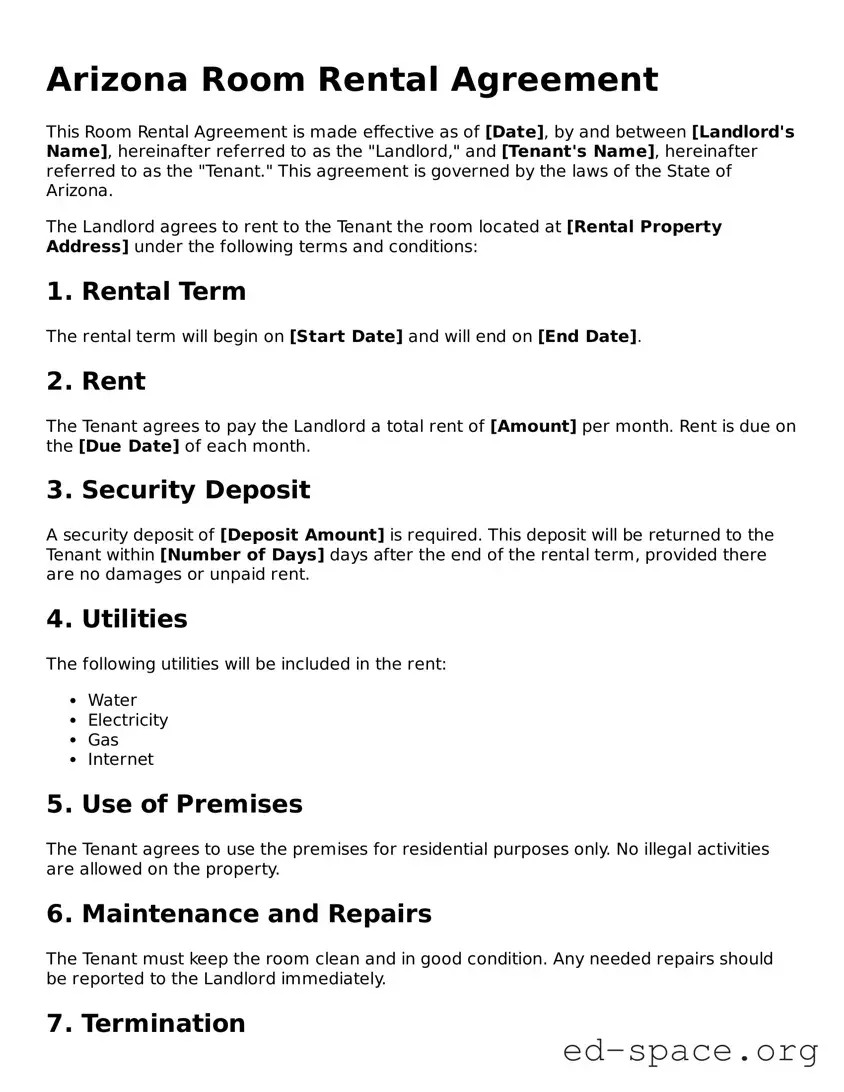
The Arizona Room Rental Agreement form serves as a crucial document for both landlords and tenants, outlining the terms and conditions of renting a room in the state of Arizona. This agreement typically includes essential details such as the names of the parties involved, the rental property's address, and the duration of the rental period. It also specifies the rental amount, payment due dates, and any security deposit requirements. Additionally, the form addresses responsibilities regarding utilities, maintenance, and any rules or restrictions that may apply during the tenancy. By clearly defining the expectations and obligations of both parties, this agreement helps to prevent misunderstandings and disputes, ensuring a smoother rental experience. Understanding the key components of this form can empower individuals to make informed decisions, whether they are renting out a room or seeking to rent one.
Arizona Room Rental Agreement
This Room Rental Agreement is made effective as of [Date], by and between [Landlord's Name], hereinafter referred to as the "Landlord," and [Tenant's Name], hereinafter referred to as the "Tenant." This agreement is governed by the laws of the State of Arizona.
The Landlord agrees to rent to the Tenant the room located at [Rental Property Address] under the following terms and conditions:
1. Rental Term
The rental term will begin on [Start Date] and will end on [End Date].
2. Rent
The Tenant agrees to pay the Landlord a total rent of [Amount] per month. Rent is due on the [Due Date] of each month.
3. Security Deposit
A security deposit of [Deposit Amount] is required. This deposit will be returned to the Tenant within [Number of Days] days after the end of the rental term, provided there are no damages or unpaid rent.
4. Utilities
The following utilities will be included in the rent:
5. Use of Premises
The Tenant agrees to use the premises for residential purposes only. No illegal activities are allowed on the property.
6. Maintenance and Repairs
The Tenant must keep the room clean and in good condition. Any needed repairs should be reported to the Landlord immediately.
7. Termination
Either party may terminate this agreement with [Number of Days] days written notice. Upon termination, the Tenant must vacate the premises and return all keys to the Landlord.
8. Governing Law
This agreement shall be governed by the laws of the State of Arizona.
By signing below, both parties agree to the terms of this Room Rental Agreement.
Landlord's Signature: ___________________________ Date: ____________
Tenant's Signature: ___________________________ Date: ____________
| Fact Name | Description |
|---|---|
| Purpose | The Arizona Room Rental Agreement form is used to outline the terms between landlords and tenants for renting a property. |
| Governing Law | This agreement is governed by the Arizona Residential Landlord and Tenant Act. |
| Duration | The form specifies the rental duration, which can be short-term or long-term. |
| Security Deposit | It outlines the amount of the security deposit required and the conditions for its return. |
| Rent Payment | The agreement details the rent amount, payment method, and due date. |
| Utilities | Responsibilities for utility payments are clearly stated in the agreement. |
| Maintenance Responsibilities | It specifies the maintenance obligations of both the landlord and the tenant. |
| Termination Clause | The form includes terms for terminating the rental agreement, including notice periods. |
| Legal Compliance | Both parties must comply with local, state, and federal laws regarding rental agreements. |
| Signatures | The agreement must be signed by both the landlord and the tenant to be legally binding. |
Filling out the Arizona Room Rental Agreement form is a straightforward process. By completing this form accurately, you will ensure that all parties involved have a clear understanding of the rental terms and conditions. Follow the steps below to fill out the form correctly.
What is the Arizona Room Rental Agreement form?
The Arizona Room Rental Agreement form is a legal document that outlines the terms and conditions for renting a room in Arizona. It serves as a contract between the landlord and tenant, detailing important information such as rental payment, duration of the lease, and responsibilities of both parties.
Who needs to use the Arizona Room Rental Agreement?
This form is typically used by landlords and property owners who are renting out rooms in their homes or rental properties. Tenants looking for a room to rent should also be familiar with this agreement to understand their rights and obligations before signing.
What information is included in the agreement?
The agreement includes essential details such as the names of the landlord and tenant, rental amount, payment due dates, security deposit requirements, and lease duration. It may also outline rules regarding the use of common areas, maintenance responsibilities, and procedures for terminating the agreement.
How long is the rental period in the agreement?
The rental period can vary based on the preferences of the landlord and tenant. The agreement can be for a fixed term, such as six months or one year, or it can be a month-to-month arrangement. It's important for both parties to agree on the duration before signing.
What happens if either party wants to terminate the agreement?
The agreement should specify the process for termination. Typically, either party must provide written notice a certain number of days in advance. This notice period can vary, so it’s essential to read the agreement carefully to understand the requirements.
Is a security deposit required?
Most rental agreements include a security deposit. This deposit protects the landlord against potential damages or unpaid rent. The amount is usually specified in the agreement and should be returned to the tenant after the lease ends, provided there are no damages or outstanding payments.
Failing to provide accurate personal information. This includes names, addresses, and contact details. Always double-check for typos.
Not specifying the rental term clearly. Ensure that the start and end dates of the rental period are clearly stated.
Overlooking the rental amount. Be sure to include the correct monthly rent and any additional fees.
Neglecting to outline the security deposit. State the amount and conditions for its return to avoid future disputes.
Missing out on signatures. Both the landlord and tenant must sign the agreement for it to be valid.
Not including the property address. Clearly identify the rental property to prevent confusion.
Failing to mention utilities. Specify which utilities are included in the rent and which are the tenant's responsibility.
Ignoring maintenance responsibilities. Clearly define who is responsible for repairs and maintenance.
Not reviewing local laws. Familiarize yourself with Arizona rental laws to ensure compliance.
Forgetting to keep a copy. Always retain a signed copy of the agreement for your records.
When entering into a room rental agreement in Arizona, several other forms and documents may be beneficial to ensure clarity and protection for both parties involved. These documents help outline responsibilities, protect rights, and clarify expectations. Here’s a brief overview of some commonly used forms alongside the Arizona Room Rental Agreement.
Having these documents in place can streamline the rental process and provide peace of mind for both landlords and tenants. Clear communication and proper documentation are key to a successful rental experience.
When filling out the Arizona Room Rental Agreement form, it’s important to be careful and thorough. Here’s a list of things to keep in mind:
When it comes to the Arizona Room Rental Agreement form, several misconceptions can lead to confusion for both landlords and tenants. Understanding these myths can help ensure that everyone involved is on the same page. Here are six common misconceptions:
Many people believe that simply filling out the form makes it a binding agreement. However, without the signatures of both parties, the document lacks the necessary legal weight.
Some assume that all rental agreements in Arizona follow the same template. In reality, each agreement can be tailored to meet specific needs, which can lead to variations in terms and conditions.
While landlords often draft the agreement, it can also provide protections for tenants. The terms outlined in the agreement can ensure that tenants have rights regarding maintenance, security deposits, and more.
Some believe that a verbal agreement is enough to establish a rental arrangement. However, having a written agreement helps clarify expectations and can prevent disputes later on.
There’s a misconception that a signed rental agreement is set in stone. In fact, both parties can agree to modifications, but these changes should be documented in writing to avoid misunderstandings.
Many think that only landlords have the power to change terms. Tenants can also propose changes, and open communication is key to reaching a mutual agreement.
By clearing up these misconceptions, both landlords and tenants can navigate their rental agreements more effectively. Open dialogue and understanding the terms can lead to a more harmonious rental experience.
When filling out and using the Arizona Room Rental Agreement form, it's essential to keep a few key points in mind. This ensures a smooth rental process for both landlords and tenants. Here are some important takeaways:
By keeping these points in mind, both landlords and tenants can foster a positive rental experience and minimize potential conflicts.