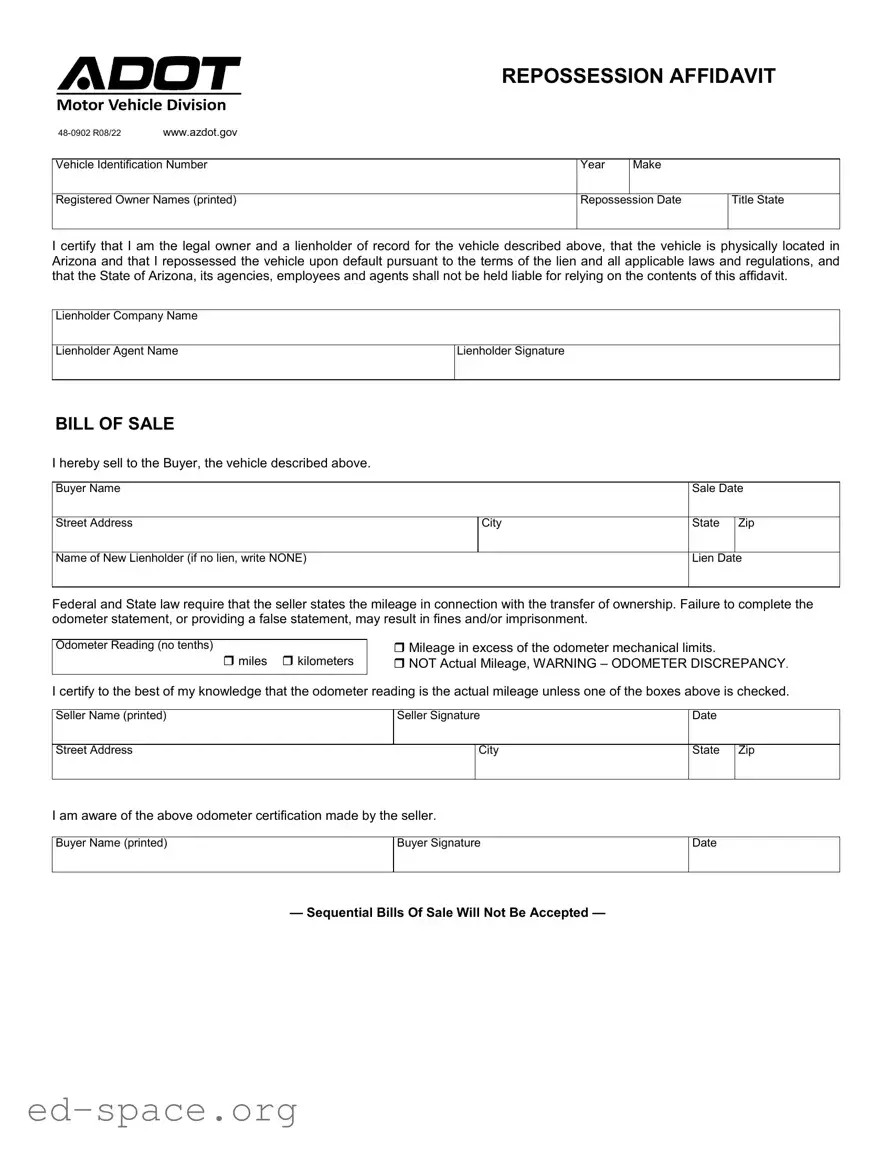
The Arizona Repossession Affidavit form serves as a critical document for lienholders who have reclaimed a vehicle due to default on payment. This form includes essential information such as the vehicle identification number, make, year, and the names of the registered owners. It also outlines the repossession date and certifies that the lienholder is the legal owner and has complied with applicable laws during the repossession process. By signing the affidavit, the lienholder affirms that the vehicle is physically located in Arizona and states that the State of Arizona and its agencies will not be held liable for the information provided. Additionally, the form includes a bill of sale section where the seller transfers ownership to the buyer, requiring details such as the buyer's name, sale date, and address. An important aspect of the form is the odometer statement, which mandates the seller to disclose the vehicle's mileage accurately. Failure to provide truthful information may lead to legal consequences. The affidavit also emphasizes that sequential bills of sale will not be accepted, ensuring clarity and legality in the transfer of ownership.
REPOSSESSION AFFIDAVIT
Vehicle Division
www.azdot.gov |
|
|
|
|
|
|
|
|
|
Vehicle Identification Number |
Year |
Make |
|
|
|
|
|
I |
|
Registered Owner Names (printed) |
Repossession Date |
Title State |
||
|
|
|
|
I |
I certify that I am the legal owner and a lienholder of record for the vehicle described above, that the vehicle is physically located in Arizona and that I repossessed the vehicle upon default pursuant to the terms of the lien and all applicable laws and regulations, and that the State of Arizona, its agencies, employees and agents shall not be held liable for relying on the contents of this affidavit.
Lienholder Company Name |
|
|
|
|
|
|
|
Lienholder Agent Name |
Lienholder Signature |
|
|
|
I |
|
|
BILL OF SALE |
|
|
|
I hereby sell to the Buyer, the vehicle described above. |
|
|
|
|
|
|
|
Buyer Name |
|
Sale Date |
|
|
|
|
|
Street Address |
City |
State |
Zip |
|
I |
|
I |
Name of New Lienholder (if no lien, write NONE) |
|
Lien Date |
|
|
|
|
|
Federal and State law require that the seller states the mileage in connection with the transfer of ownership. Failure to complete the odometer statement, or providing a false statement, may result in fines and/or imprisonment.
Odometer Reading (no tenths)
miles kilometers
Mileage in excess of the odometer mechanical limits.
NOT Actual Mileage, WARNING – ODOMETER DISCREPANCY.
I certify to the best of my knowledge that the odometer reading is the actual mileage unless one of the boxes above is checked.
Seller Name (printed)
Seller Signature
Date
Street Address
City
State Zip
I am aware of the above odometer certification made by the seller.
Buyer Name (printed)
Buyer Signature
Date
— Sequential Bills Of Sale Will Not Be Accepted —
| Fact Name | Details |
|---|---|
| Governing Law | The Arizona Repossession Affidavit is governed by Arizona Revised Statutes § 47-9609 and § 47-9610. |
| Purpose | This affidavit serves to document the repossession of a vehicle by a lienholder after a default on payment. |
| Required Information | The form requires the vehicle identification number (VIN), year, make, and details of the registered owner. |
| Liability Disclaimer | The affidavit includes a statement that the State of Arizona and its agents are not liable for the information provided. |
| Odometer Disclosure | Federal and state law mandates that the seller must disclose the vehicle's mileage during the transfer of ownership. |
| Signatures Required | Both the lienholder and the buyer must provide their signatures on the form to validate the transaction. |
| Consequences of False Information | Providing false odometer readings can lead to fines or imprisonment under federal and state laws. |
Once you have gathered the necessary information, you can begin filling out the Arizona Repossession Affidavit form. This form is crucial for documenting the repossession of a vehicle and ensuring that all parties involved are aware of the transaction details.
After completing the form, ensure that all information is accurate and legible. Keep a copy for your records and submit the form as required by local regulations.
What is the Arizona Repossession Affidavit form?
The Arizona Repossession Affidavit form is a legal document used by lienholders to certify the repossession of a vehicle. This form confirms that the lienholder has taken back possession of the vehicle due to the owner's default on the loan or lease agreement. It includes important details such as the vehicle's identification number, make, model, and the date of repossession.
Who needs to fill out the Arizona Repossession Affidavit?
This affidavit must be completed by the legal owner of the vehicle, typically the lienholder. If a vehicle has been repossessed due to non-payment or other breaches of the loan agreement, the lienholder is responsible for filling out this form to document the repossession process legally.
What information is required on the form?
The form requires specific details including the vehicle identification number (VIN), the year and make of the vehicle, the names of the registered owners, the repossession date, and the lienholder's information. Additionally, it includes an odometer reading and a certification of the mileage at the time of sale.
What happens if I don’t complete the odometer statement?
Failing to complete the odometer statement can lead to serious consequences. Both federal and state laws mandate that the seller provides accurate mileage when transferring ownership. Not doing so may result in fines or even imprisonment, depending on the circumstances surrounding the omission or any false statements made.
Is the State of Arizona liable for the contents of the affidavit?
No, the affidavit includes a disclaimer stating that the State of Arizona, along with its agencies and employees, will not be held liable for any reliance on the contents of the affidavit. This means that it is the responsibility of the lienholder to ensure the information provided is accurate and truthful.
What is the significance of the lienholder's signature?
The lienholder's signature on the affidavit is crucial. It serves as a formal acknowledgment that the lienholder has repossessed the vehicle and confirms the accuracy of the information provided in the affidavit. This signature also helps establish the legal ownership of the vehicle after repossession.
Can I transfer ownership of the vehicle after repossession?
Yes, once the vehicle has been repossessed, the lienholder can transfer ownership to a new buyer. The affidavit includes a section for a bill of sale, where the lienholder can sell the vehicle to a new buyer, along with the required odometer statement to ensure compliance with the law.
What should I do if I have questions about the form?
If you have questions about the Arizona Repossession Affidavit form, it’s best to consult with a legal professional or reach out to the Arizona Department of Transportation. They can provide guidance on how to properly complete the form and ensure that all legal requirements are met.
Failing to provide accurate vehicle information, such as the Vehicle Identification Number (VIN), can lead to complications. Ensure that the VIN matches the vehicle's title and registration documents.
Not including the correct repossession date can cause issues with the legality of the repossession. It is essential to document the date accurately.
Neglecting to certify that the vehicle is physically located in Arizona may invalidate the affidavit. This detail is crucial for jurisdictional purposes.
Omitting the odometer reading or providing an incorrect reading can result in legal consequences. Double-check the mileage before submission.
Failing to sign the affidavit can render it incomplete. All required signatures, including those of the lienholder and seller, must be present.
Not disclosing the name of the new lienholder, if applicable, can lead to confusion regarding ownership. If there is no new lienholder, clearly state "NONE."
Providing a false odometer statement can result in serious penalties. Ensure that the statement reflects the actual mileage or check the appropriate box if there is a discrepancy.
Ignoring the requirement for a bill of sale can complicate the transfer of ownership. This document must be completed accurately and included with the affidavit.
Submitting the form without reviewing it for errors can lead to delays or rejection. Take the time to proofread all information before finalizing.
The Arizona Repossession Affidavit form is an important document for lienholders who have repossessed a vehicle. Along with this affidavit, several other forms and documents may be necessary to complete the repossession process and transfer ownership legally. Below is a list of related documents that are often used in conjunction with the Arizona Repossession Affidavit.
Understanding these documents can help streamline the repossession process and ensure compliance with Arizona laws. Each form plays a specific role in documenting the repossession and transfer of ownership, making it essential to have them prepared and filed correctly.
When filling out the Arizona Repossession Affidavit form, it’s important to follow certain guidelines to ensure that the process goes smoothly. Here are six things you should and shouldn't do:
Misconceptions about the Arizona Repossession Affidavit form can lead to confusion and mistakes. Here are seven common misunderstandings:
Filling out the Arizona Repossession Affidavit form correctly is crucial for ensuring a smooth repossession process. Here are key takeaways to keep in mind:
By following these guidelines, you can navigate the repossession process more effectively and ensure compliance with Arizona regulations.