The Arizona Quitclaim Deed is a vital legal document that facilitates the transfer of property ownership from one party to another without any guarantees regarding the title's validity. This form is particularly useful in situations where the seller may not be able to provide a warranty of clear title, such as in transfers between family members or in divorce settlements. Unlike other types of deeds, a Quitclaim Deed does not ensure that the grantor has a valid claim to the property; instead, it simply conveys whatever interest the grantor may have at the time of the transfer. This makes it a straightforward yet powerful tool for property transactions. In Arizona, the Quitclaim Deed must be properly filled out and signed to be legally effective, and it must also be recorded with the county recorder’s office to provide public notice of the change in ownership. Understanding the nuances of this document can help individuals navigate property transfers more effectively, ensuring that all parties involved are aware of their rights and responsibilities.
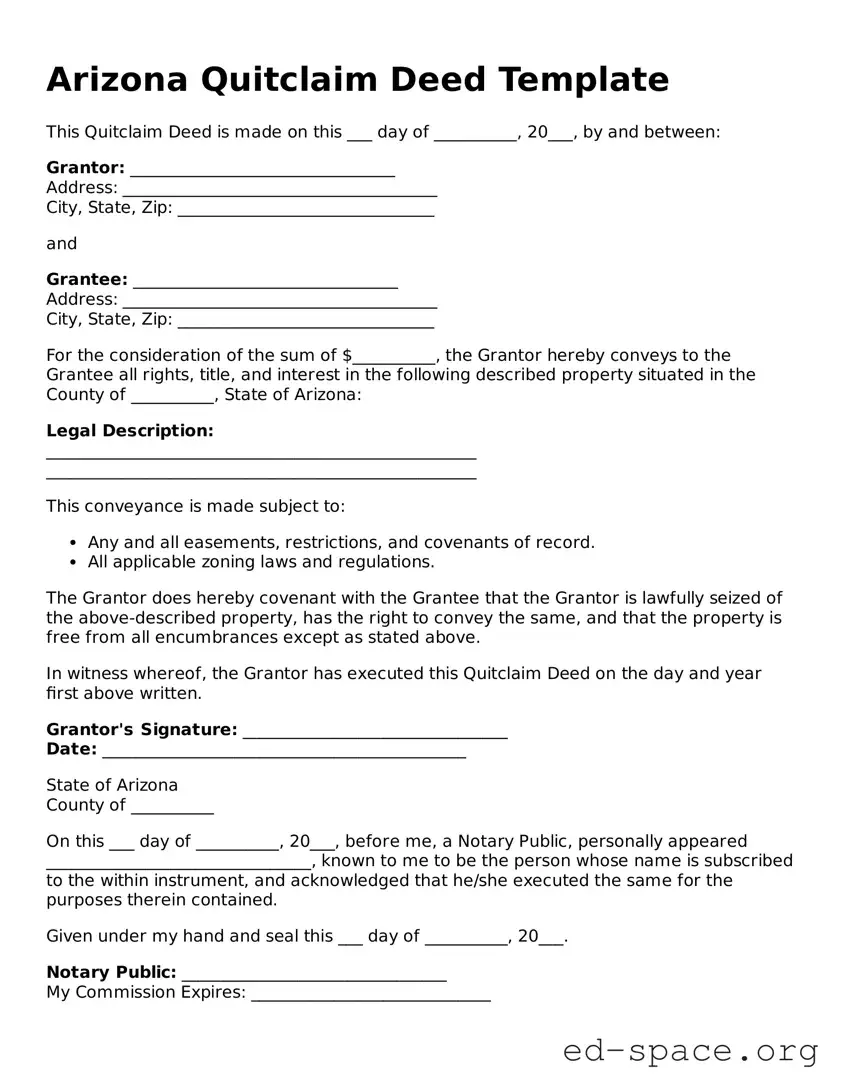
Arizona Quitclaim Deed Template
This Quitclaim Deed is made on this ___ day of __________, 20___, by and between:
Grantor: ________________________________
Address: ______________________________________
City, State, Zip: _______________________________
and
Grantee: ________________________________
Address: ______________________________________
City, State, Zip: _______________________________
For the consideration of the sum of $__________, the Grantor hereby conveys to the Grantee all rights, title, and interest in the following described property situated in the County of __________, State of Arizona:
Legal Description:
____________________________________________________
____________________________________________________
This conveyance is made subject to:
The Grantor does hereby covenant with the Grantee that the Grantor is lawfully seized of the above-described property, has the right to convey the same, and that the property is free from all encumbrances except as stated above.
In witness whereof, the Grantor has executed this Quitclaim Deed on the day and year first above written.
Grantor's Signature: ________________________________
Date: ____________________________________________
State of Arizona
County of __________
On this ___ day of __________, 20___, before me, a Notary Public, personally appeared ________________________________, known to me to be the person whose name is subscribed to the within instrument, and acknowledged that he/she executed the same for the purposes therein contained.
Given under my hand and seal this ___ day of __________, 20___.
Notary Public: ________________________________
My Commission Expires: _____________________________
| Fact Name | Description |
|---|---|
| Definition | A Quitclaim Deed is a legal document that transfers ownership interest in a property from one party to another without any warranties. |
| Governing Law | The Quitclaim Deed in Arizona is governed by Arizona Revised Statutes (ARS) § 33-401 to § 33-420. |
| Use Cases | Commonly used for transferring property between family members, in divorce settlements, or to clear up title issues. |
| Property Types | Can be used for various types of real estate, including residential, commercial, and vacant land. |
| No Guarantees | The grantor makes no guarantees about the title, meaning the grantee assumes any risks associated with the property. |
| Signature Requirement | The deed must be signed by the grantor. Notarization is recommended but not always required. |
| Recording | To provide public notice, the Quitclaim Deed should be recorded with the county recorder's office. |
| Tax Implications | Transfer taxes may apply depending on the county, but many family transfers are exempt. |
| Revocation | Once executed, a Quitclaim Deed cannot be revoked without the consent of both parties. |
| Legal Advice | It is advisable to seek legal advice when using a Quitclaim Deed to understand potential risks and implications. |
After you have the Arizona Quitclaim Deed form ready, you will need to fill it out accurately. This document is essential for transferring property ownership. Make sure you have all necessary information at hand before you start filling it out.
What is a Quitclaim Deed in Arizona?
A Quitclaim Deed is a legal document used to transfer ownership of real estate from one person to another in Arizona. Unlike other types of deeds, a Quitclaim Deed does not guarantee that the person transferring the property has clear title to it. Instead, it simply conveys whatever interest the grantor has in the property, if any. This makes it a useful tool for transferring property between family members or in situations where the parties know each other well.
When should I use a Quitclaim Deed?
You might consider using a Quitclaim Deed in several situations. Common scenarios include transferring property between family members, removing a former spouse from the title after a divorce, or adding someone to the title of a property. It is important to note that this type of deed does not provide any warranties, so it is best used when both parties understand the risks involved.
What information is required on a Quitclaim Deed?
A Quitclaim Deed must include several key pieces of information. This includes the names and addresses of the grantor (the person transferring the property) and the grantee (the person receiving the property). Additionally, a legal description of the property being transferred is necessary, along with the date of the transfer. The document must be signed by the grantor, and it may also need to be notarized to be valid.
Do I need to have a lawyer to prepare a Quitclaim Deed?
While it is not legally required to have a lawyer prepare a Quitclaim Deed, consulting with one can be beneficial. A legal professional can help ensure that the deed is filled out correctly and meets all local requirements. This can help prevent future disputes or issues regarding the property transfer.
How do I file a Quitclaim Deed in Arizona?
To file a Quitclaim Deed in Arizona, you will need to take the completed document to the county recorder's office in the county where the property is located. There may be a filing fee, so it’s a good idea to check with the office beforehand. Once filed, the deed becomes a matter of public record, which can help protect the interests of the grantee.
Are there any tax implications when using a Quitclaim Deed?
Generally, transferring property with a Quitclaim Deed may not trigger immediate tax consequences. However, the grantee may need to consider potential property taxes or capital gains taxes if the property is sold in the future. It’s wise to consult a tax professional to understand any implications specific to your situation.
Can a Quitclaim Deed be revoked?
Once a Quitclaim Deed has been executed and recorded, it cannot be revoked unilaterally. If the grantor wishes to regain ownership, they would typically need to execute another deed to transfer the property back. This process can be complicated, so it’s advisable to seek legal guidance if you find yourself in this situation.
Incorrect Property Description: Many individuals fail to provide a complete and accurate description of the property. This can lead to confusion or disputes later on. Always include the legal description, which can usually be found on the property's title or tax records.
Not Notarizing the Document: A common mistake is neglecting to have the deed notarized. Without a notary's signature, the deed may not be considered valid. Ensure that all parties sign in the presence of a notary public.
Missing Signatures: Failing to obtain all required signatures is another frequent error. All owners of the property must sign the deed for it to be effective. Double-check that everyone involved has signed.
Improper Filing: Some people do not file the deed with the appropriate county recorder's office. This step is crucial to make the transfer official. Make sure to submit the completed deed to the correct office in a timely manner.
Not Understanding the Implications: Many individuals do not fully grasp the legal implications of a quitclaim deed. This type of deed does not guarantee that the grantor has clear title to the property. It is essential to understand what you are signing and the potential risks involved.
A Quitclaim Deed is a useful document for transferring property ownership in Arizona. However, several other forms and documents may accompany it to ensure a smooth transaction. Below is a list of commonly used documents related to the Quitclaim Deed.
Each of these documents plays a vital role in the property transfer process. Understanding their purpose can help ensure a successful transaction and protect the interests of all parties involved.
A Quitclaim Deed is a legal document used to transfer ownership of real property. It is often compared to several other documents that serve similar purposes in property transactions. Here are five documents that share similarities with a Quitclaim Deed:
When filling out the Arizona Quitclaim Deed form, attention to detail is crucial. Here are nine important dos and don’ts to guide you through the process.
By following these guidelines, you can help ensure that your Quitclaim Deed is processed smoothly and efficiently.
When it comes to the Arizona Quitclaim Deed form, several misconceptions can lead to confusion. Understanding these myths can help individuals make informed decisions regarding property transfer. Here are six common misconceptions:
Understanding these misconceptions can help you navigate the complexities of property transfers in Arizona. Always consider consulting a legal professional to ensure that you are making the best choices for your specific situation.
When filling out and using the Arizona Quitclaim Deed form, it is important to keep several key points in mind. Understanding these aspects can help ensure a smooth transfer of property rights.
By following these guidelines, individuals can effectively navigate the process of using a Quitclaim Deed in Arizona.