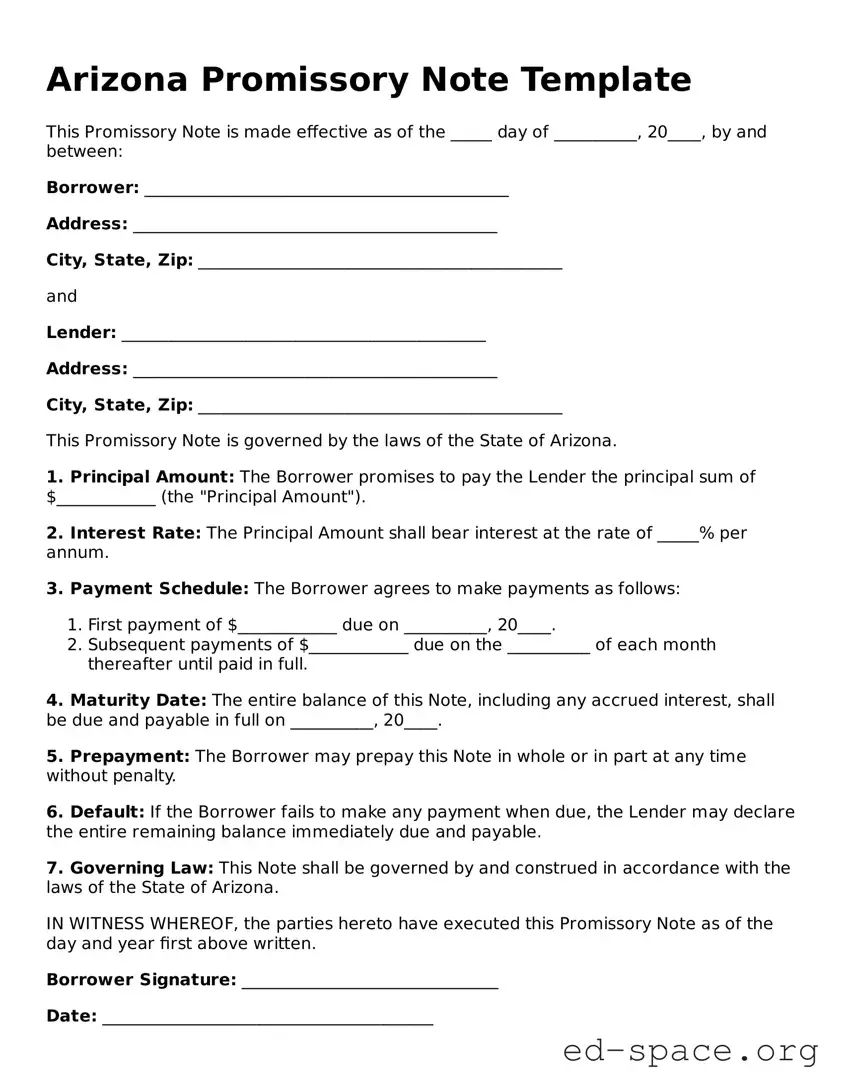
The Arizona Promissory Note form serves as a vital tool for individuals and businesses alike, facilitating clear agreements regarding borrowed money. This document outlines the terms of the loan, including the principal amount, interest rate, and repayment schedule. Both the borrower and lender benefit from its structured approach, as it helps prevent misunderstandings by clearly stating the obligations of each party. Additionally, the form may include clauses related to late payments, prepayment options, and default consequences, ensuring that all parties are aware of their rights and responsibilities. By using this form, borrowers can secure the funds they need while lenders can protect their investments, making it an essential element in financial transactions within Arizona.
Arizona Promissory Note Template
This Promissory Note is made effective as of the _____ day of __________, 20____, by and between:
Borrower: ____________________________________________
Address: ____________________________________________
City, State, Zip: ____________________________________________
and
Lender: ____________________________________________
Address: ____________________________________________
City, State, Zip: ____________________________________________
This Promissory Note is governed by the laws of the State of Arizona.
1. Principal Amount: The Borrower promises to pay the Lender the principal sum of $____________ (the "Principal Amount").
2. Interest Rate: The Principal Amount shall bear interest at the rate of _____% per annum.
3. Payment Schedule: The Borrower agrees to make payments as follows:
4. Maturity Date: The entire balance of this Note, including any accrued interest, shall be due and payable in full on __________, 20____.
5. Prepayment: The Borrower may prepay this Note in whole or in part at any time without penalty.
6. Default: If the Borrower fails to make any payment when due, the Lender may declare the entire remaining balance immediately due and payable.
7. Governing Law: This Note shall be governed by and construed in accordance with the laws of the State of Arizona.
IN WITNESS WHEREOF, the parties hereto have executed this Promissory Note as of the day and year first above written.
Borrower Signature: _______________________________
Date: ________________________________________
Lender Signature: _______________________________
Date: ________________________________________
| Fact Name | Description |
|---|---|
| Definition | A promissory note is a written promise to pay a specified amount of money to a designated person or entity at a defined future date. |
| Governing Law | Arizona's promissory notes are governed by Arizona Revised Statutes, specifically Title 47, which covers the Uniform Commercial Code. |
| Parties Involved | Typically, a promissory note involves two parties: the borrower (maker) and the lender (payee). |
| Interest Rates | Interest rates on promissory notes can vary, but they must comply with Arizona's usury laws to avoid excessive charges. |
| Payment Terms | The note should clearly outline the payment terms, including the due date and the payment frequency (monthly, quarterly, etc.). |
| Default Clauses | It is advisable to include default clauses, which explain the consequences if the borrower fails to make payments. |
| Secured vs. Unsecured | Promissory notes can be secured by collateral or unsecured, depending on the agreement between the parties. |
| Signatures Required | Both parties must sign the promissory note for it to be legally binding, ensuring mutual agreement. |
| Amendments | Any changes to the note should be documented in writing and signed by both parties to maintain clarity and legality. |
| Legal Enforcement | If a borrower defaults, the lender has the right to enforce the note in court, seeking repayment or other remedies. |
Completing the Arizona Promissory Note form is a straightforward process that requires careful attention to detail. After filling out the form, the next steps involve ensuring that all parties understand their obligations and responsibilities as outlined in the document. It is essential to keep a copy for personal records and to share signed copies with all relevant parties.
What is a Promissory Note in Arizona?
A Promissory Note is a written promise to pay a specific amount of money to a designated person or entity at a defined time or on demand. In Arizona, this document serves as a legal record of the debt and outlines the terms of repayment, including interest rates and payment schedules. It provides clarity and protection for both the borrower and lender.
Why would I need a Promissory Note?
A Promissory Note is essential when borrowing or lending money. It formalizes the agreement and helps prevent misunderstandings. By clearly stating the repayment terms, both parties have a reference point if any disputes arise. Additionally, it can be used in court if the borrower fails to repay the loan as agreed.
What should be included in an Arizona Promissory Note?
Key elements of a Promissory Note include the names and addresses of both the borrower and lender, the principal amount borrowed, the interest rate (if applicable), the repayment schedule, and any late fees or penalties. It’s also important to include the date of the agreement and the signatures of both parties to make it legally binding.
Is a Promissory Note legally binding in Arizona?
Yes, a Promissory Note is legally binding in Arizona as long as it meets certain requirements. It must be written, signed by both parties, and clearly outline the terms of the loan. If these conditions are met, the note can be enforced in court, providing the lender with legal recourse if the borrower defaults.
Can I modify an existing Promissory Note?
Yes, modifications can be made to an existing Promissory Note, but it’s important to do so in writing. Both parties must agree to the changes and sign the amended document. This ensures that the updated terms are clear and legally enforceable, preventing any future disputes over the agreement.
What happens if a borrower defaults on a Promissory Note?
If a borrower defaults, the lender has several options. They may attempt to work out a new repayment plan or negotiate a settlement. If those efforts fail, the lender can take legal action to recover the owed amount. This may involve filing a lawsuit to obtain a judgment against the borrower, which can lead to wage garnishment or asset seizure.
Are there any specific state laws I should be aware of regarding Promissory Notes in Arizona?
Yes, Arizona has specific laws governing Promissory Notes, including regulations about interest rates and collection practices. It’s important to familiarize yourself with the Arizona Revised Statutes to ensure compliance. This helps protect your rights and ensures that the Promissory Note is enforceable under state law.
Where can I find an Arizona Promissory Note template?
Templates for Arizona Promissory Notes can be found online through legal websites, local law libraries, or by consulting with an attorney. Using a template can save time and ensure that you include all necessary elements. However, it’s always wise to have a legal professional review the document to ensure it meets your specific needs and complies with state laws.
Failing to include the date of the agreement. This is crucial as it establishes the timeline for repayment.
Not specifying the amount being borrowed. Clearly stating the loan amount prevents misunderstandings later.
Omitting the interest rate. If applicable, this detail is essential for calculating the total repayment amount.
Neglecting to define the payment terms. Include details such as the frequency of payments and the due dates.
Not providing a signature from both the borrower and the lender. Without signatures, the document may not be enforceable.
Failing to keep a copy of the signed note. Retaining a copy is important for both parties to refer to in the future.
A promissory note is a crucial document for outlining a borrower's promise to repay a loan. In Arizona, several other forms and documents often accompany a promissory note to ensure clarity and legal protection for both parties involved. Here’s a list of those documents, along with a brief description of each.
These documents work together to create a clear framework for the loan process. By using them alongside the Arizona Promissory Note form, both lenders and borrowers can protect their interests and ensure a smooth transaction.
When filling out the Arizona Promissory Note form, attention to detail is crucial. Here are some important dos and don’ts to consider:
Misconceptions about the Arizona Promissory Note form can lead to confusion and potential legal issues. Below are four common misconceptions, along with clarifications for each.
While notarization can add a layer of authenticity, it is not a legal requirement for a Promissory Note to be enforceable in Arizona. The agreement is valid as long as it is signed by the parties involved.
There is no mandated format for a Promissory Note in Arizona. As long as the document includes essential elements such as the amount borrowed, interest rate, repayment terms, and signatures, it can be considered valid.
Individuals lending money to friends or family members can also benefit from a Promissory Note. This document serves to clarify terms and protect both parties, regardless of the lender's status.
While verbal agreements can be legally binding, they are difficult to enforce. A written Promissory Note provides clear evidence of the terms agreed upon, making it easier to resolve disputes if they arise.
When filling out and using the Arizona Promissory Note form, it is essential to understand several key aspects to ensure its effectiveness and legality.
Understanding these points can help prevent disputes and ensure that the promissory note serves its intended purpose effectively.