In the vibrant landscape of Arizona's legal framework, the prenuptial agreement form stands out as a pivotal tool for couples preparing to embark on the journey of marriage. This document serves as a proactive measure, allowing partners to outline their financial rights and responsibilities before tying the knot. By addressing potential issues such as property division, debt allocation, and spousal support in advance, couples can foster a sense of security and clarity in their relationship. The Arizona prenuptial agreement form is designed to be straightforward, ensuring that both parties can easily understand its provisions. Importantly, the form emphasizes the need for full disclosure of assets and debts, which is essential for creating a fair and enforceable agreement. Additionally, it provides a framework for customizing terms that reflect the unique dynamics of each couple's financial situation, making it a versatile option for those looking to safeguard their interests while nurturing their commitment to one another.
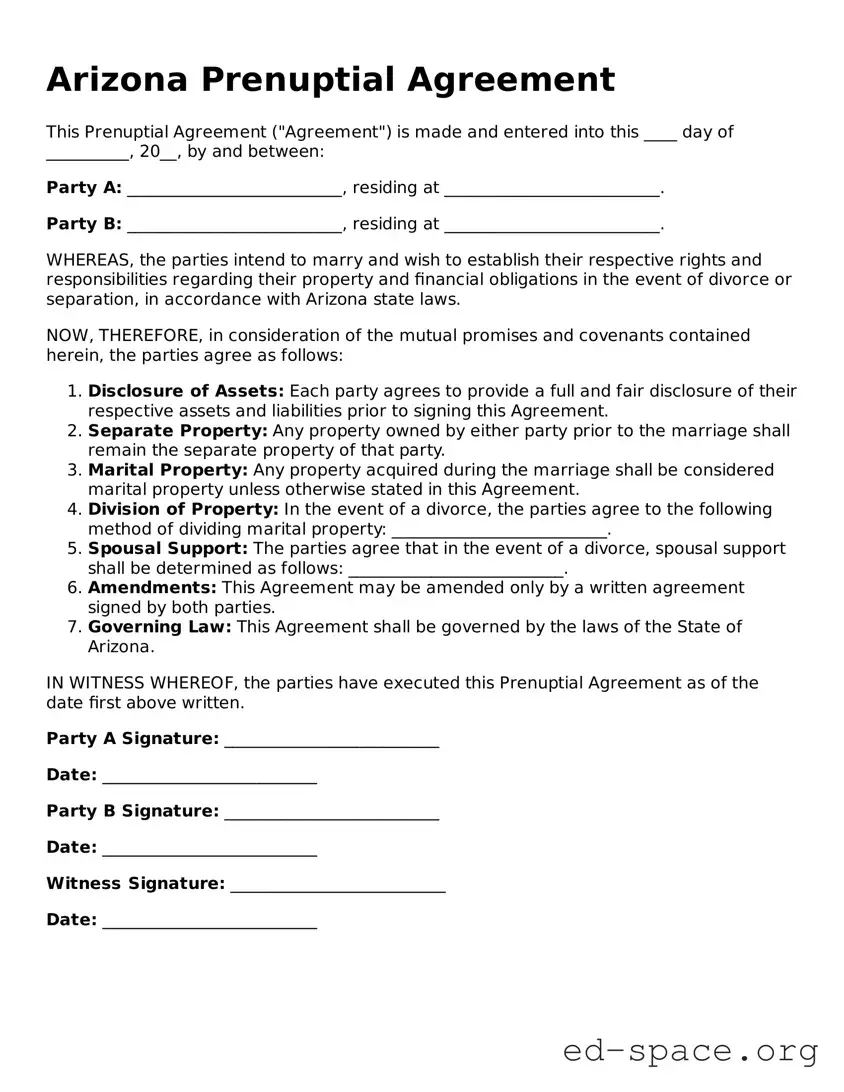
Arizona Prenuptial Agreement
This Prenuptial Agreement ("Agreement") is made and entered into this ____ day of __________, 20__, by and between:
Party A: __________________________, residing at __________________________.
Party B: __________________________, residing at __________________________.
WHEREAS, the parties intend to marry and wish to establish their respective rights and responsibilities regarding their property and financial obligations in the event of divorce or separation, in accordance with Arizona state laws.
NOW, THEREFORE, in consideration of the mutual promises and covenants contained herein, the parties agree as follows:
IN WITNESS WHEREOF, the parties have executed this Prenuptial Agreement as of the date first above written.
Party A Signature: __________________________
Date: __________________________
Party B Signature: __________________________
Date: __________________________
Witness Signature: __________________________
Date: __________________________
| Fact Name | Description |
|---|---|
| Governing Law | The Arizona Prenuptial Agreement is governed by Arizona Revised Statutes, Title 25, Chapter 2. |
| Purpose | This agreement allows couples to outline the division of assets and financial responsibilities in the event of divorce or separation. |
| Voluntary Agreement | Both parties must enter into the agreement voluntarily without coercion or undue influence. |
| Full Disclosure | Each party should provide a full and fair disclosure of their financial situation prior to signing the agreement. |
| Written Requirement | The agreement must be in writing to be enforceable in Arizona. |
| Notarization | While notarization is not required, it is recommended to validate the agreement. |
| Modification | Parties can modify the agreement at any time, provided the changes are made in writing and signed by both parties. |
| Enforceability | Courts in Arizona will enforce prenuptial agreements unless they are found to be unconscionable or obtained through fraud. |
| Legal Representation | It is advisable for both parties to seek independent legal counsel before signing the agreement. |
| Timing | It is best to create and sign the prenuptial agreement well in advance of the wedding date to avoid claims of duress. |
Filling out the Arizona Prenuptial Agreement form is a crucial step for couples planning to marry. It establishes the financial rights and responsibilities of each partner during the marriage and in the event of a divorce. Completing this form accurately is essential to ensure that both parties are protected under Arizona law.
Once the form is completed, both parties should retain a copy for their records. It's also wise to consult with a legal professional to ensure that the agreement complies with Arizona laws and addresses all necessary aspects of your financial situation.
What is a prenuptial agreement in Arizona?
A prenuptial agreement, often called a "prenup," is a legal contract entered into by a couple before they marry. In Arizona, this agreement outlines how assets, debts, and other financial matters will be handled in the event of divorce or separation. It can also address issues like spousal support. By having a prenup, couples can clarify their financial rights and responsibilities, potentially avoiding disputes in the future.
Why should I consider a prenuptial agreement?
Considering a prenuptial agreement can provide peace of mind. It allows both partners to openly discuss their finances and set clear expectations. This proactive approach can help prevent misunderstandings and conflicts later on. Additionally, it can protect individual assets and ensure that both parties are treated fairly in case of a divorce.
What can be included in an Arizona prenuptial agreement?
In Arizona, a prenuptial agreement can cover a wide range of topics. You can include provisions about the division of property, management of debts, and spousal support. It’s also possible to specify how future income or assets acquired during the marriage will be treated. However, certain matters, like child custody and child support, cannot be predetermined in a prenup, as these are subject to court approval based on the child's best interests.
How do I create a valid prenuptial agreement in Arizona?
To create a valid prenuptial agreement in Arizona, both parties must enter into the contract voluntarily. It should be in writing and signed by both individuals. Full disclosure of assets and debts is crucial for the agreement to be enforceable. It’s highly recommended to have separate legal representation to ensure that both parties understand their rights and the implications of the agreement.
Can a prenuptial agreement be changed after marriage?
Yes, a prenuptial agreement can be modified after marriage. To do so, both parties must agree to the changes and put them in writing. This modification should also be signed by both individuals. It’s essential to approach this process with transparency and mutual consent to avoid future disputes.
Are prenuptial agreements enforceable in Arizona?
Yes, prenuptial agreements are generally enforceable in Arizona, provided they meet specific legal requirements. If the agreement is deemed fair and both parties had a full understanding of their rights at the time of signing, it is likely to be upheld in court. However, if one party can prove that the agreement was signed under duress or without proper disclosure, it may be challenged.
What happens if we don’t have a prenuptial agreement?
If a couple does not have a prenuptial agreement, Arizona's community property laws will govern the division of assets and debts in the event of divorce. This means that any property acquired during the marriage is generally considered jointly owned, regardless of whose name is on the title. Without a prenup, couples may face a more complicated and contentious divorce process.
How can I find a lawyer to help with my prenuptial agreement?
Finding a lawyer to assist with a prenuptial agreement can be done through several avenues. Start by seeking recommendations from friends or family. Online legal directories and local bar associations can also provide lists of qualified family law attorneys. When selecting a lawyer, consider their experience with prenuptial agreements and ensure they are someone you feel comfortable discussing personal financial matters with.
Failing to fully disclose assets and debts. Both parties should provide a complete picture of their financial situations. Omitting information can lead to disputes later.
Not understanding the legal implications. Individuals often overlook the fact that a prenuptial agreement is a legal document that can impact their rights and obligations.
Using vague language. Clarity is crucial. Ambiguous terms can result in misinterpretations and complications during enforcement.
Neglecting to include provisions for future changes. Life circumstances can change. It is important to address how the agreement will adapt to significant life events.
Failing to have the agreement reviewed by legal professionals. Seeking legal advice ensures that the document complies with state laws and addresses both parties' interests.
Not allowing sufficient time for consideration. Rushing through the process can lead to pressure and may result in one party feeling coerced.
Ignoring state-specific requirements. Each state has unique laws governing prenuptial agreements. Familiarity with Arizona's regulations is essential for validity.
Not signing the agreement in front of witnesses. Proper execution often requires signatures in the presence of witnesses or a notary, depending on state law.
When preparing a prenuptial agreement in Arizona, several other forms and documents may be useful to ensure a comprehensive understanding of each party's rights and responsibilities. Below is a list of documents that are often associated with a prenuptial agreement.
These documents can work together with a prenuptial agreement to create a clearer picture of each partner's rights and responsibilities, both during the marriage and in the event of a separation or death. Taking the time to prepare these forms can help ensure that both parties feel secure and informed about their financial futures.
When preparing to fill out the Arizona Prenuptial Agreement form, it is important to keep certain guidelines in mind. Here are some key things to do and avoid:
Following these guidelines can help ensure a smoother process when completing your prenuptial agreement in Arizona.
When considering a prenuptial agreement in Arizona, it's common to encounter various misconceptions. Understanding the facts can help couples make informed decisions. Here are five prevalent misconceptions:
Prenuptial agreements are only for the wealthy. Many believe that these agreements are only necessary for individuals with significant assets. In reality, anyone entering a marriage can benefit from a prenuptial agreement. It can help clarify financial expectations and protect both parties, regardless of their financial situation.
Prenuptial agreements are unromantic. Some couples feel that discussing a prenup undermines their love and commitment. However, addressing financial matters openly can actually strengthen a relationship. It encourages communication and sets a solid foundation for the future.
Prenuptial agreements are not enforceable in court. There is a belief that these agreements hold no legal weight. In Arizona, prenuptial agreements are enforceable as long as they are properly drafted and executed. Courts typically uphold them unless there is evidence of fraud or coercion.
Prenuptial agreements can cover anything. Some individuals think they can include any and all terms in a prenup. While they can address many financial aspects, certain topics, like child custody and support, are not enforceable in a prenup. These issues are better addressed during divorce proceedings.
A prenup means you expect the marriage to fail. This misconception suggests that creating a prenup signals a lack of faith in the marriage. In truth, a prenuptial agreement is a proactive step. It helps couples navigate potential challenges and provides peace of mind, allowing them to focus on their relationship.
By dispelling these misconceptions, couples can approach the idea of a prenuptial agreement with clarity and confidence, ensuring that both parties feel secure and understood as they embark on their journey together.
Here are some key takeaways about filling out and using the Arizona Prenuptial Agreement form: