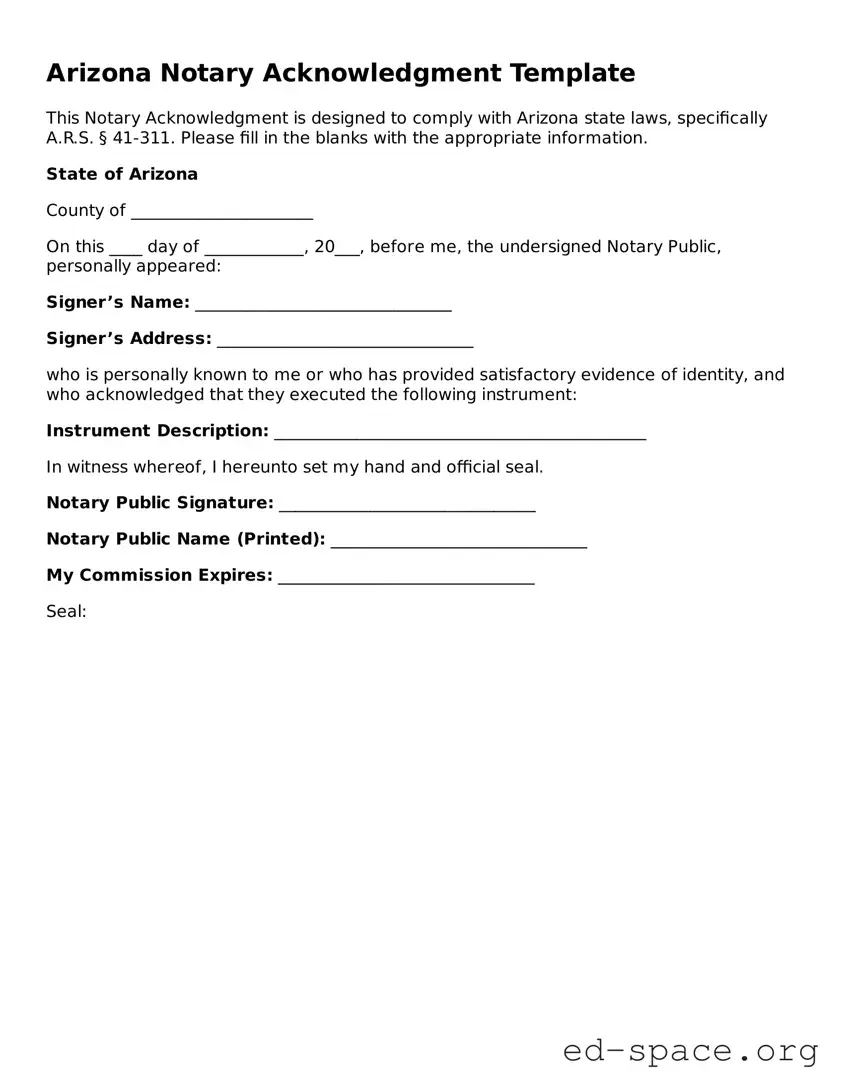
The Arizona Notary Acknowledgment form serves as a vital tool in the realm of legal documentation, ensuring the authenticity of signatures on various important papers. This form is primarily used when a signer needs to affirm their identity and willingness to sign a document in the presence of a notary public. Key elements of the form include the name and address of the signer, the date of the acknowledgment, and the notary's details, which typically consist of their name, commission number, and seal. The form also requires the notary to confirm that the signer appeared before them and provided satisfactory evidence of identity. By utilizing this form, individuals can enhance the credibility of their documents, making them more likely to be accepted in legal and official contexts. It is essential to complete the acknowledgment accurately, as any errors could lead to complications in the validation of the signed documents.
Arizona Notary Acknowledgment Template
This Notary Acknowledgment is designed to comply with Arizona state laws, specifically A.R.S. § 41-311. Please fill in the blanks with the appropriate information.
State of Arizona
County of ______________________
On this ____ day of ____________, 20___, before me, the undersigned Notary Public, personally appeared:
Signer’s Name: _______________________________
Signer’s Address: _______________________________
who is personally known to me or who has provided satisfactory evidence of identity, and who acknowledged that they executed the following instrument:
Instrument Description: _____________________________________________
In witness whereof, I hereunto set my hand and official seal.
Notary Public Signature: _______________________________
Notary Public Name (Printed): _______________________________
My Commission Expires: _______________________________
Seal:
| Fact Name | Details |
|---|---|
| Purpose | The Arizona Notary Acknowledgment form is used to verify the identity of the signer and confirm that they signed the document voluntarily. |
| Governing Law | This form is governed by Arizona Revised Statutes, Title 41, Chapter 2, which outlines the powers and duties of notaries public. |
| Signature Requirement | The signer must be present before the notary at the time of signing to ensure authenticity. |
| Record Keeping | Notaries are required to maintain a record of all acknowledgments performed, including details about the signer and the document. |
After obtaining the Arizona Notary Acknowledgement form, it is essential to fill it out accurately. Follow these steps to ensure that all required information is provided correctly.
Once the form is completed, it is ready for submission or filing as needed. Make sure to keep a copy for your records.
What is an Arizona Notary Acknowledgment form?
The Arizona Notary Acknowledgment form is a document used to confirm that a person has signed a document in the presence of a notary public. This form helps to verify the identity of the signer and ensures that they signed willingly and without any pressure.
When do I need to use a Notary Acknowledgment form?
You typically need a Notary Acknowledgment form when you are signing important documents such as contracts, deeds, or powers of attorney. It is often required by law or by the institution receiving the document to ensure its validity.
How do I complete the Notary Acknowledgment form?
To complete the form, first, fill in the name of the person signing the document. Next, provide the date of the acknowledgment and the title of the document being signed. The notary will then complete their section, which includes their signature, seal, and commission details.
Who can act as a notary public in Arizona?
In Arizona, a notary public must be at least 18 years old, a resident of the state, and have no felony convictions. They must also complete a notary training course and pass an exam to obtain their notary commission.
Is there a fee for notarization in Arizona?
Yes, notaries in Arizona can charge a fee for their services. The maximum fee for most notarial acts is $10 per signature. However, some notaries may charge additional fees for travel or other services, so it’s best to ask beforehand.
Do I need to bring anything to the notary?
Yes, you should bring a valid form of identification, such as a driver’s license or passport, to the notary. This helps the notary verify your identity before witnessing your signature.
Can I sign the document before seeing the notary?
It is not recommended to sign the document before meeting with the notary. The notary needs to witness your signature to complete the acknowledgment. If you sign beforehand, the notary may refuse to notarize the document.
How long is a Notary Acknowledgment valid?
A Notary Acknowledgment does not expire as long as the document itself remains valid. However, if the document has a specific time frame for its use or if it is tied to a legal matter, you should check those details separately.
What happens if I lose my Notary Acknowledgment form?
If you lose your Notary Acknowledgment form, you may need to have the document re-notarized. It’s important to keep a copy of the notarized document in a safe place to avoid any issues in the future.
Failing to include the signer's name correctly. Make sure the name matches the identification provided.
Not checking the date of the acknowledgment. The date must be accurate and reflect when the document was signed.
Using an incorrect notary seal. Ensure that the seal is current and meets state requirements.
Omitting the signature of the notary. The notary must sign the form in the designated area.
Not including the notary's commission expiration date. This date is necessary for the acknowledgment to be valid.
Forgetting to provide the jurisdiction. This should indicate the county and state where the acknowledgment takes place.
Leaving out the type of document being acknowledged. Clearly state what document is being notarized for clarity.
In Arizona, the Notary Acknowledgment form is commonly used to verify the identity of individuals signing a document. However, several other forms and documents often accompany it to facilitate various legal processes. Below is a list of these documents, each serving a specific purpose.
Each of these documents plays a crucial role in various legal and financial transactions. Ensuring they are properly executed and notarized can help prevent future disputes and safeguard the interests of all parties involved.
The Notary Acknowledgement form is a crucial document in many legal processes. Here are ten other documents that share similarities with it:
When filling out the Arizona Notary Acknowledgement form, it’s important to follow specific guidelines to ensure accuracy and compliance. Here are six essential dos and don’ts to keep in mind:
Understanding the Arizona Notary Acknowledgement form is essential for ensuring proper legal documentation. However, several misconceptions can lead to confusion. Here are four common misconceptions:
Notaries can draft legal documents. Many people believe that notaries are allowed to create or modify legal documents. In reality, notaries serve a specific role in verifying identities and witnessing signatures. They cannot provide legal advice or draft documents.
All documents need a notary acknowledgment. Some individuals think that every legal document must be notarized. However, not all documents require a notary. The need for notarization depends on the type of document and its intended use. Always check the specific requirements for your situation.
Notaries are responsible for the contents of a document. There is a misconception that notaries are liable for the accuracy of the information in the documents they acknowledge. In truth, notaries only verify the identity of the signer and witness the signing process. They do not guarantee the content is correct.
Notary acknowledgments are the same in every state. Many assume that notary acknowledgment forms are uniform across the United States. This is not the case. Each state has its own laws and requirements regarding notary acknowledgments, including the specific wording and format of the acknowledgment.
Being aware of these misconceptions can help individuals navigate the notary process more effectively and ensure that their documents are properly executed.
When using the Arizona Notary Acknowledgement form, it is essential to follow specific guidelines to ensure proper execution. Here are five key takeaways: