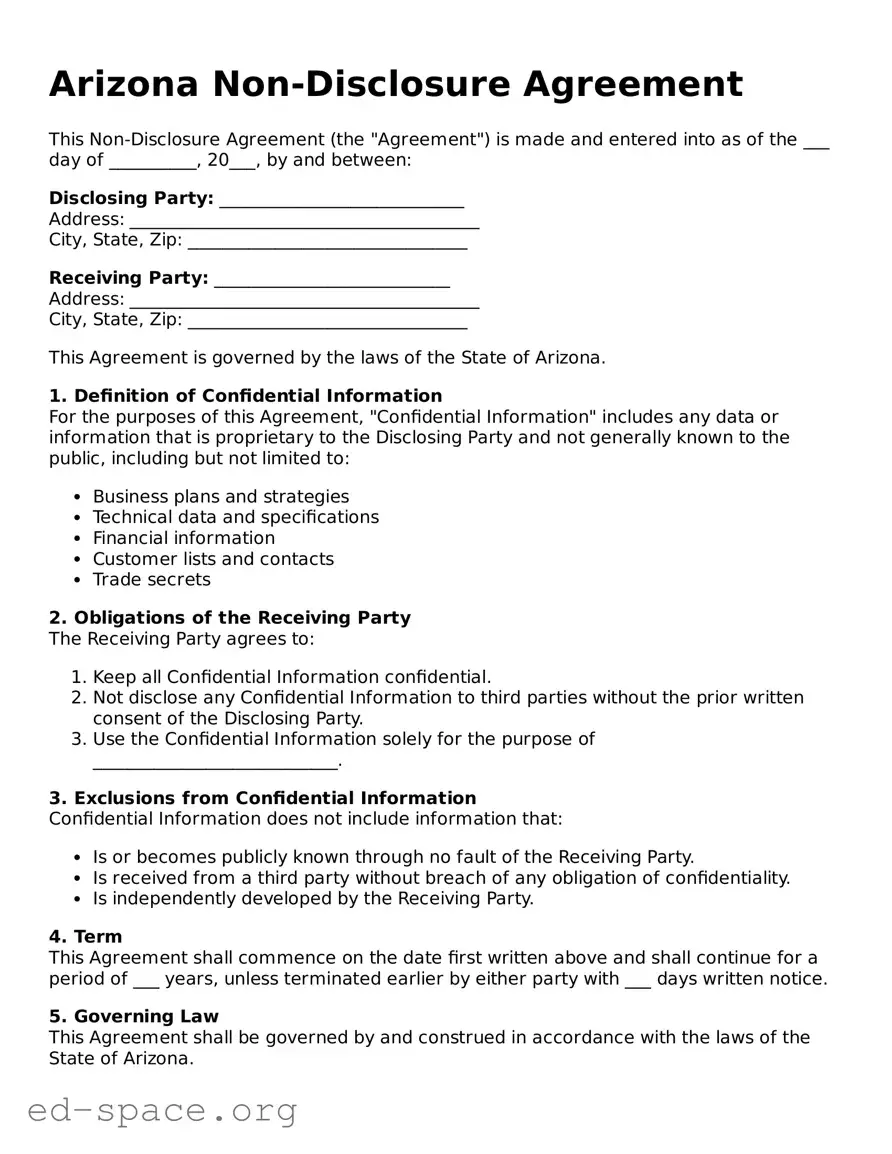
In the realm of business and personal relationships, confidentiality often plays a crucial role in fostering trust and protecting sensitive information. The Arizona Non-disclosure Agreement (NDA) form serves as a vital tool for individuals and organizations looking to safeguard their proprietary data from unauthorized disclosure. This legally binding document outlines the obligations of the parties involved, detailing what information is considered confidential and how it should be handled. Key components of the form typically include definitions of confidential information, the duration of the confidentiality obligations, and any exclusions that may apply. Additionally, the NDA may specify the remedies available in case of a breach, thereby providing a clear framework for addressing potential disputes. By utilizing this form, parties can establish a mutual understanding and create a secure environment for sharing information, whether in business negotiations, collaborations, or employment scenarios.
Arizona Non-Disclosure Agreement
This Non-Disclosure Agreement (the "Agreement") is made and entered into as of the ___ day of __________, 20___, by and between:
Disclosing Party: ____________________________
Address: ________________________________________
City, State, Zip: ________________________________
Receiving Party: ___________________________
Address: ________________________________________
City, State, Zip: ________________________________
This Agreement is governed by the laws of the State of Arizona.
1. Definition of Confidential Information
For the purposes of this Agreement, "Confidential Information" includes any data or information that is proprietary to the Disclosing Party and not generally known to the public, including but not limited to:
2. Obligations of the Receiving Party
The Receiving Party agrees to:
3. Exclusions from Confidential Information
Confidential Information does not include information that:
4. Term
This Agreement shall commence on the date first written above and shall continue for a period of ___ years, unless terminated earlier by either party with ___ days written notice.
5. Governing Law
This Agreement shall be governed by and construed in accordance with the laws of the State of Arizona.
6. Signatures
By signing below, the parties agree to the terms and conditions set forth in this Non-Disclosure Agreement.
Disclosing Party Signature: ____________________________
Date: ________________
Receiving Party Signature: ____________________________
Date: ________________
| Fact Name | Details |
|---|---|
| Definition | An Arizona Non-disclosure Agreement (NDA) is a legally binding contract that protects confidential information shared between parties. |
| Purpose | The primary purpose of an NDA is to prevent the unauthorized disclosure of sensitive information. |
| Parties Involved | The agreement typically involves at least two parties: the disclosing party and the receiving party. |
| Governing Law | The NDA is governed by Arizona state laws, specifically under the Arizona Revised Statutes. |
| Duration | The duration of confidentiality obligations can vary, often lasting between 1 to 5 years, depending on the agreement. |
| Enforceability | For an NDA to be enforceable, it must be clear, reasonable, and not overly broad in scope. |
| Exceptions | Common exceptions to confidentiality include information that is publicly available or independently developed by the receiving party. |
| Signatures | Both parties must sign the NDA for it to be legally binding. |
| Types of NDAs | There are unilateral and mutual NDAs. A unilateral NDA involves one party disclosing information, while a mutual NDA involves both parties sharing information. |
| Consequences of Breach | If a party breaches the NDA, they may face legal consequences, including monetary damages or injunctive relief. |
Once you have the Arizona Non-disclosure Agreement form in hand, you’re ready to fill it out. This process involves providing specific information that will ensure clarity and protect the interests of all parties involved. Follow these steps carefully to complete the form accurately.
After completing the form, review it for accuracy. Make sure all information is correct and that all parties have signed. Once finalized, distribute copies to each party for their records.
What is an Arizona Non-disclosure Agreement (NDA)?
An Arizona Non-disclosure Agreement is a legal contract that protects confidential information shared between parties. This agreement ensures that sensitive information, such as trade secrets, business strategies, or proprietary data, remains private. By signing the NDA, parties agree not to disclose this information to third parties without permission, fostering trust and encouraging open communication.
Who should use an NDA in Arizona?
Any individual or business that plans to share confidential information may benefit from an NDA. This includes entrepreneurs discussing business ideas with potential investors, employers sharing sensitive company data with employees, or companies negotiating contracts with suppliers. An NDA serves as a safeguard for anyone who wishes to protect their intellectual property or proprietary information.
What are the key elements of an Arizona NDA?
Typically, an effective NDA includes several critical components. First, it clearly defines what constitutes confidential information. Second, it outlines the obligations of the parties involved regarding the handling of that information. Additionally, the agreement should specify the duration of confidentiality, detailing how long the information must remain protected. Finally, it often includes clauses regarding the consequences of breaching the agreement.
How is an NDA enforced in Arizona?
If a party breaches the NDA, the injured party may seek legal remedies. This can include seeking monetary damages or injunctive relief, which is a court order to prevent further disclosure of the information. Enforcement may involve litigation, but many disputes can be resolved through negotiation or mediation, which can be less costly and time-consuming.
Can an NDA be modified after it is signed?
Yes, an NDA can be modified, but both parties must agree to any changes. It is advisable to document any amendments in writing and have both parties sign the revised agreement. This ensures clarity and maintains the integrity of the original contract while accommodating any necessary adjustments.
Are there any limitations to what can be protected under an NDA in Arizona?
While NDAs are powerful tools for protecting confidential information, they cannot be used to shield all types of information. For instance, information that is already publicly available or independently developed by the receiving party cannot be protected. Additionally, information that is required to be disclosed by law or court order is also exempt from NDA protections.
Is it necessary to have a lawyer draft an NDA in Arizona?
While it is not strictly necessary to have a lawyer draft an NDA, it is highly advisable. A legal professional can ensure that the agreement is comprehensive, enforceable, and tailored to the specific needs of the parties involved. This can help prevent future disputes and provide peace of mind that the agreement meets all legal requirements.
Failing to read the entire agreement carefully. Many individuals overlook important clauses that could affect their rights and obligations.
Not identifying all parties involved. It's crucial to list all individuals or entities that will be bound by the agreement to avoid future disputes.
Leaving out the definition of confidential information. Without a clear definition, it can lead to misunderstandings about what information is protected.
Neglecting to specify the duration of the confidentiality obligation. This can result in confusion regarding how long the information must remain confidential.
Using vague language. Ambiguities can create loopholes that undermine the agreement's effectiveness.
Forgetting to include exceptions to confidentiality. Certain situations, such as legal requirements, should be explicitly stated to avoid complications.
Not considering the governing law. Specifying which state's laws will govern the agreement can prevent legal complications later on.
Overlooking the importance of signatures. An unsigned agreement may not be enforceable, so all parties should ensure they sign the document.
Failing to keep a copy of the signed agreement. It's essential to have a record for future reference and to ensure compliance.
When entering into a Non-disclosure Agreement (NDA) in Arizona, several other documents may be used to complement the NDA. These documents help clarify the terms of the agreement and ensure all parties are on the same page regarding confidentiality and related matters.
Using these documents alongside the Arizona Non-disclosure Agreement can enhance protection for all parties involved. They clarify expectations and responsibilities, helping to build trust and facilitate smoother business relationships.
A Non-disclosure Agreement (NDA) is a legal contract that establishes a confidential relationship between parties. While NDAs are widely recognized for their role in protecting sensitive information, several other documents serve similar purposes in various contexts. Below is a list of eight documents that share similarities with NDAs, along with explanations of how they align in function and intent.
Each of these documents plays a vital role in safeguarding sensitive information and maintaining trust between parties. By establishing clear expectations regarding confidentiality, they help foster secure and collaborative environments in various professional settings.
When filling out the Arizona Non-disclosure Agreement form, it is essential to follow certain guidelines to ensure accuracy and compliance. Here are seven things to keep in mind:
By adhering to these guidelines, you can ensure that the Non-disclosure Agreement is filled out properly and serves its intended purpose.
When it comes to the Arizona Non-disclosure Agreement (NDA), several misconceptions can lead to confusion. Understanding the facts can help individuals and businesses navigate these agreements more effectively. Here are six common misconceptions:
This is not true. NDAs can be useful for businesses of all sizes. Small businesses and freelancers often use them to protect sensitive information just as much as larger corporations do.
While NDAs do restrict sharing confidential information, they do not prevent all communication. You can still discuss general topics or seek advice, as long as you don’t disclose the protected information.
This misconception overlooks the fact that NDAs can also be important for contractors, vendors, and even clients. Anyone who may have access to sensitive information can be asked to sign an NDA.
NDAs can vary significantly in terms of scope and terms. Each agreement should be tailored to fit the specific needs of the parties involved, ensuring that it adequately protects the sensitive information in question.
NDAs can have a defined duration. Many agreements specify a time period during which the information must remain confidential. After this period, the obligations may no longer apply.
In reality, breaching an NDA can lead to serious legal consequences. Depending on the terms of the agreement, the injured party may seek damages or even an injunction to prevent further disclosures.
By clarifying these misconceptions, individuals and businesses can better understand the purpose and importance of NDAs in protecting sensitive information.
When filling out and using the Arizona Non-disclosure Agreement (NDA) form, consider the following key takeaways:
By following these guidelines, parties can effectively utilize the Arizona Non-disclosure Agreement to protect sensitive information.