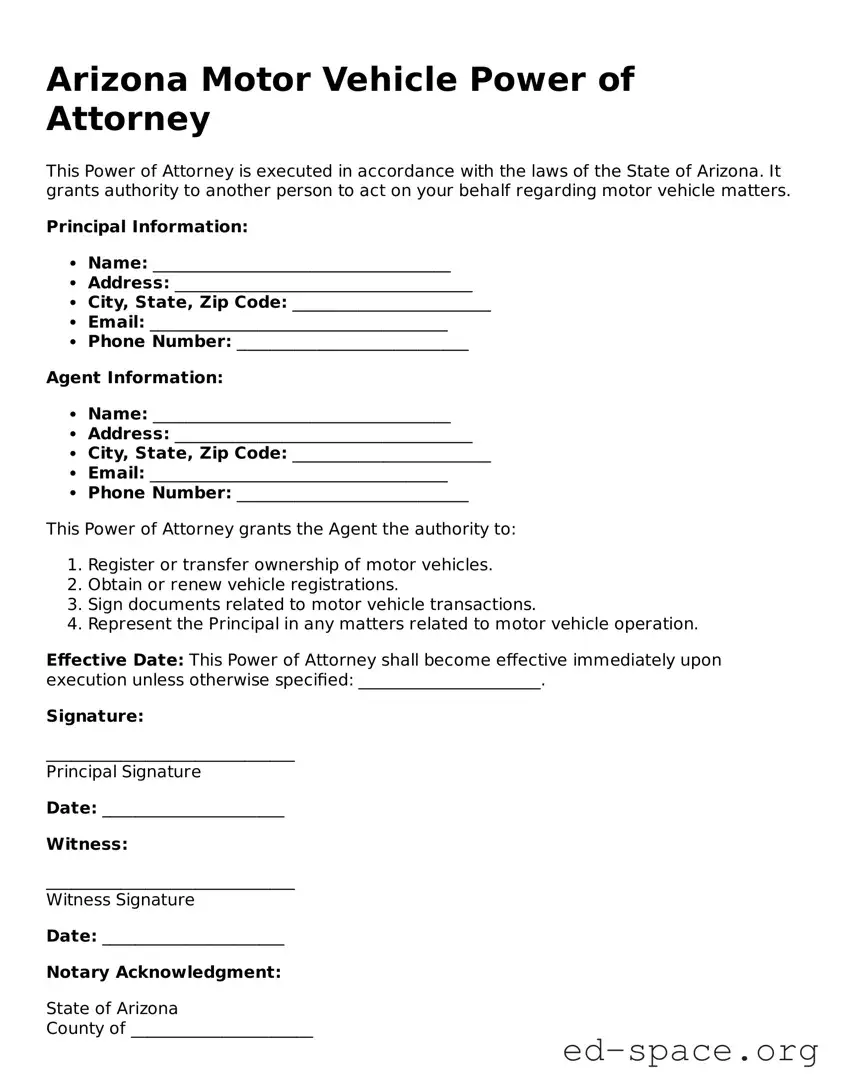
When it comes to managing your vehicle in Arizona, having the right paperwork can make all the difference. The Arizona Motor Vehicle Power of Attorney form allows you to grant someone else the authority to handle vehicle-related tasks on your behalf. This can include signing documents for vehicle registration, title transfers, and even dealing with the Department of Motor Vehicles. It’s especially useful if you’re unable to be present for these transactions due to time constraints or other commitments. By designating a trusted individual, you ensure that your vehicle matters are taken care of efficiently. Understanding how to fill out this form correctly is crucial, as it helps avoid any potential delays or complications. Whether you’re selling a car, buying a new one, or simply need someone to manage your vehicle paperwork, this form can streamline the process and provide peace of mind.
Arizona Motor Vehicle Power of Attorney
This Power of Attorney is executed in accordance with the laws of the State of Arizona. It grants authority to another person to act on your behalf regarding motor vehicle matters.
Principal Information:
Agent Information:
This Power of Attorney grants the Agent the authority to:
Effective Date: This Power of Attorney shall become effective immediately upon execution unless otherwise specified: ______________________.
Signature:
______________________________
Principal Signature
Date: ______________________
Witness:
______________________________
Witness Signature
Date: ______________________
Notary Acknowledgment:
State of Arizona
County of ______________________
On this _____ day of ____________, 20___, before me, a Notary Public, personally appeared ______________________, known to me to be the person whose name is subscribed to this instrument, and acknowledged that they executed the same for the purposes therein contained.
______________________________
Notary Public
My commission expires: ______________________
| Fact Name | Description |
|---|---|
| Purpose | The Arizona Motor Vehicle Power of Attorney form allows one person to designate another to act on their behalf regarding motor vehicle transactions. |
| Governing Law | This form is governed by Arizona Revised Statutes, Title 14, Chapter 5. |
| Eligibility | Any adult resident of Arizona can create a Power of Attorney for motor vehicle matters. |
| Signature Requirement | The form must be signed by the principal (the person granting authority) and may require notarization. |
| Revocation | The principal can revoke the Power of Attorney at any time, provided they do so in writing. |
| Duration | The Power of Attorney remains effective until revoked or until the specific transaction is completed. |
| Usage | This form can be used for tasks such as transferring ownership, registering vehicles, and obtaining title documents. |
Filling out the Arizona Motor Vehicle Power of Attorney form is a straightforward process that allows you to designate someone to act on your behalf regarding your vehicle. Once completed, this form will enable the designated person to handle various vehicle-related tasks, simplifying your responsibilities.
After completing these steps, your form is ready to be submitted or presented as needed. Keep it in a safe place, and ensure your attorney-in-fact knows how to access it when required.
What is the Arizona Motor Vehicle Power of Attorney form?
The Arizona Motor Vehicle Power of Attorney form is a legal document that allows one person to designate another individual to act on their behalf in matters related to motor vehicles. This includes tasks such as registering a vehicle, transferring ownership, or obtaining title documents. The form ensures that the designated agent has the authority to handle these transactions without requiring the principal's presence.
Who can be designated as an agent in this form?
Any competent adult can be designated as an agent in the Arizona Motor Vehicle Power of Attorney form. This can include family members, friends, or professionals such as lawyers or notaries. It is essential that the person chosen is trustworthy and capable of handling the responsibilities assigned to them.
How do I complete the form?
To complete the Arizona Motor Vehicle Power of Attorney form, you must fill in the required fields, including your name, the name of your agent, and specific powers you wish to grant. You may also need to provide details about the vehicle involved. After filling out the form, both you and your agent should sign it, and it may need to be notarized to ensure its validity.
Is notarization required for the form?
While notarization is not always mandatory for the Arizona Motor Vehicle Power of Attorney form, it is highly recommended. Having the document notarized adds an extra layer of authenticity and may be required by certain entities when the agent presents the form for vehicle-related transactions.
How long is the Power of Attorney valid?
The validity of the Arizona Motor Vehicle Power of Attorney form typically lasts until the specified tasks are completed or until the principal revokes it. The principal can revoke the power of attorney at any time by notifying the agent and any relevant parties. It is advisable to keep a copy of the revocation for your records.
What should I do if I need to revoke the Power of Attorney?
If you need to revoke the Power of Attorney, you should create a written notice stating your intention to revoke it. This notice should be signed and dated. Notify your agent and any institutions that may have a copy of the original Power of Attorney. Keeping a record of the revocation is important for your protection.
Not specifying the powers granted: Individuals often fail to clearly outline the specific powers they wish to grant. Without this clarity, the agent may not have the authority needed to act effectively on behalf of the principal.
Neglecting to sign and date: A common oversight is not signing or dating the form. This can render the document invalid, as proper execution is essential for legal recognition.
Forgetting to include personal information: People sometimes omit critical personal details, such as full names, addresses, or identification numbers. This information is vital for identifying both the principal and the agent.
Not having a witness or notarization: In Arizona, some forms require a witness or notarization to be legally binding. Failing to include this step can lead to complications down the line.
Using outdated forms: Legal documents can change over time. Using an outdated version of the Power of Attorney form may lead to issues regarding its validity and acceptance.
Overlooking the agent's responsibilities: Individuals may not fully understand what responsibilities they are assigning to their agent. It is crucial to ensure that the chosen agent is trustworthy and understands the duties involved.
Failing to provide copies: After filling out the form, some forget to distribute copies to relevant parties. Providing copies to the agent and any institutions involved can help avoid confusion and ensure smooth transactions.
The Arizona Motor Vehicle Power of Attorney form allows an individual to designate another person to act on their behalf regarding vehicle-related matters. This document is often accompanied by several other forms that facilitate various aspects of vehicle ownership, registration, and transfer. Below is a list of commonly used forms and documents that complement the Power of Attorney in Arizona.
Understanding these documents is crucial for anyone navigating vehicle ownership in Arizona. Each form plays a specific role in ensuring that vehicle transactions are conducted legally and efficiently.
When filling out the Arizona Motor Vehicle Power of Attorney form, it’s important to follow certain guidelines to ensure everything is done correctly. Here’s a list of what you should and shouldn’t do:
Understanding the Arizona Motor Vehicle Power of Attorney form can be challenging. Here are seven common misconceptions that people often have about this document:
Many believe that the Power of Attorney form is solely for selling a vehicle. In reality, it can also authorize someone to handle various tasks related to vehicle registration, title transfers, and more.
This is not true. While legal advice can be helpful, individuals can complete the form themselves as long as they follow the proper guidelines and requirements.
Some think that notarization is mandatory for the form to be valid. However, notarization is not required in Arizona, although it can add an extra layer of authenticity.
There is a misconception that all Power of Attorney forms have an expiration date. In Arizona, the form remains effective until the principal revokes it, unless it specifies a termination date.
Many people assume that the Power of Attorney grants only temporary authority. However, it can provide either temporary or ongoing authority, depending on how it is drafted.
While it's true that you can choose anyone to act as your agent, it is essential to select someone trustworthy, as they will have significant control over your vehicle-related matters.
Some believe that signing the Power of Attorney is a one-way street. In fact, you can revoke it at any time, as long as you follow the proper procedures for revocation.
By clearing up these misconceptions, individuals can better navigate the process of using the Arizona Motor Vehicle Power of Attorney form effectively.
When filling out and using the Arizona Motor Vehicle Power of Attorney form, it’s essential to understand several key points. Here are five important takeaways:
By keeping these points in mind, you can navigate the process more effectively and ensure that your intentions are clearly communicated.