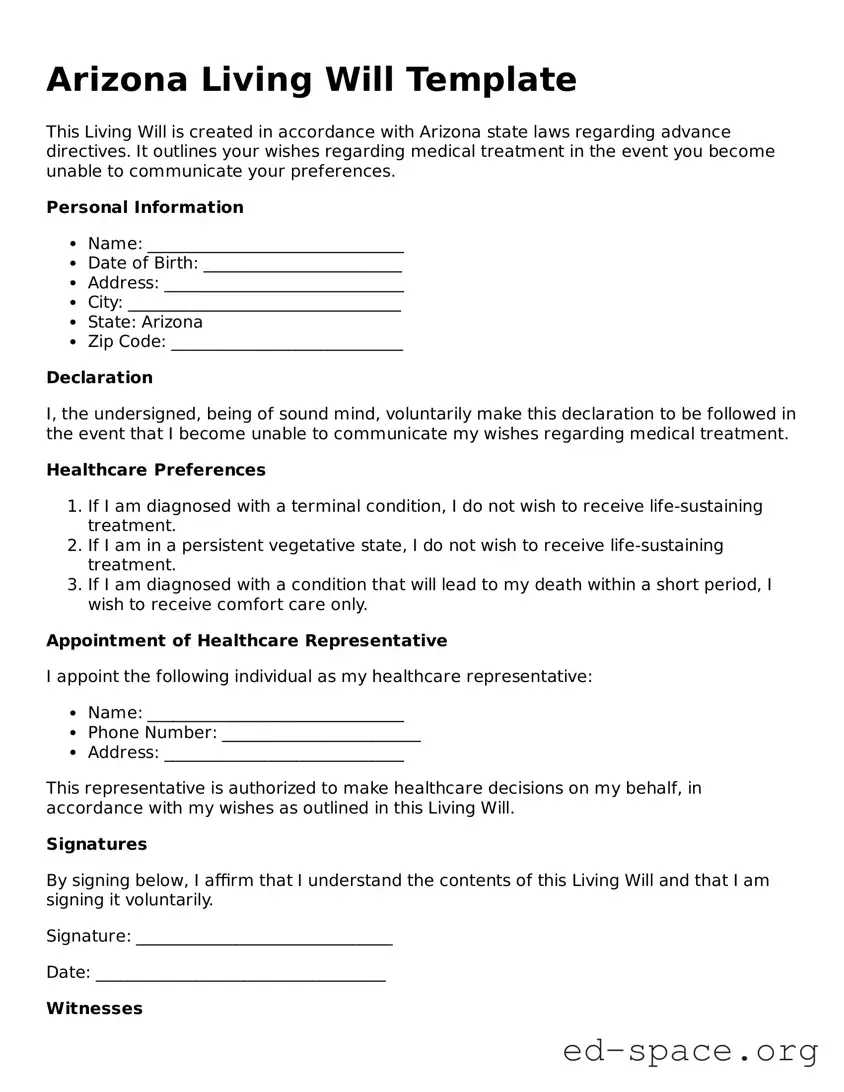
In Arizona, the Living Will form serves as a crucial document for individuals wishing to express their healthcare preferences in the event they become unable to communicate their wishes. This form allows individuals to outline their desires regarding medical treatment, particularly in situations involving terminal illness or irreversible conditions. By completing a Living Will, a person can specify whether they wish to receive life-sustaining treatments or prefer to forgo such measures. The document also provides guidance on pain management and other supportive care options. Importantly, it is designed to alleviate the burden on family members and healthcare providers by clearly articulating the individual's values and choices. Understanding the implications of this form is essential for anyone considering their future healthcare decisions, as it ensures that one's wishes are respected and upheld when it matters most.
Arizona Living Will Template
This Living Will is created in accordance with Arizona state laws regarding advance directives. It outlines your wishes regarding medical treatment in the event you become unable to communicate your preferences.
Personal Information
Declaration
I, the undersigned, being of sound mind, voluntarily make this declaration to be followed in the event that I become unable to communicate my wishes regarding medical treatment.
Healthcare Preferences
Appointment of Healthcare Representative
I appoint the following individual as my healthcare representative:
This representative is authorized to make healthcare decisions on my behalf, in accordance with my wishes as outlined in this Living Will.
Signatures
By signing below, I affirm that I understand the contents of this Living Will and that I am signing it voluntarily.
Signature: _______________________________
Date: ___________________________________
Witnesses
Two witnesses must sign below, attesting that the principal is of sound mind and under no undue influence.
This Living Will is effective immediately upon signing, unless otherwise specified.
| Fact Name | Description |
|---|---|
| Governing Law | The Arizona Living Will form is governed by Arizona Revised Statutes § 36-3261 to § 36-3265. |
| Purpose | This document allows individuals to outline their preferences for medical treatment in the event they become unable to communicate their wishes. |
| Eligibility | Any adult who is of sound mind can create a Living Will in Arizona. |
| Witness Requirements | The form must be signed in the presence of two witnesses who are not related to the individual or beneficiaries of their estate. |
| Revocation | A Living Will can be revoked at any time by the individual, either verbally or in writing. |
Completing the Arizona Living Will form is a crucial step in ensuring your healthcare wishes are respected. This document allows you to express your preferences regarding medical treatment in situations where you may be unable to communicate your desires. Follow these steps carefully to fill out the form accurately.
What is a Living Will in Arizona?
A Living Will is a legal document that allows individuals to express their wishes regarding medical treatment in situations where they are unable to communicate their preferences. In Arizona, this document specifically addresses end-of-life care and can guide healthcare providers and loved ones in making decisions that align with your values and desires. It’s an important tool for ensuring that your healthcare preferences are respected when you cannot speak for yourself.
Who should consider creating a Living Will?
Anyone over the age of 18 should consider creating a Living Will, especially those with specific healthcare preferences or chronic illnesses. It’s particularly vital for individuals who want to ensure their wishes are known regarding life-sustaining treatments, such as resuscitation or artificial nutrition. Having a Living Will can provide peace of mind, knowing that your healthcare decisions will be honored even if you cannot voice them yourself.
How do I create a Living Will in Arizona?
Creating a Living Will in Arizona is a straightforward process. You can either use a pre-printed form available through various resources or draft your own document, provided it meets state requirements. The form must clearly state your healthcare preferences and be signed in the presence of a notary public or two witnesses who are not related to you or beneficiaries of your estate. It’s wise to discuss your wishes with family members and healthcare providers to ensure everyone understands your intentions.
Can I change or revoke my Living Will?
Yes, you can change or revoke your Living Will at any time as long as you are mentally competent. To make changes, you can create a new document or modify the existing one, ensuring that it is signed and witnessed according to Arizona law. If you decide to revoke your Living Will, it’s essential to inform your healthcare providers and loved ones so they are aware of your current wishes.
What happens if I don’t have a Living Will?
If you do not have a Living Will, decisions about your medical treatment may be made by family members or healthcare providers based on their understanding of what you would want. This can lead to confusion and conflict among loved ones, especially if there are differing opinions. Without a Living Will, you may not receive the care you desire during critical moments, which is why having this document is highly recommended.
Is a Living Will the same as a Power of Attorney?
No, a Living Will and a Power of Attorney are distinct documents. A Living Will focuses specifically on your medical treatment preferences, while a Power of Attorney for healthcare designates someone to make medical decisions on your behalf if you are unable to do so. While both documents are essential for comprehensive healthcare planning, they serve different purposes. It’s often advisable to have both in place to ensure your wishes are fully respected.
Failing to specify treatment preferences clearly. Individuals may leave sections blank or use vague language, which can lead to confusion.
Not signing the form. A Living Will is not valid unless it is signed by the individual creating it.
Forgetting to date the document. A date is essential to establish the timeline of the wishes expressed.
Neglecting to have witnesses present. Arizona requires the Living Will to be signed in the presence of two witnesses.
Choosing inappropriate witnesses. Witnesses cannot be related to the individual or have a financial interest in their estate.
Not discussing the Living Will with family members. Open communication can help ensure that loved ones understand the individual's wishes.
Using outdated forms. It's important to ensure that the latest version of the Arizona Living Will form is being used.
Overlooking the importance of reviewing and updating the document regularly. Life changes may require adjustments to the Living Will.
Failing to provide copies to relevant parties. Distributing copies to healthcare providers and family members can facilitate adherence to the wishes expressed.
Not understanding the implications of the choices made. Individuals should fully comprehend the medical options and outcomes associated with their preferences.
A Living Will is an important document that outlines an individual's preferences for medical treatment in situations where they cannot communicate their wishes. In Arizona, several other forms and documents complement the Living Will, ensuring comprehensive planning for healthcare decisions. Below are four key documents often used alongside the Arizona Living Will.
Utilizing these documents in conjunction with a Living Will can help ensure that an individual's healthcare wishes are honored. Proper planning promotes peace of mind for both the individual and their loved ones during challenging times.
When filling out the Arizona Living Will form, it's important to approach the process with care. Here are some guidelines to follow:
Understanding the Arizona Living Will form is essential for making informed decisions about healthcare preferences. However, several misconceptions can lead to confusion. Here are seven common misconceptions:
This is not true. A Living Will can guide healthcare decisions even if you are not in a terminal condition, particularly regarding treatments you do or do not want.
You do not necessarily need a lawyer. While legal advice can be beneficial, many resources are available to help you complete the form on your own.
These are different documents. A Living Will outlines your wishes about medical treatment, while a Durable Power of Attorney designates someone to make decisions on your behalf.
This is a misconception. You can update or revoke your Living Will at any time as long as you are mentally competent.
Assumptions can lead to misunderstandings. A Living Will clearly communicates your preferences, reducing the burden on loved ones during difficult times.
While healthcare providers generally respect your wishes, they must also adhere to laws and regulations. Some situations may require different considerations.
Anyone over the age of 18 can benefit from a Living Will. It is a proactive step for individuals of all ages to ensure their healthcare preferences are known.
Clearing up these misconceptions can empower individuals to make informed decisions about their healthcare and ensure their wishes are respected.
When considering a Living Will in Arizona, it’s essential to understand its purpose and how to complete it effectively. Here are some key takeaways to guide you through the process:
By following these key points, you can ensure that your Living Will accurately reflects your wishes and provides guidance to your loved ones and healthcare providers in times of need.