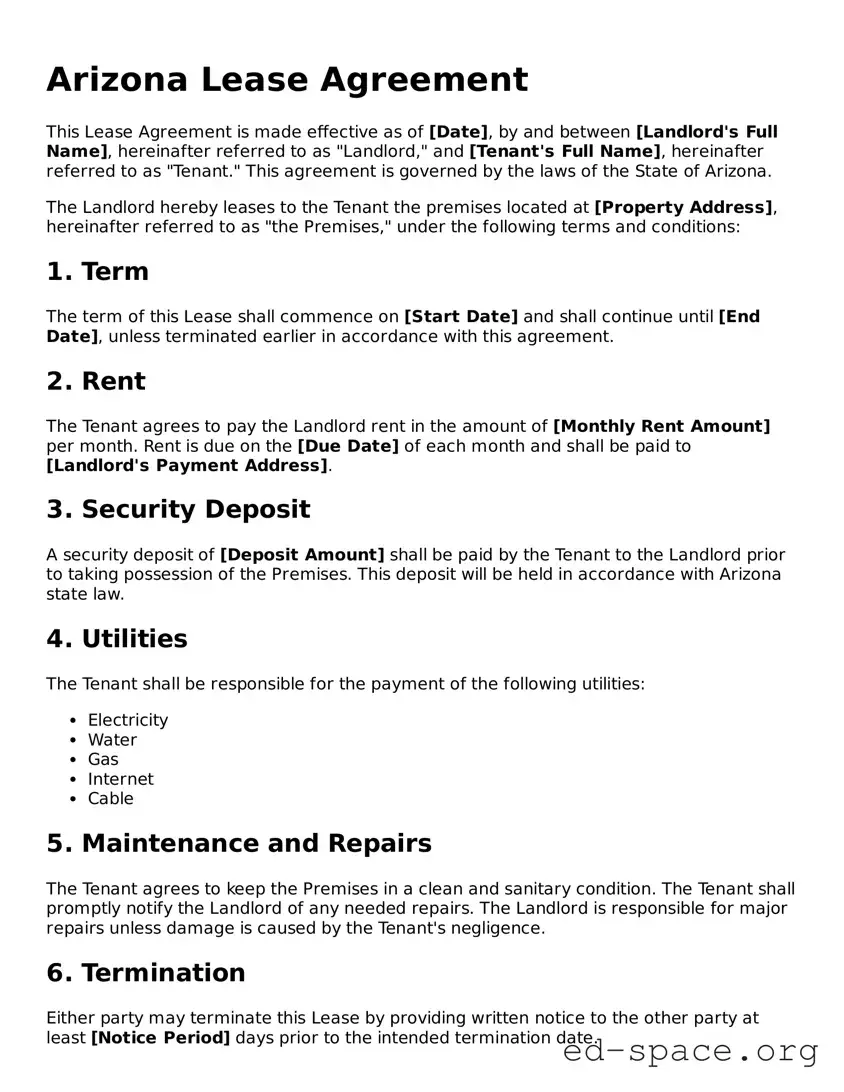
In Arizona, a lease agreement serves as a crucial document for both landlords and tenants, outlining the terms and conditions of renting a residential property. This form typically includes essential details such as the names of the parties involved, the property address, and the duration of the lease. It also specifies the monthly rent amount, payment due dates, and any security deposit requirements. Additionally, the lease agreement addresses maintenance responsibilities, rules regarding pets, and procedures for terminating the lease. By clearly defining the rights and obligations of both parties, the Arizona Lease Agreement form helps to prevent misunderstandings and disputes, fostering a more harmonious rental experience. Understanding the key components of this document is vital for anyone entering into a rental arrangement in the state.
Arizona Lease Agreement
This Lease Agreement is made effective as of [Date], by and between [Landlord's Full Name], hereinafter referred to as "Landlord," and [Tenant's Full Name], hereinafter referred to as "Tenant." This agreement is governed by the laws of the State of Arizona.
The Landlord hereby leases to the Tenant the premises located at [Property Address], hereinafter referred to as "the Premises," under the following terms and conditions:
1. Term
The term of this Lease shall commence on [Start Date] and shall continue until [End Date], unless terminated earlier in accordance with this agreement.
2. Rent
The Tenant agrees to pay the Landlord rent in the amount of [Monthly Rent Amount] per month. Rent is due on the [Due Date] of each month and shall be paid to [Landlord's Payment Address].
3. Security Deposit
A security deposit of [Deposit Amount] shall be paid by the Tenant to the Landlord prior to taking possession of the Premises. This deposit will be held in accordance with Arizona state law.
4. Utilities
The Tenant shall be responsible for the payment of the following utilities:
5. Maintenance and Repairs
The Tenant agrees to keep the Premises in a clean and sanitary condition. The Tenant shall promptly notify the Landlord of any needed repairs. The Landlord is responsible for major repairs unless damage is caused by the Tenant's negligence.
6. Termination
Either party may terminate this Lease by providing written notice to the other party at least [Notice Period] days prior to the intended termination date.
7. Governing Law
This Lease Agreement shall be governed by and construed in accordance with the laws of the State of Arizona.
8. Signatures
By signing below, both parties agree to the terms of this Lease Agreement.
__________________________ [Landlord's Signature] [Date]
__________________________ [Tenant's Signature] [Date]
| Fact Name | Description |
|---|---|
| Governing Law | The Arizona Lease Agreement is governed by Arizona state laws, particularly Title 33 of the Arizona Revised Statutes. |
| Types of Lease | This form can be used for residential leases, commercial leases, or agricultural leases, depending on the needs of the parties involved. |
| Duration of Lease | The lease agreement specifies the duration, which can range from month-to-month to multiple years. |
| Security Deposit | Arizona law allows landlords to collect a security deposit, which cannot exceed one and a half times the monthly rent for residential leases. |
| Notice Requirements | Both landlords and tenants must provide written notice for lease termination, typically 30 days in advance for month-to-month leases. |
| Rent Payment | The lease agreement should clearly state the amount of rent, payment due date, and acceptable payment methods. |
| Maintenance Responsibilities | Responsibilities for property maintenance and repairs should be outlined in the lease to avoid disputes. |
| Pets Policy | The lease can include specific terms regarding pet ownership, including any additional deposits or fees required. |
| Subleasing | Terms regarding subleasing should be clearly defined, including whether it is permitted and under what conditions. |
| Dispute Resolution | The lease may include clauses on how disputes will be resolved, such as mediation or arbitration, to streamline the process. |
Filling out the Arizona Lease Agreement form requires careful attention to detail. This process ensures that both the landlord and tenant understand their rights and responsibilities. After completing the form, both parties should review it thoroughly before signing to confirm that all information is accurate and agreed upon.
What is an Arizona Lease Agreement form?
An Arizona Lease Agreement form is a legal document that outlines the terms and conditions under which a landlord rents property to a tenant. This agreement typically includes details such as the rental amount, duration of the lease, security deposit requirements, and responsibilities of both parties. It serves to protect the rights of both the landlord and tenant, ensuring a clear understanding of expectations and obligations during the rental period.
What are the essential components of an Arizona Lease Agreement?
Essential components of an Arizona Lease Agreement include the names of the parties involved, the property address, the lease term, and the rental amount. Additionally, it should specify payment methods, late fees, security deposit information, and maintenance responsibilities. It is also important to include clauses related to termination, renewal options, and any rules or regulations that tenants must follow. These elements help create a comprehensive understanding of the rental arrangement.
How long is a typical lease term in Arizona?
In Arizona, lease terms can vary widely, but they commonly range from six months to one year. However, month-to-month leases are also an option, providing flexibility for both landlords and tenants. It is crucial for both parties to agree on the duration of the lease at the outset, as this will determine the stability of the rental arrangement and the obligations for renewal or termination.
Can a landlord increase the rent during a lease term?
Generally, a landlord cannot increase the rent during a lease term unless the lease agreement specifically allows for such increases. If a tenant is on a month-to-month lease, the landlord must provide proper notice, usually 30 days, before implementing any rent increase. It is essential for tenants to carefully review their lease agreement to understand the terms regarding rent adjustments and to communicate openly with their landlord about any concerns.
What happens if a tenant needs to break the lease early?
If a tenant needs to break the lease early, they should first review the lease agreement for any specific terms regarding early termination. Many agreements include provisions that outline the penalties or fees associated with breaking the lease. In some cases, the tenant may be required to provide notice to the landlord and may be responsible for paying rent until a new tenant is found. Open communication with the landlord can sometimes lead to a mutual agreement that minimizes penalties and facilitates a smoother transition.
Failing to include all tenant names. All individuals who will occupy the rental unit should be listed to avoid future disputes.
Not specifying the lease term. Clearly stating the duration of the lease helps prevent misunderstandings about the rental period.
Overlooking the security deposit amount. The lease should clearly outline the amount and conditions for return to protect both parties.
Neglecting to detail maintenance responsibilities. Clearly defining who is responsible for repairs can prevent conflicts later on.
Using vague language. Specific terms regarding rent payment, late fees, and other obligations should be included to avoid confusion.
Forgetting to include pet policies. If pets are allowed or prohibited, this should be clearly stated to avoid issues.
Not providing a method for notice. The lease should specify how and when notices should be delivered to ensure effective communication.
Ignoring local laws. Familiarity with Arizona rental laws is essential to ensure compliance and protect rights.
When entering into a lease agreement in Arizona, several other documents can help clarify the terms and protect the interests of both landlords and tenants. Understanding these forms can provide a smoother leasing experience.
Having these documents in place can significantly enhance the leasing process. They provide clarity and help ensure that both landlords and tenants understand their rights and responsibilities.
Rental Agreement: Much like a lease agreement, a rental agreement outlines the terms under which a tenant may occupy a property. It typically covers the duration of the tenancy, rent amount, and responsibilities of both the landlord and tenant. However, rental agreements are often more flexible and can be month-to-month, whereas leases usually span a fixed term.
Sublease Agreement: A sublease agreement allows a tenant to rent out the property they are leasing to another person. Similar to a lease, it specifies terms such as rent, duration, and responsibilities. The original tenant remains liable to the landlord, but the sublease governs the relationship between the original tenant and the subtenant.
Property Management Agreement: This document is used when a property owner hires a management company to oversee their rental property. It shares similarities with a lease agreement in that it outlines the terms of the relationship, including responsibilities, fees, and duration. However, it focuses more on the management of the property rather than the tenant's occupancy.
Commercial Lease Agreement: A commercial lease agreement is designed for businesses renting commercial space. Like residential leases, it includes terms regarding rent, duration, and responsibilities. The key difference lies in the complexity and specific provisions tailored to business operations, such as maintenance of common areas and compliance with zoning laws.
Tenancy Agreement: This document serves a similar purpose as a lease agreement, establishing the terms of occupancy. It details the rights and obligations of both the landlord and tenant. While a lease is typically for a fixed term, a tenancy agreement can be for a shorter or more flexible duration, such as periodic tenancies.
When filling out the Arizona Lease Agreement form, it’s essential to follow specific guidelines to ensure accuracy and compliance. Here’s a list of things you should and shouldn’t do:
Understanding the Arizona Lease Agreement form is crucial for both landlords and tenants. However, several misconceptions can lead to confusion and potential disputes. Here is a list of common misconceptions:
While it is advisable to have a written lease for clarity, verbal agreements can be legally binding in Arizona. However, proving the terms of a verbal agreement can be challenging.
Tenants also have the right to terminate a lease under certain conditions, such as uninhabitable living conditions or breach of contract by the landlord.
Landlords can deduct from the security deposit for damages beyond normal wear and tear. Clear documentation of the condition of the property is essential.
Each state has its own laws governing lease agreements. The Arizona Lease Agreement form includes specific provisions that may not apply in other states.
Most lease agreements require tenant approval for alterations. Unauthorized changes can lead to penalties or loss of the security deposit.
Landlords must provide reasonable notice before entering a rental property, except in emergencies. This protects tenants' privacy rights.
While many terms can be negotiated, some provisions, especially those mandated by law, are non-negotiable. Understanding these is vital for both parties.
In Arizona, landlords must provide proper notice before raising rent, typically 30 days for month-to-month leases. Long-term leases usually lock in the rent for the duration.
Eviction can be a lengthy legal process that requires following specific procedures. Tenants have rights and can contest evictions in court.
Each lease agreement should be tailored to fit the specific needs of the landlord and tenant. Generic forms may not address unique situations or local laws.
By dispelling these misconceptions, both landlords and tenants can navigate their lease agreements with greater confidence and understanding.
When filling out and using the Arizona Lease Agreement form, keep these key takeaways in mind: