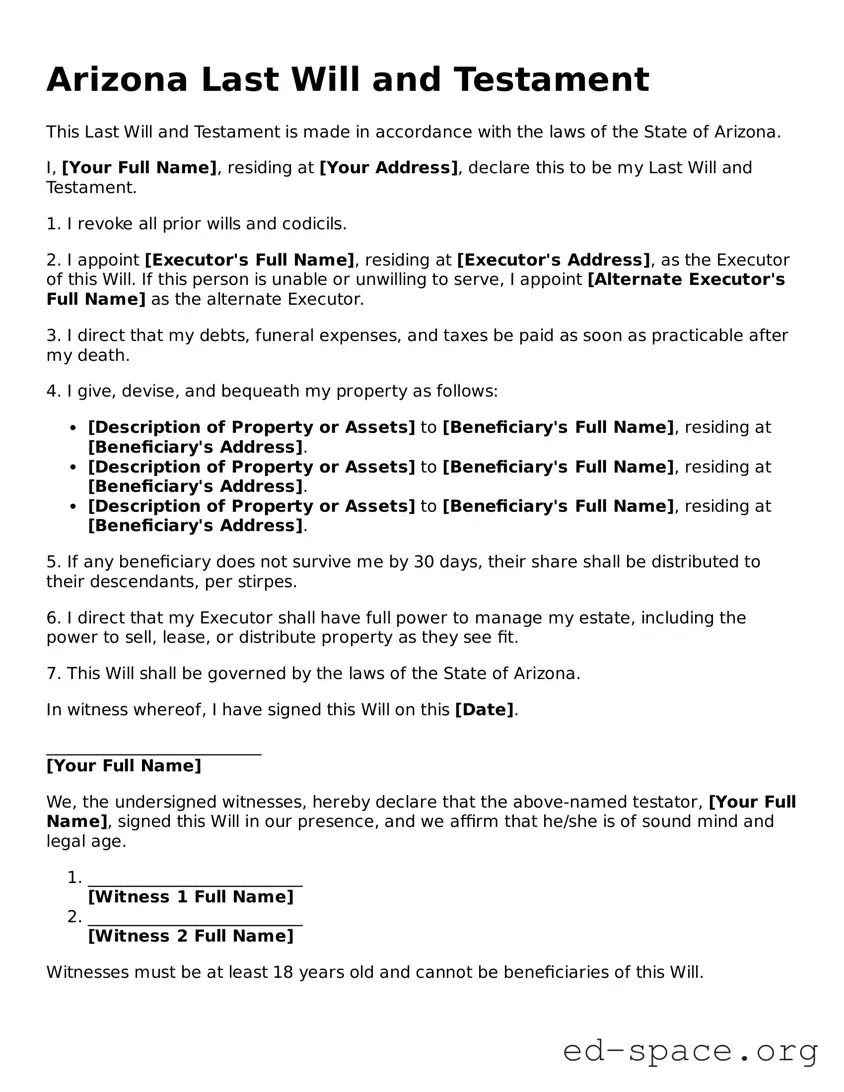
Creating a Last Will and Testament is an essential step in ensuring that your wishes are honored after your passing. In Arizona, this legal document allows you to specify how your assets will be distributed, who will care for your minor children, and who will manage your estate. The Arizona Last Will and Testament form is straightforward, making it accessible for anyone looking to secure their legacy. It typically includes sections for naming an executor, outlining your beneficiaries, and detailing any specific bequests. Additionally, the form requires your signature and the signatures of witnesses to validate your intentions. By taking the time to complete this document, you can provide peace of mind for yourself and your loved ones, knowing that your affairs will be handled according to your wishes.
Arizona Last Will and Testament
This Last Will and Testament is made in accordance with the laws of the State of Arizona.
I, [Your Full Name], residing at [Your Address], declare this to be my Last Will and Testament.
1. I revoke all prior wills and codicils.
2. I appoint [Executor's Full Name], residing at [Executor's Address], as the Executor of this Will. If this person is unable or unwilling to serve, I appoint [Alternate Executor's Full Name] as the alternate Executor.
3. I direct that my debts, funeral expenses, and taxes be paid as soon as practicable after my death.
4. I give, devise, and bequeath my property as follows:
5. If any beneficiary does not survive me by 30 days, their share shall be distributed to their descendants, per stirpes.
6. I direct that my Executor shall have full power to manage my estate, including the power to sell, lease, or distribute property as they see fit.
7. This Will shall be governed by the laws of the State of Arizona.
In witness whereof, I have signed this Will on this [Date].
__________________________
[Your Full Name]
We, the undersigned witnesses, hereby declare that the above-named testator, [Your Full Name], signed this Will in our presence, and we affirm that he/she is of sound mind and legal age.
Witnesses must be at least 18 years old and cannot be beneficiaries of this Will.
| Fact Name | Details |
|---|---|
| Governing Law | The Arizona Last Will and Testament form is governed by Arizona Revised Statutes Title 14, Chapter 2. |
| Age Requirement | To create a valid will in Arizona, the individual must be at least 18 years old. |
| Witness Requirement | Arizona law requires that the will be signed by at least two witnesses who are present at the same time. |
| Holographic Wills | A holographic will, which is handwritten and signed by the testator, is recognized in Arizona without the need for witnesses. |
| Revocation | A will can be revoked in Arizona by creating a new will or by destroying the existing will with the intent to revoke it. |
| Self-Proving Wills | Arizona allows for self-proving wills, which can simplify the probate process by including a notarized affidavit from the witnesses. |
Once you have the Arizona Last Will and Testament form ready, it’s time to fill it out carefully. This document will help ensure your wishes are honored regarding the distribution of your assets and care of your dependents after you pass away. Following the steps below will guide you through the process of completing the form accurately.
After completing the form, store it in a safe place and inform your executor where it can be found. Regularly review and update your will as your circumstances change, ensuring it always reflects your current wishes.
What is a Last Will and Testament in Arizona?
A Last Will and Testament is a legal document that outlines how a person's assets and affairs should be handled after their death. In Arizona, this document specifies who will inherit your property, appoints guardians for minor children, and can even name an executor to carry out your wishes. It’s an essential tool for ensuring that your desires are respected and that your loved ones are taken care of according to your wishes.
Do I need a lawyer to create a Last Will and Testament in Arizona?
While it's not legally required to have a lawyer to create a Last Will and Testament in Arizona, consulting one can be beneficial. A lawyer can help ensure that your will complies with state laws and accurately reflects your wishes. If your estate is complex, or if you have specific concerns, legal advice can provide peace of mind.
What are the requirements for a valid will in Arizona?
For a will to be valid in Arizona, it must be in writing and signed by the person making the will (the testator). Additionally, it should be witnessed by at least two people who are not beneficiaries. These witnesses must sign the will in the presence of the testator. Following these steps helps ensure that your will is legally enforceable.
Can I change my will after it’s been created?
Yes, you can change your will at any time while you are alive and mentally competent. This is typically done through a document called a codicil, which amends the original will. Alternatively, you can create a completely new will that revokes the previous one. Just remember to follow the same legal requirements to ensure the new document is valid.
What happens if I die without a will in Arizona?
If you die without a will, you are considered to have died "intestate." In this case, Arizona's intestacy laws will determine how your assets are distributed. This process may not align with your wishes, and it can lead to complications for your family. Having a will in place helps avoid this uncertainty and ensures your preferences are honored.
Can I include funeral arrangements in my will?
Yes, you can include your funeral arrangements in your will. This can provide guidance to your loved ones about your wishes regarding burial, cremation, or other memorial services. However, keep in mind that wills are not typically read until after the funeral, so it may be wise to communicate your wishes to family members directly as well.
Is a handwritten will valid in Arizona?
A handwritten will, also known as a holographic will, can be valid in Arizona as long as it meets specific criteria. The entire document must be in your handwriting and signed by you. However, it’s important to note that handwritten wills can lead to disputes or confusion, so it’s often advisable to use a formal will template or consult a lawyer to ensure clarity and legality.
Failing to properly identify the testator. The will should clearly state the full name and address of the individual creating the will. Omitting this information can lead to confusion about the document's validity.
Not signing the will in the presence of witnesses. In Arizona, a will must be signed by the testator and witnessed by at least two individuals who are not beneficiaries. Neglecting this step can render the will invalid.
Using outdated forms. Laws change, and it is crucial to use the most current version of the Arizona Last Will and Testament form. Using an outdated form may lead to unintended legal issues.
Failing to update the will after significant life events. Changes such as marriage, divorce, or the birth of a child should prompt a review and possible revision of the will. Not doing so can result in outdated provisions that do not reflect current wishes.
Neglecting to include specific bequests. If there are particular items or assets intended for specific individuals, these should be clearly stated. Omitting this information can lead to disputes among heirs.
Not keeping the will in a safe place. After completing the will, it should be stored securely, yet remain accessible to the executor and beneficiaries. Failing to do so can result in the will being lost or destroyed, complicating the probate process.
When creating a Last Will and Testament in Arizona, several other documents may be useful to ensure that your wishes are clearly defined and legally upheld. Each of these forms serves a specific purpose in estate planning and can help streamline the process for your loved ones.
Having these documents in place can provide peace of mind and clarity for both you and your loved ones. Proper estate planning helps ensure that your wishes are respected and that your family is taken care of during difficult times.
The Last Will and Testament is a crucial legal document that outlines an individual's wishes regarding the distribution of their assets after death. Several other documents serve similar purposes in estate planning. Below are four such documents:
When filling out the Arizona Last Will and Testament form, it is important to follow specific guidelines to ensure the document is valid and accurately reflects your wishes. Here are six things to do and avoid:
By following these guidelines, you can create a clear and effective Last Will and Testament that reflects your wishes and protects your loved ones.
Understanding the Arizona Last Will and Testament form is essential for anyone looking to create a will in the state. However, several misconceptions can lead to confusion. Here are five common misunderstandings:
By clarifying these misconceptions, individuals can better navigate the process of creating a Last Will and Testament in Arizona, ensuring their wishes are respected and upheld.
Creating a Last Will and Testament is an important step in ensuring that your wishes are honored after your passing. Here are some key takeaways to keep in mind when filling out and using the Arizona Last Will and Testament form:
By keeping these points in mind, you can create a will that reflects your wishes and provides peace of mind for you and your family.