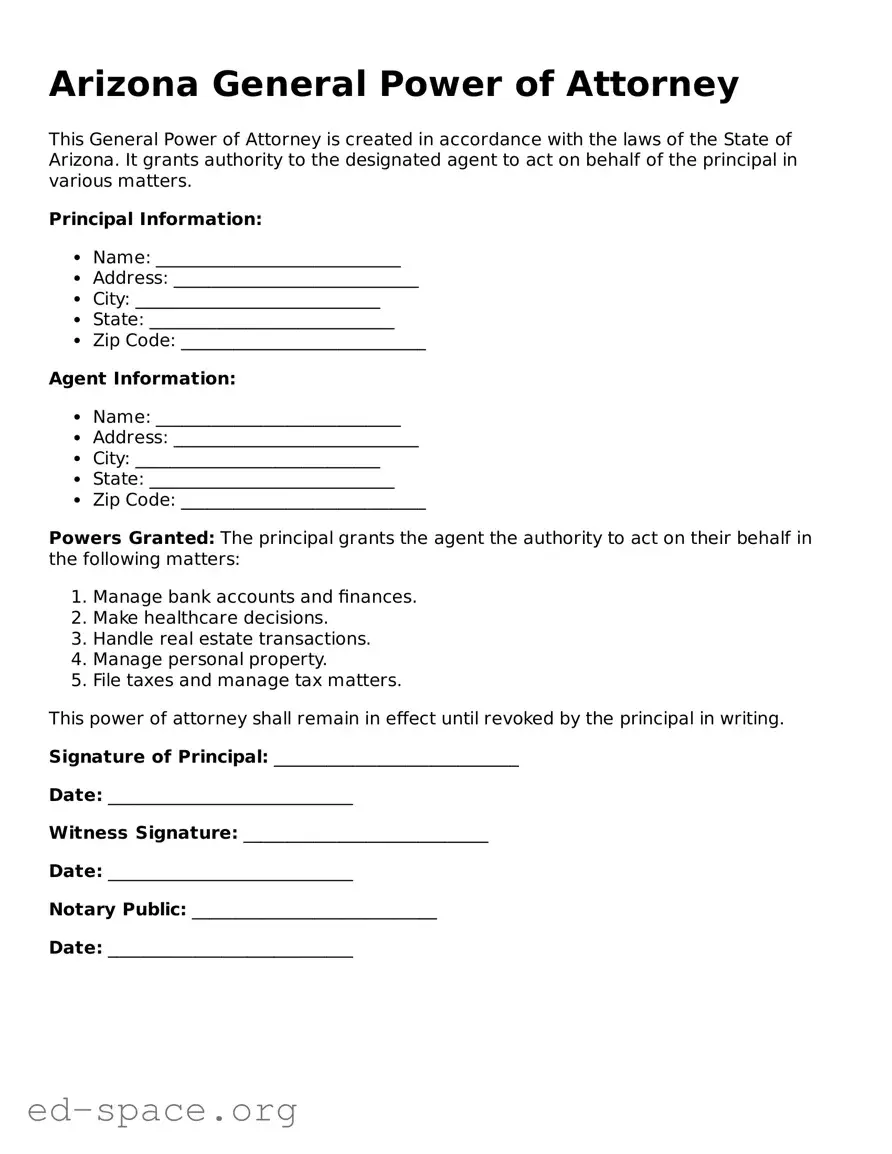
In Arizona, the General Power of Attorney form serves as a crucial legal document that empowers an individual, known as the agent or attorney-in-fact, to make decisions on behalf of another person, referred to as the principal. This form is particularly significant for those who wish to ensure their financial and legal matters are managed effectively, especially during times of incapacity or absence. The document outlines the specific powers granted to the agent, which can include handling financial transactions, managing real estate, and making healthcare decisions, among others. Importantly, the General Power of Attorney can be tailored to fit the unique needs of the principal, allowing for broad or limited authority as desired. Additionally, it is essential to understand that this form becomes effective immediately upon signing, unless otherwise specified, and it can be revoked at any time by the principal, provided they are mentally competent. Understanding the nuances of this form is vital for anyone considering its use, as it plays a pivotal role in safeguarding one’s interests and ensuring that trusted individuals can act decisively when needed.
Arizona General Power of Attorney
This General Power of Attorney is created in accordance with the laws of the State of Arizona. It grants authority to the designated agent to act on behalf of the principal in various matters.
Principal Information:
Agent Information:
Powers Granted: The principal grants the agent the authority to act on their behalf in the following matters:
This power of attorney shall remain in effect until revoked by the principal in writing.
Signature of Principal: ____________________________
Date: ____________________________
Witness Signature: ____________________________
Date: ____________________________
Notary Public: ____________________________
Date: ____________________________
| Fact Name | Description |
|---|---|
| Definition | The Arizona General Power of Attorney form allows an individual to designate another person to act on their behalf in financial and legal matters. |
| Governing Law | This form is governed by Arizona Revised Statutes, Title 14, Chapter 5, specifically A.R.S. § 14-5501 et seq. |
| Durability | The General Power of Attorney can be durable, meaning it remains in effect even if the principal becomes incapacitated, unless specified otherwise. |
| Agent Authority | The agent can perform a variety of actions, including managing bank accounts, selling property, and making financial decisions. |
| Principal's Signature | The form must be signed by the principal, affirming their intent to grant authority to the agent. |
| Witness Requirement | Arizona law does not require witnesses for the execution of a General Power of Attorney, but it is advisable to have them for added legal protection. |
| Notarization | While notarization is not mandatory, having the document notarized can enhance its validity and acceptance by third parties. |
| Revocation | The principal can revoke the General Power of Attorney at any time, provided they are mentally competent to do so. |
| Limitations | Some powers, such as making medical decisions, require a separate document, as the General Power of Attorney primarily covers financial matters. |
| Use Cases | This form is commonly used for managing finances during travel, illness, or when the principal is otherwise unable to handle their affairs. |
Filling out the Arizona General Power of Attorney form is an important step in designating someone to act on your behalf. After completing the form, you will need to sign it in front of a notary public to ensure it is legally binding. Follow these steps to fill out the form accurately.
What is a General Power of Attorney in Arizona?
A General Power of Attorney (GPOA) is a legal document that allows one person, known as the principal, to grant another person, known as the agent, the authority to make decisions on their behalf. This can include financial, legal, and business matters. The agent's powers can be broad or limited, depending on the principal's wishes.
Who can serve as an agent in a General Power of Attorney?
In Arizona, any competent adult can serve as an agent. This includes friends, family members, or professionals such as attorneys. It is crucial to choose someone trustworthy, as the agent will have significant control over the principal's affairs.
Does a General Power of Attorney need to be notarized?
Yes, in Arizona, a General Power of Attorney must be notarized to be valid. This means that the principal must sign the document in the presence of a notary public, who will then acknowledge the signature. Some situations may also require witnesses, so it’s wise to check specific requirements based on your needs.
Can I revoke a General Power of Attorney?
Yes, a principal can revoke a General Power of Attorney at any time, as long as they are mentally competent. To do this, the principal should create a written revocation document and notify the agent and any relevant institutions. This ensures that the agent no longer has authority over the principal's affairs.
What happens if the principal becomes incapacitated?
If the principal becomes incapacitated, the General Power of Attorney typically remains in effect unless it was specifically stated that it would terminate upon incapacity. This means the agent can continue to act on behalf of the principal. However, a Durable Power of Attorney is often recommended for this situation, as it explicitly remains valid during incapacity.
Can a General Power of Attorney be used for healthcare decisions?
No, a General Power of Attorney does not cover healthcare decisions. For medical decisions, a separate document called a Healthcare Power of Attorney or Advance Directive is needed. This document allows the agent to make healthcare choices on behalf of the principal if they are unable to do so themselves.
Is a General Power of Attorney valid in other states?
A General Power of Attorney created in Arizona is generally valid in other states, but laws can vary. It’s important to check the specific requirements of the state where the document will be used. Some states may require additional forms or notarization to recognize the Arizona GPOA.
What should I include in a General Power of Attorney?
When drafting a General Power of Attorney, include the principal's full name, the agent's full name, and a clear statement of the powers granted. Specify any limitations or conditions. Additionally, include the date of execution and ensure it is signed and notarized according to Arizona law.
Can I use a template for my General Power of Attorney?
While templates can provide a useful starting point, it is advisable to consult with a legal professional to ensure that the document meets all legal requirements and accurately reflects your wishes. Customizing the document can help avoid potential issues in the future.
Failing to specify the powers granted. It's essential to clearly outline what decisions the agent can make on your behalf. Without this, the document may not serve its intended purpose.
Not including a durable clause. If you want the power of attorney to remain effective if you become incapacitated, ensure you include a durable clause. Otherwise, it may become void.
Neglecting to sign and date the form. A signature is crucial for the validity of the document. Without it, the power of attorney cannot be enforced.
Forgetting to have witnesses or notarization. Arizona law requires that a power of attorney be either witnessed or notarized. Skipping this step can lead to issues later.
Choosing an unsuitable agent. It's important to select someone trustworthy and capable. An unsuitable choice can lead to misuse of power.
Not reviewing the document regularly. Life circumstances change. Regularly reviewing your power of attorney ensures it still reflects your wishes and needs.
Overlooking state-specific requirements. Each state has its own rules regarding powers of attorney. Familiarize yourself with Arizona's specific requirements to avoid invalidation.
When considering a General Power of Attorney in Arizona, it is helpful to understand other documents that may accompany it. These documents can assist in managing legal, financial, or healthcare decisions effectively. Below is a list of forms that are commonly used alongside the General Power of Attorney.
Understanding these documents can provide clarity and peace of mind when making important decisions regarding health, finances, and personal affairs. It is advisable to consult with a qualified professional to ensure that all necessary documents are in place and properly executed.
A General Power of Attorney (GPOA) is a powerful document that allows one person to act on behalf of another in various matters. While it has its unique features, several other documents serve similar purposes. Below is a list of eight documents that share similarities with the General Power of Attorney:
Understanding these documents can help you choose the right one for your needs. Each serves a specific purpose, so it’s important to consider your situation carefully.
When filling out the Arizona General Power of Attorney form, it is essential to follow certain guidelines to ensure the document is valid and meets your needs. Here are four key do's and don'ts:
When it comes to the Arizona General Power of Attorney (GPOA) form, many people hold misconceptions that can lead to confusion or unintended consequences. Here are eight common misunderstandings:
Many believe that a GPOA gives the agent unrestricted authority. In reality, the powers granted are specified in the document. The principal can choose to limit the agent's authority to certain tasks or decisions.
This is a significant misconception. A GPOA becomes invalid upon the death of the principal. After that, the agent can no longer act on behalf of the deceased.
While many use a GPOA for financial decisions, it can also cover healthcare and other personal matters. The principal can specify various areas where the agent can act.
Although it is possible to create a GPOA without a lawyer, seeking legal advice can help ensure that the document meets all legal requirements and accurately reflects the principal's wishes.
This is not true. A principal can revoke or modify a GPOA at any time as long as they are mentally competent. Changes should be documented properly to avoid confusion.
A GPOA is valid in Arizona, but other states may have different laws. If the principal moves or needs the document to be recognized elsewhere, they may need to create a new one that complies with that state’s laws.
In Arizona, while notarization is not strictly required, having the document notarized can provide additional legal protection and help with acceptance by third parties.
Many people think a GPOA is only necessary in case of an emergency. However, it can be a proactive tool for planning and managing affairs, even when the principal is fully capable.
Understanding these misconceptions can help individuals make informed decisions about their legal documents and ensure that their intentions are clearly communicated.
Filling out and using the Arizona General Power of Attorney form is an important step in ensuring that your financial and legal matters are managed according to your wishes. Here are some key takeaways to consider: