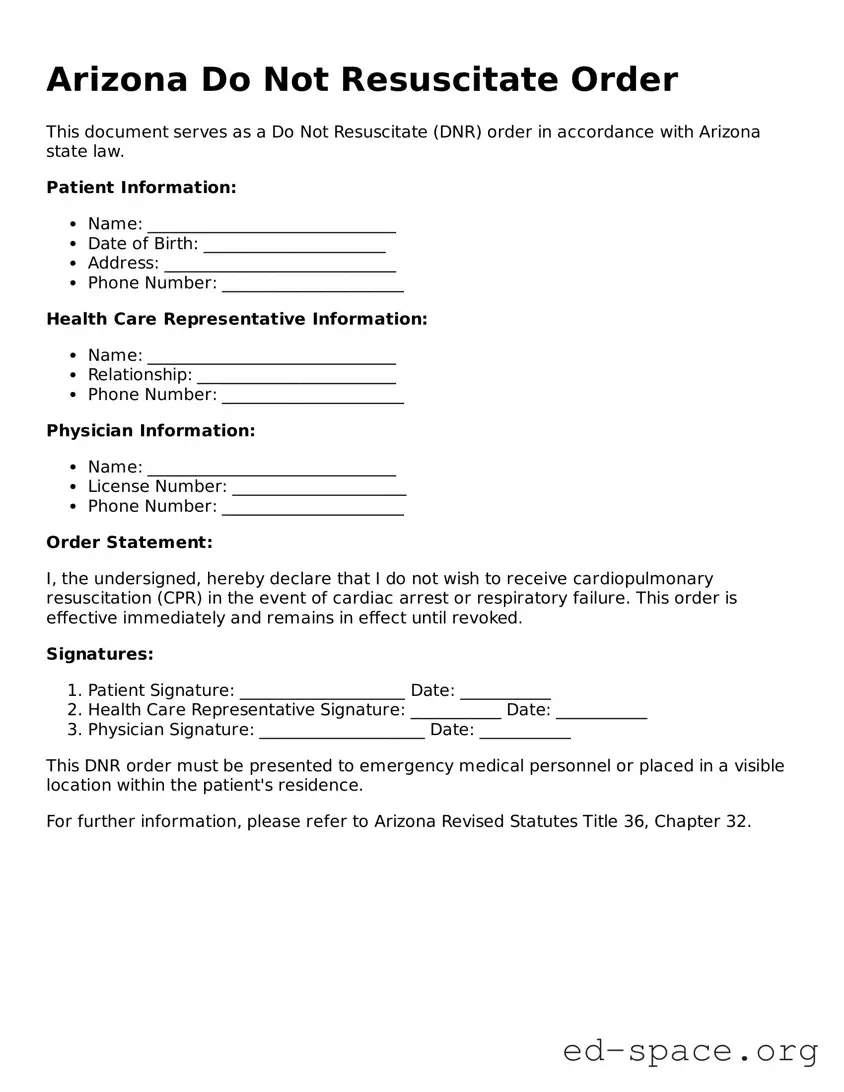
The Arizona Do Not Resuscitate Order (DNR) form is a crucial legal document that allows individuals to express their wishes regarding medical treatment in emergency situations. This form is designed for patients who have a terminal illness or are facing a medical condition where resuscitation efforts would not align with their personal values or desired quality of life. By completing the DNR, individuals can ensure that their preferences are respected, particularly in situations where they may be unable to communicate them. The form must be signed by both the patient and a physician, confirming that the patient understands the implications of the order. Additionally, it is important to have the DNR readily accessible to medical personnel to ensure that it is honored during emergencies. Understanding the significance of the Arizona DNR form empowers individuals to make informed decisions about their healthcare, providing peace of mind for both patients and their families.
Arizona Do Not Resuscitate Order
This document serves as a Do Not Resuscitate (DNR) order in accordance with Arizona state law.
Patient Information:
Health Care Representative Information:
Physician Information:
Order Statement:
I, the undersigned, hereby declare that I do not wish to receive cardiopulmonary resuscitation (CPR) in the event of cardiac arrest or respiratory failure. This order is effective immediately and remains in effect until revoked.
Signatures:
This DNR order must be presented to emergency medical personnel or placed in a visible location within the patient's residence.
For further information, please refer to Arizona Revised Statutes Title 36, Chapter 32.
| Fact Name | Description |
|---|---|
| Purpose | The Arizona Do Not Resuscitate Order (DNR) form allows individuals to refuse resuscitation efforts in case of cardiac or respiratory arrest. |
| Governing Law | The DNR form is governed by Arizona Revised Statutes § 36-3201 to § 36-3209. |
| Eligibility | Any adult can complete a DNR order, and it is typically used by individuals with terminal illnesses or serious medical conditions. |
| Signature Requirements | The form must be signed by the patient or their legal representative, along with a physician's signature. |
| Validity | The DNR order remains valid until revoked by the patient or their representative, or until a specified expiration date. |
| Location | It is recommended to keep the DNR form in a visible location, such as on the refrigerator or with medical records. |
| Emergency Medical Services | Emergency medical personnel are required to honor a valid DNR order in the event of a medical emergency. |
| Revocation | A DNR order can be revoked verbally or in writing by the patient or their legal representative at any time. |
| Additional Considerations | Individuals may want to discuss their wishes with family members and healthcare providers to ensure understanding and compliance. |
Filling out the Arizona Do Not Resuscitate Order form is an important step in expressing your healthcare preferences. This document allows you to communicate your wishes regarding resuscitation efforts in the event of a medical emergency. The following steps will guide you through the process of completing the form accurately.
Once you have filled out the form, ensure that it is readily accessible to your healthcare team. Discuss your wishes with family members and loved ones to ensure they understand your preferences. Keeping open lines of communication can help avoid confusion in critical situations.
What is a Do Not Resuscitate Order (DNR) in Arizona?
A Do Not Resuscitate Order (DNR) in Arizona is a legal document that allows a person to refuse resuscitation efforts in the event of a medical emergency. This means that if a person’s heart stops beating or they stop breathing, medical personnel will not perform cardiopulmonary resuscitation (CPR) or other life-saving measures. The order is typically used by individuals with terminal illnesses or those who wish to avoid aggressive medical interventions at the end of life.
How do I obtain a DNR form in Arizona?
To obtain a DNR form in Arizona, individuals can download it from the Arizona Department of Health Services website or request a copy from their healthcare provider. It is important to ensure that the form is the most current version. Once completed, the form must be signed by the patient and a physician to be valid.
Who can sign a DNR order?
A DNR order can be signed by the patient themselves if they are of sound mind and able to make their own medical decisions. If the patient is unable to sign, a legally authorized representative, such as a healthcare proxy or family member, may sign on their behalf. It is essential that the person signing the order understands the implications of the decision.
Is a DNR order valid in all healthcare settings?
Yes, a DNR order is valid in all healthcare settings in Arizona, including hospitals, nursing homes, and at home. However, it is crucial to ensure that the order is clearly visible and accessible to medical personnel. Carrying a copy of the DNR order or wearing a medical alert bracelet can help ensure that healthcare providers are aware of the patient’s wishes.
Can a DNR order be revoked?
Yes, a DNR order can be revoked at any time by the patient or their authorized representative. To revoke the order, the individual should destroy the original document and inform their healthcare provider of the change. It is advisable to create a new order if the patient’s wishes change regarding resuscitation.
What should I discuss with my doctor before completing a DNR order?
Before completing a DNR order, it is important to have an open discussion with your doctor about your medical condition, prognosis, and treatment options. Understanding the implications of a DNR order and how it aligns with your personal values and wishes is essential. Your doctor can help clarify any questions and provide guidance on end-of-life care decisions.
Are there any other documents related to end-of-life decisions I should consider?
Yes, in addition to a DNR order, individuals may want to consider creating an advance directive or a living will. These documents outline your preferences for medical treatment and appoint someone to make healthcare decisions on your behalf if you become unable to do so. It is advisable to discuss these documents with your healthcare provider to ensure they align with your wishes.
Not including a date on the form. A DNR order must be current to be valid.
Failing to sign the form. Without a signature, the order cannot be enforced.
Not having a witness present when signing. Arizona law requires a witness to validate the order.
Leaving out critical medical information. Ensure that all relevant medical history is included.
Using unclear language. Be specific about the wishes regarding resuscitation.
Not discussing the order with healthcare providers. Communication with medical staff is essential.
Forgetting to update the order if circumstances change. Review the DNR regularly.
Not providing copies to family members. Ensure that loved ones are aware of the order.
Failing to check state-specific requirements. Each state may have unique regulations regarding DNR orders.
Neglecting to include a designated healthcare proxy. This person can help communicate your wishes if needed.
When considering end-of-life care options, it's essential to have a comprehensive understanding of the various documents that may accompany an Arizona Do Not Resuscitate (DNR) Order. Each of these forms serves a unique purpose, ensuring that your healthcare preferences are respected and followed. Below is a list of other important documents that are often used alongside a DNR Order.
Understanding these documents can empower you and your loved ones to make informed decisions about healthcare preferences. By preparing these forms in advance, you can ensure that your wishes are respected and that your loved ones are not left to make difficult decisions during emotionally challenging times.
When filling out the Arizona Do Not Resuscitate Order form, it is crucial to approach the task with care and understanding. Here are some important dos and don'ts to keep in mind:
Understanding the Arizona Do Not Resuscitate (DNR) Order form is crucial for making informed healthcare decisions. However, several misconceptions can lead to confusion. Here are six common misunderstandings about the Arizona DNR Order form:
This is not true. A DNR order specifically pertains to resuscitation efforts in the event of cardiac arrest. Other medical treatments and interventions will still be provided as necessary.
This misconception overlooks the fact that anyone can request a DNR order, regardless of their health status. It is a personal choice that reflects an individual's wishes regarding resuscitation.
In reality, individuals can change or revoke their DNR order at any time. It is important to communicate any changes to healthcare providers and ensure that the latest version is available.
This is a misconception. An Arizona DNR order is valid in various settings, including at home, in assisted living facilities, and in hospice care. It is essential to have the order readily available in all locations.
While family members can advocate for a patient's wishes, only the individual or their legally designated representative can complete and sign a DNR order. Clear communication about wishes is key.
This is incorrect. A DNR order specifically addresses resuscitation efforts, while a living will outlines broader healthcare decisions and preferences regarding end-of-life care.
Clarifying these misconceptions can help individuals make informed decisions about their healthcare preferences and ensure that their wishes are respected.
Filling out a Do Not Resuscitate (DNR) Order form in Arizona is a critical step in ensuring that your healthcare preferences are respected. Here are some key takeaways to consider:
Taking these steps can provide peace of mind, knowing your healthcare preferences will be honored. Make sure your loved ones are aware of your decisions, as this can facilitate discussions during challenging times.