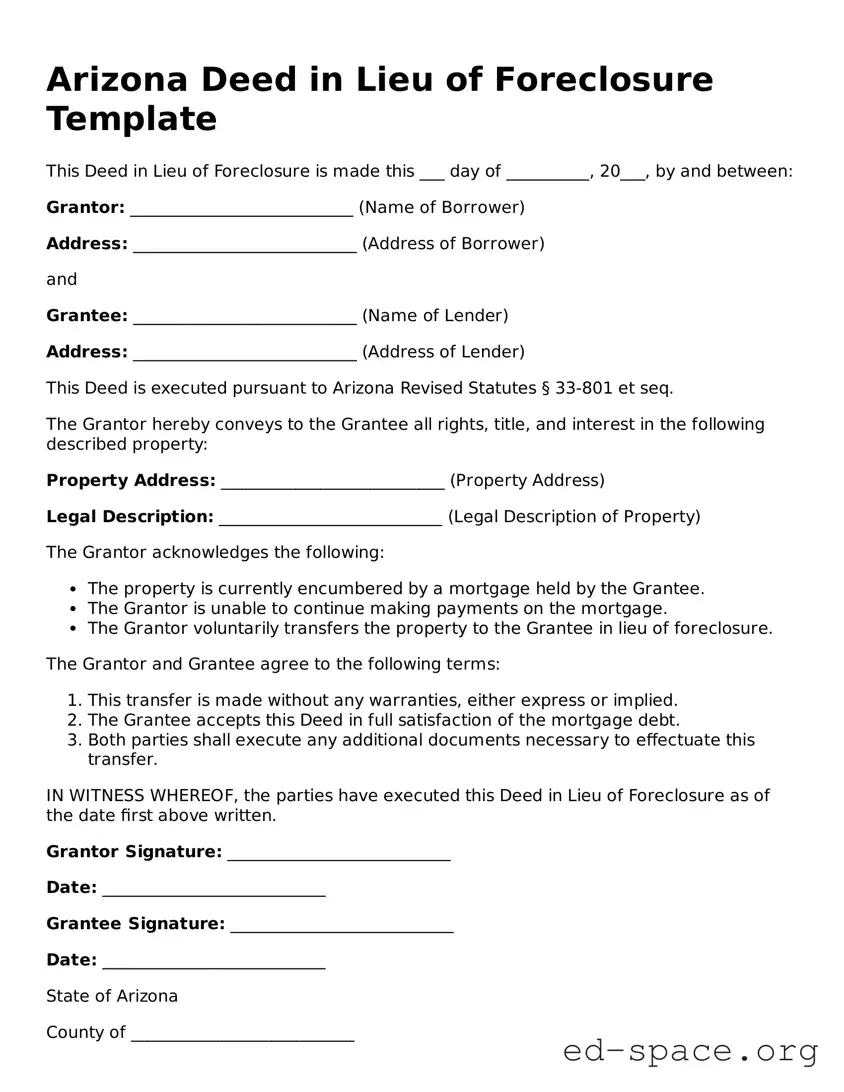
The Arizona Deed in Lieu of Foreclosure form serves as a vital tool for homeowners facing financial difficulties and potential foreclosure. This legal document allows a property owner to voluntarily transfer ownership of their property to the lender, thereby avoiding the lengthy and often stressful foreclosure process. By signing this form, the homeowner relinquishes their rights to the property in exchange for the lender agreeing to release them from the mortgage obligation. This arrangement can benefit both parties; the lender may save time and resources by bypassing foreclosure proceedings, while the homeowner can mitigate the negative impact on their credit score. Additionally, the Deed in Lieu of Foreclosure can offer a smoother transition for the homeowner, potentially allowing them to negotiate terms that could include debt forgiveness or the possibility of remaining in the home for a limited time. Understanding the implications and requirements of this form is crucial for anyone considering it as a viable option in Arizona's real estate landscape.
Arizona Deed in Lieu of Foreclosure Template
This Deed in Lieu of Foreclosure is made this ___ day of __________, 20___, by and between:
Grantor: ___________________________ (Name of Borrower)
Address: ___________________________ (Address of Borrower)
and
Grantee: ___________________________ (Name of Lender)
Address: ___________________________ (Address of Lender)
This Deed is executed pursuant to Arizona Revised Statutes § 33-801 et seq.
The Grantor hereby conveys to the Grantee all rights, title, and interest in the following described property:
Property Address: ___________________________ (Property Address)
Legal Description: ___________________________ (Legal Description of Property)
The Grantor acknowledges the following:
The Grantor and Grantee agree to the following terms:
IN WITNESS WHEREOF, the parties have executed this Deed in Lieu of Foreclosure as of the date first above written.
Grantor Signature: ___________________________
Date: ___________________________
Grantee Signature: ___________________________
Date: ___________________________
State of Arizona
County of ___________________________
On this ___ day of __________, 20___, before me, a Notary Public, personally appeared ___________________________ (Name of Grantor) and ___________________________ (Name of Grantee), known to me to be the persons whose names are subscribed to this instrument, and acknowledged that they executed the same for the purposes therein contained.
Witness my hand and official seal.
Notary Public Signature: ___________________________
My Commission Expires: ___________________________
| Fact Name | Description |
|---|---|
| Definition | An Arizona Deed in Lieu of Foreclosure is a legal document where a borrower voluntarily transfers property ownership to the lender to avoid foreclosure proceedings. |
| Governing Law | This form is governed by Arizona Revised Statutes, specifically Title 33, which covers property laws. |
| Eligibility | To qualify, the borrower must be in default on the mortgage and unable to keep up with payments. |
| Process | The borrower must submit a written request to the lender, who will then evaluate the situation before accepting the deed. |
| Benefits | One major benefit includes avoiding the lengthy foreclosure process, which can be costly and time-consuming. |
| Impact on Credit | A deed in lieu of foreclosure may have a less severe impact on the borrower's credit score compared to a full foreclosure. |
| Tax Implications | Borrowers should consult a tax professional, as there may be tax consequences related to debt forgiveness in a deed in lieu of foreclosure. |
After obtaining the Arizona Deed in Lieu of Foreclosure form, it's important to ensure that all sections are completed accurately. Once filled out, the form must be signed and submitted to the appropriate parties. Following these steps will help ensure a smooth process.
What is a Deed in Lieu of Foreclosure?
A Deed in Lieu of Foreclosure is a legal agreement where a homeowner voluntarily transfers ownership of their property to the lender to avoid the lengthy and often stressful foreclosure process. In this arrangement, the lender agrees to accept the property instead of pursuing foreclosure, which can help the homeowner mitigate damage to their credit score and provide a quicker resolution to their financial difficulties.
Who is eligible to use a Deed in Lieu of Foreclosure?
Eligibility for a Deed in Lieu of Foreclosure typically includes homeowners who are facing financial hardship and are unable to keep up with mortgage payments. The property must be the homeowner's primary residence, and the homeowner should have little to no equity in the property. Additionally, the lender must agree to this arrangement, as they have the final say in whether to accept the deed.
What are the benefits of choosing a Deed in Lieu of Foreclosure?
Opting for a Deed in Lieu of Foreclosure can offer several advantages. First, it allows homeowners to avoid the foreclosure process, which can be lengthy and damaging to credit. Second, it often results in a quicker resolution, allowing homeowners to move on more swiftly. Lastly, it may provide the homeowner with the opportunity to negotiate potential forgiveness of remaining mortgage debt, depending on the lender's policies.
What are the potential drawbacks of a Deed in Lieu of Foreclosure?
While there are benefits, there are also potential drawbacks to consider. A Deed in Lieu of Foreclosure may still impact the homeowner's credit score, albeit less severely than a foreclosure. Additionally, homeowners may be required to vacate the property quickly, which can be challenging. There may also be tax implications if the lender forgives any remaining debt, so it is advisable to consult a tax professional before proceeding.
How does the process of completing a Deed in Lieu of Foreclosure work?
The process begins with the homeowner contacting their lender to express interest in a Deed in Lieu of Foreclosure. The lender will review the homeowner's financial situation and the property’s status. If both parties agree to move forward, the homeowner will need to sign the deed, transferring ownership to the lender. The lender may also require the homeowner to complete certain documents, and the process may vary depending on the lender's specific requirements.
Can a Deed in Lieu of Foreclosure affect future home buying?
Yes, a Deed in Lieu of Foreclosure can affect future home buying. While it may have a less severe impact on credit than a foreclosure, it can still remain on a credit report for several years. Lenders may view this as a red flag when considering future mortgage applications. However, the specific impact can vary based on individual circumstances and the homeowner's overall credit profile at the time of applying for a new loan.
Not including the correct property description. Ensure that the legal description of the property is accurate and complete.
Failing to sign the document. All necessary parties must sign the deed for it to be valid.
Overlooking the need for notarization. The deed must be notarized to be legally enforceable.
Leaving out the names of all owners. All individuals listed on the title should be included in the deed.
Not providing a date. A date is essential to establish when the deed takes effect.
Ignoring local laws and regulations. Each jurisdiction may have specific requirements that must be followed.
Submitting the form without reviewing it thoroughly. Errors can lead to delays or complications in the foreclosure process.
A Deed in Lieu of Foreclosure is a legal document that allows a borrower to transfer ownership of their property to the lender to avoid foreclosure. Along with this form, several other documents may be necessary to complete the process. Below is a list of commonly used forms and documents that often accompany the Deed in Lieu of Foreclosure in Arizona.
Understanding these documents can help facilitate a smoother transition during the deed in lieu process. Each document plays a critical role in protecting both the borrower and the lender, ensuring that all legal and financial obligations are clearly defined and agreed upon.
A Deed in Lieu of Foreclosure is a legal document that allows a homeowner to transfer the title of their property to the lender to avoid foreclosure. This form shares similarities with several other documents related to property ownership and debt resolution. Here are seven documents that are comparable to a Deed in Lieu of Foreclosure:
When completing the Arizona Deed in Lieu of Foreclosure form, it is important to adhere to certain guidelines to ensure a smooth process. Below is a list of actions to consider.
The Deed in Lieu of Foreclosure is a legal document that allows homeowners to transfer their property back to the lender to avoid foreclosure. However, several misconceptions surround this process. Here are four common misunderstandings:
This is not necessarily true. While the homeowner may relinquish their property, they could still be responsible for any remaining debt not covered by the sale of the property. Lenders may pursue a deficiency judgment if the property sells for less than the outstanding mortgage balance.
Although it may seem straightforward, the process can be lengthy and complex. Homeowners must negotiate with the lender, and both parties must agree to the terms. Additionally, the lender may require a thorough review of the homeowner's financial situation before approval.
In reality, this action can negatively affect a homeowner's credit score. While it may be less damaging than a foreclosure, it is still reported to credit bureaus and can remain on a credit report for several years.
Homeowners must be in a specific situation to pursue this option. Typically, lenders prefer to see that the homeowner has exhausted all other alternatives, such as loan modifications or short sales, before considering a Deed in Lieu of Foreclosure.
Filling out and using the Arizona Deed in Lieu of Foreclosure form can be a crucial step for homeowners facing financial difficulties. Here are some key takeaways to consider:
By understanding these key points, homeowners can navigate the Deed in Lieu of Foreclosure process more effectively, making informed decisions during challenging times.