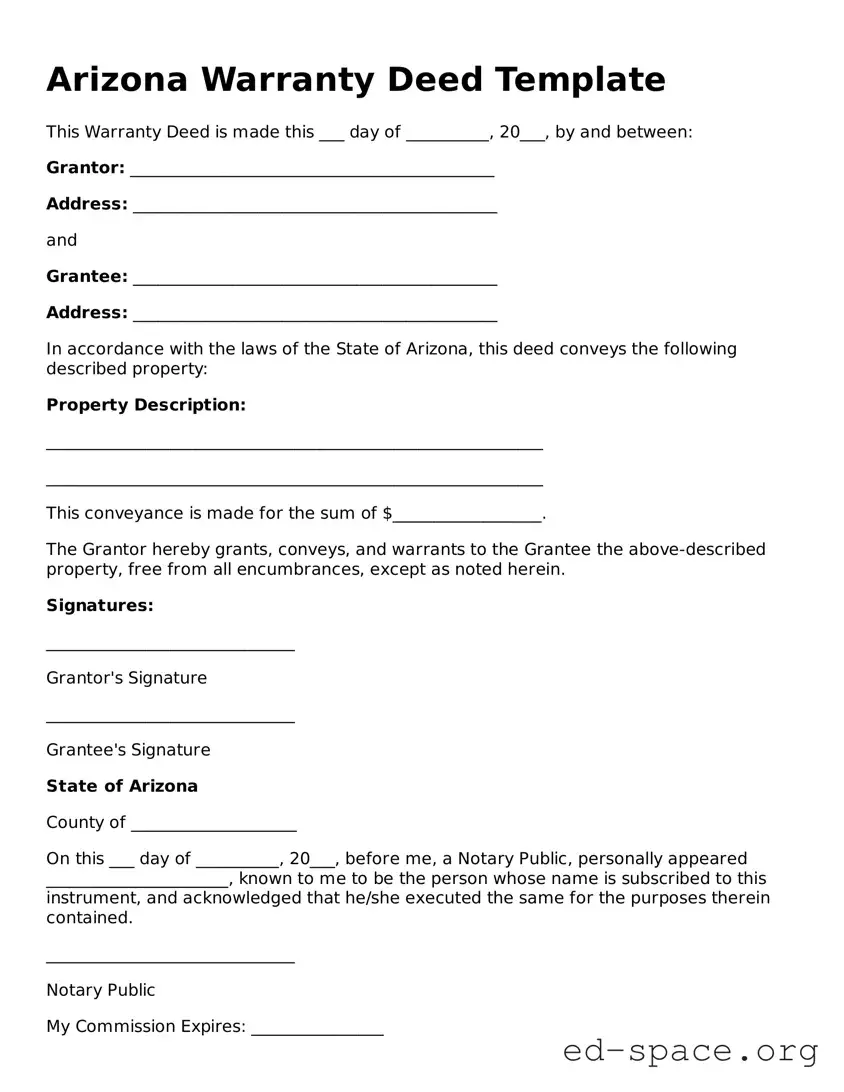
In the realm of real estate transactions, the Arizona Deed form plays a pivotal role, serving as a crucial instrument for the transfer of property ownership. This legal document encapsulates essential information, including the names of the grantor and grantee, a detailed description of the property, and the terms under which the transfer occurs. It is important to note that the form varies depending on the type of deed being utilized—be it a warranty deed, quitclaim deed, or special warranty deed—each serving distinct purposes and offering different levels of protection to the parties involved. Additionally, the execution of the deed requires adherence to specific legal formalities, such as notarization and, in some cases, witness signatures, which lend the document its legitimacy. Understanding the nuances of the Arizona Deed form is vital for both buyers and sellers, as it not only facilitates the transfer of real estate but also safeguards the interests of all parties engaged in the transaction.
Arizona Warranty Deed Template
This Warranty Deed is made this ___ day of __________, 20___, by and between:
Grantor: ____________________________________________
Address: ____________________________________________
and
Grantee: ____________________________________________
Address: ____________________________________________
In accordance with the laws of the State of Arizona, this deed conveys the following described property:
Property Description:
____________________________________________________________
____________________________________________________________
This conveyance is made for the sum of $__________________.
The Grantor hereby grants, conveys, and warrants to the Grantee the above-described property, free from all encumbrances, except as noted herein.
Signatures:
______________________________
Grantor's Signature
______________________________
Grantee's Signature
State of Arizona
County of ____________________
On this ___ day of __________, 20___, before me, a Notary Public, personally appeared ______________________, known to me to be the person whose name is subscribed to this instrument, and acknowledged that he/she executed the same for the purposes therein contained.
______________________________
Notary Public
My Commission Expires: ________________
| Fact Name | Description |
|---|---|
| Definition | An Arizona Deed form is a legal document used to transfer ownership of real property from one party to another. |
| Types of Deeds | Common types include Warranty Deed, Quitclaim Deed, and Special Warranty Deed. |
| Governing Law | The Arizona Revised Statutes, particularly Title 33, govern the laws related to property and deeds. |
| Signature Requirements | The grantor must sign the deed in the presence of a notary public for it to be valid. |
| Recording | To provide public notice, the deed must be recorded with the county recorder's office where the property is located. |
| Consideration | While not always required, the deed typically includes a statement of consideration, or the value exchanged for the property. |
| Legal Description | A precise legal description of the property must be included to ensure clarity in the transfer of ownership. |
Once you have the Arizona Deed form ready, it's important to fill it out accurately to ensure that the transfer of property is recognized legally. After completing the form, you will typically need to file it with the appropriate county recorder's office to finalize the process.
What is an Arizona Deed form?
An Arizona Deed form is a legal document used to transfer ownership of real estate in the state of Arizona. It serves as a record of the transfer between the seller (grantor) and the buyer (grantee). The deed includes important information such as the names of the parties involved, a description of the property, and the date of the transfer. There are different types of deeds, such as warranty deeds and quitclaim deeds, each serving a specific purpose in the transfer process.
How do I complete an Arizona Deed form?
Completing an Arizona Deed form requires careful attention to detail. Start by filling in the names of the grantor and grantee, ensuring they are accurate and match the official identification. Next, provide a clear legal description of the property being transferred. This may include the parcel number and any relevant boundaries. After completing the form, both parties should sign it in the presence of a notary public. Notarization is essential for the deed to be legally binding.
Do I need to file the Arizona Deed form with the county?
Yes, it is necessary to file the Arizona Deed form with the county recorder's office where the property is located. Filing the deed ensures that the transfer of ownership is officially recorded in public records. This step protects the rights of the new owner and provides notice to the public about the change in ownership. There may be a small fee associated with filing, so it’s a good idea to check with the local recorder’s office for specific requirements and costs.
What happens if I don’t use an Arizona Deed form?
Failing to use an Arizona Deed form when transferring property can lead to significant legal complications. Without a proper deed, there is no official record of the ownership transfer, which can create disputes and confusion over property rights. Additionally, the new owner may face challenges in proving ownership when it comes to selling the property or obtaining financing. To avoid these issues, always use a deed form and ensure it is properly executed and filed.
Incorrect Property Description: Failing to provide a complete and accurate description of the property can lead to complications. Ensure you include the full legal description, including lot number, block number, and any relevant subdivision information.
Missing Signatures: All parties involved must sign the deed. If a signature is missing, the deed may be considered invalid. Double-check that everyone has signed before submission.
Improper Notarization: A deed must be notarized to be legally binding. If the notarization is missing or not completed correctly, the deed may not be accepted by the county recorder.
Wrong Date: The date on the deed should reflect the actual date of signing. An incorrect date can create confusion and may affect the validity of the document.
Failure to Record: After completing the deed, it must be recorded with the appropriate county office. Not recording the deed can result in loss of rights to the property.
Inaccurate Grantee Information: Ensure that the name of the grantee is spelled correctly and matches their legal name. Errors in this section can lead to ownership disputes.
When dealing with property transactions in Arizona, several forms and documents complement the Arizona Deed form. Understanding these documents is crucial for a smooth and efficient transfer of property ownership. Below is a list of commonly used forms that play a vital role in the process.
Each of these documents serves a specific purpose in the property transaction process, helping to protect the interests of all parties involved. Familiarity with these forms can lead to a more informed and efficient real estate experience.
The Deed form is a crucial document in real estate transactions, but it shares similarities with several other important documents. Below is a list of eight documents that have comparable features or purposes to the Deed form:
When filling out the Arizona Deed form, it is important to follow certain guidelines to ensure accuracy and compliance. Below is a list of things to do and things to avoid.
Here are seven common misconceptions about the Arizona Deed form:
Not all deeds serve the same purpose. Arizona recognizes several types, including warranty deeds and quitclaim deeds, each with distinct legal implications.
While notarization is often recommended, Arizona law does not require it for a deed to be valid. However, notarization can help prevent disputes.
Deeds are not limited to sales. They can also be used for transfers between family members, gifts, or estate planning purposes.
A recorded deed can be amended or revoked, but the process requires additional legal documentation and may involve court approval.
While having a lawyer can be beneficial, individuals can complete property transfers using the Arizona Deed form without legal assistance, as long as they follow the necessary steps.
Both parties—the grantor and the grantee—must sign the deed for it to be valid. This ensures that the transfer is agreed upon by both sides.
Disputes can arise even after a deed is executed. Issues such as fraud, misrepresentation, or lack of capacity can lead to legal challenges.
When it comes to transferring property in Arizona, understanding the Deed form is crucial. Here are some key takeaways to keep in mind:
By keeping these points in mind, you can navigate the Arizona Deed form process with confidence and clarity.