The Arizona Affidavit of Death form serves as an important legal document that facilitates the transfer of property and assets following an individual's passing. This form is typically utilized when a person dies and their estate needs to be settled. It provides a means for the surviving party to officially declare the death and affirm their relationship to the deceased. Completing this affidavit is essential for heirs or beneficiaries to claim their rights to any property, bank accounts, or other assets that belonged to the deceased. The form must be signed in front of a notary public, ensuring its authenticity. Additionally, it often requires supporting documentation, such as a death certificate, to validate the claim. Understanding the proper use and requirements of the Arizona Affidavit of Death can help streamline the process of estate management during a challenging time.
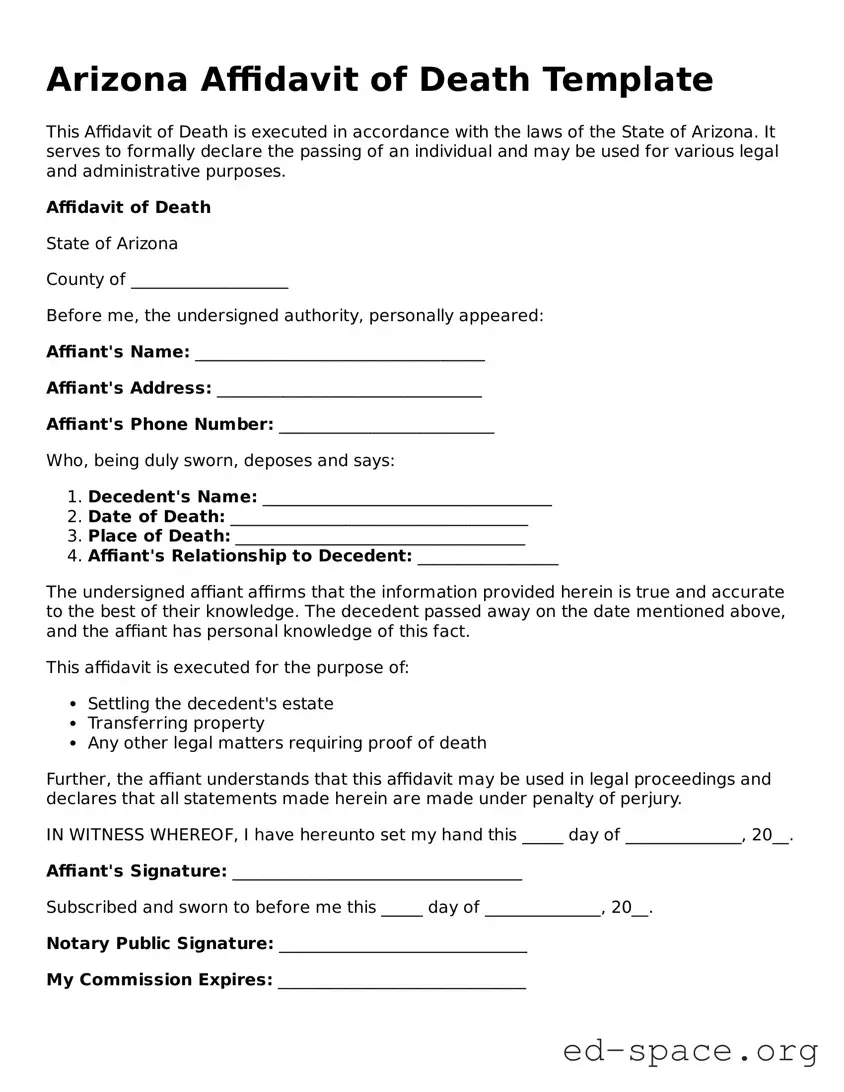
Arizona Affidavit of Death Template
This Affidavit of Death is executed in accordance with the laws of the State of Arizona. It serves to formally declare the passing of an individual and may be used for various legal and administrative purposes.
Affidavit of Death
State of Arizona
County of ___________________
Before me, the undersigned authority, personally appeared:
Affiant's Name: ___________________________________
Affiant's Address: ________________________________
Affiant's Phone Number: __________________________
Who, being duly sworn, deposes and says:
The undersigned affiant affirms that the information provided herein is true and accurate to the best of their knowledge. The decedent passed away on the date mentioned above, and the affiant has personal knowledge of this fact.
This affidavit is executed for the purpose of:
Further, the affiant understands that this affidavit may be used in legal proceedings and declares that all statements made herein are made under penalty of perjury.
IN WITNESS WHEREOF, I have hereunto set my hand this _____ day of ______________, 20__.
Affiant's Signature: ___________________________________
Subscribed and sworn to before me this _____ day of ______________, 20__.
Notary Public Signature: ______________________________
My Commission Expires: ______________________________
| Fact Name | Details |
|---|---|
| Purpose | The Arizona Affidavit of Death is used to officially declare the death of an individual, allowing for the transfer of property and settling of affairs. |
| Governing Law | This form is governed by Arizona Revised Statutes, specifically Title 14, which pertains to probate and trusts. |
| Eligibility | Any individual with knowledge of the deceased's death can complete the affidavit, but it is often filled out by a family member or executor. |
| Required Information | The form typically requires the deceased's full name, date of death, and details about the affiant's relationship to the deceased. |
| Notarization | The affidavit must be notarized to ensure its authenticity and to verify the identity of the affiant. |
| Filing Process | Once completed, the affidavit should be filed with the appropriate county recorder's office in Arizona. |
| Use in Property Transfer | This document is crucial for transferring real property ownership from the deceased to their heirs or beneficiaries. |
After completing the Arizona Affidavit of Death form, the next step involves submitting it to the appropriate county recorder's office. This will ensure that the death is officially recorded and can be referenced in future legal matters.
What is an Arizona Affidavit of Death form?
The Arizona Affidavit of Death form is a legal document used to officially declare the death of an individual. This form serves as a way to notify various institutions, such as banks and property registries, about the passing of a person. It can help facilitate the transfer of assets and the settling of the deceased's affairs without the need for probate in certain situations.
Who can file an Affidavit of Death in Arizona?
Generally, any interested party can file an Affidavit of Death. This includes family members, personal representatives, or anyone who has a legal interest in the deceased's estate. It is important that the person filing the affidavit has knowledge of the death and can provide the necessary information to support the claim.
What information is required on the form?
The Affidavit of Death typically requires details such as the full name of the deceased, their date of birth, the date of death, and the place of death. Additionally, the affiant— the person completing the form— must provide their own name, address, and relationship to the deceased. It may also be necessary to include information about any surviving heirs or beneficiaries.
Is there a specific format for the Affidavit of Death?
Yes, while the form can vary slightly, it generally follows a standard format. It should be clearly written, organized, and include all required information. Many people choose to use a template to ensure that all necessary elements are included. It is advisable to check with local authorities or legal resources for any specific formatting requirements.
Do I need witnesses or notarization for the Affidavit of Death?
In Arizona, the Affidavit of Death must be signed in the presence of a notary public. This helps to verify the identity of the affiant and ensures the document's authenticity. Some institutions may also require additional witnesses, so it’s wise to check with the specific entity to which you will be submitting the affidavit.
Where do I file the Affidavit of Death?
The Affidavit of Death can be filed with various entities depending on the purpose. Commonly, it is filed with the county recorder's office if it pertains to real estate transactions. If the affidavit is being used to settle financial matters, it may need to be presented to banks or other financial institutions where the deceased held accounts.
Can the Affidavit of Death be used for any type of estate?
While the Affidavit of Death can be a useful tool in many situations, it is not suitable for all estates. It is typically used when the deceased's assets are not subject to probate, such as when they are held in joint tenancy or when there are designated beneficiaries. If the estate is complex or includes significant assets, consulting with an attorney may be advisable.
What happens after filing the Affidavit of Death?
Once the Affidavit of Death is filed, it serves as an official record of the individual's passing. This can facilitate the transfer of assets and help settle the deceased's affairs. However, it is essential to follow up with any institutions or entities that may require additional documentation or steps to complete the process. Keeping copies of the filed affidavit is also a good practice for future reference.
Incomplete Information: Failing to provide all required details can lead to delays. Ensure every section is filled out completely.
Incorrect Dates: Double-check the date of death. An incorrect date can cause significant issues in legal proceedings.
Missing Signatures: The affidavit must be signed by the appropriate parties. Without the necessary signatures, the document is not valid.
Wrong Notary Public: The affidavit must be notarized by a licensed notary public. Using an unlicensed individual can invalidate the document.
Failure to Provide Identification: Some jurisdictions require identification to be attached to the affidavit. Check local requirements to avoid complications.
Omitting Witness Information: If witnesses are required, their information must be included. Omitting this can lead to questions about the affidavit's authenticity.
Incorrect Form Version: Using an outdated version of the Affidavit of Death can result in rejection. Always ensure you have the most current form.
Not Following Submission Guidelines: Each county may have specific submission guidelines. Failing to follow these can delay processing.
Neglecting to Keep Copies: It’s crucial to keep copies of the submitted affidavit for your records. Losing track of the document can lead to future complications.
When navigating the process of handling a deceased person's estate in Arizona, various forms and documents may be required alongside the Arizona Affidavit of Death. Each document serves a specific purpose and helps ensure that the legal and financial matters are addressed appropriately. Here is a list of commonly used documents in this context.
Understanding these documents can significantly ease the process of settling an estate. Each one plays a vital role in ensuring that legal requirements are met and that the deceased's wishes are honored. Being well-informed about these forms can help individuals navigate this challenging time more effectively.
The Affidavit of Death form serves a specific purpose, but there are other documents that share similarities in function or intent. Here are four such documents:
When filling out the Arizona Affidavit of Death form, it is essential to approach the task with care. The following guidelines outline key actions to take and avoid.
By following these guidelines, individuals can help ensure that the process of completing the Arizona Affidavit of Death form goes smoothly and effectively.
When dealing with the Arizona Affidavit of Death form, it’s easy to encounter some common misconceptions. Understanding these can help clarify the process and ensure everything is handled correctly. Here are five misconceptions:
Understanding these misconceptions can ease the process of completing the Arizona Affidavit of Death form. It’s essential to approach this matter with accurate information to ensure all legal requirements are met.
When dealing with the Arizona Affidavit of Death form, it is important to understand its purpose and how to complete it properly. Here are some key takeaways: