The Alaska Small Estate Affidavit form provides a streamlined process for settling the estates of deceased individuals when the total value of their assets falls below a certain threshold. This form allows heirs to claim property without the need for formal probate proceedings, which can often be lengthy and costly. By using this affidavit, eligible individuals can assert their rights to inherit property, ensuring that the deceased's assets are distributed efficiently and in accordance with state law. Key aspects of the form include requirements for eligibility, necessary documentation, and the specific information that must be included to validate the claim. Understanding how to properly complete and submit this form can significantly ease the burden during a challenging time, allowing families to focus on what truly matters: honoring their loved ones and moving forward with their lives.
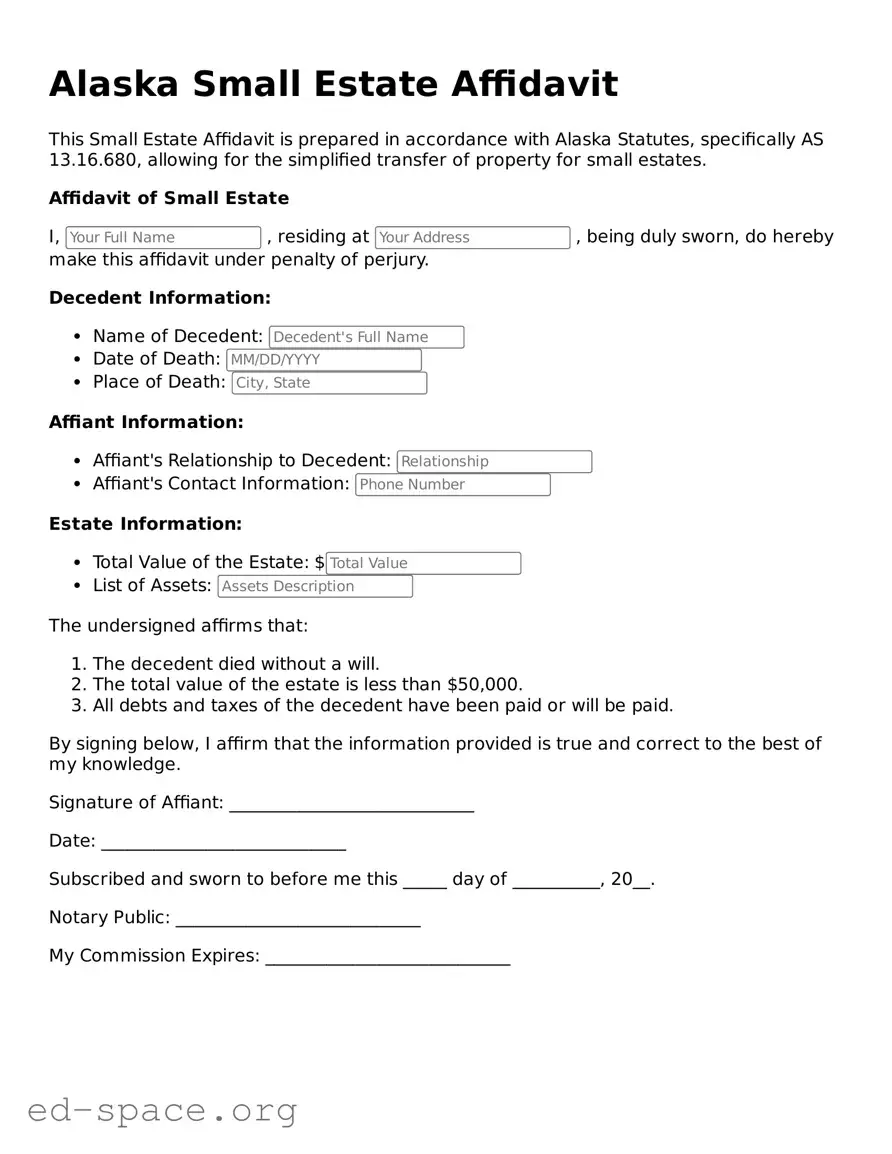
Alaska Small Estate Affidavit
This Small Estate Affidavit is prepared in accordance with Alaska Statutes, specifically AS 13.16.680, allowing for the simplified transfer of property for small estates.
Affidavit of Small Estate
I, , residing at , being duly sworn, do hereby make this affidavit under penalty of perjury.
Decedent Information:
Affiant Information:
Estate Information:
The undersigned affirms that:
By signing below, I affirm that the information provided is true and correct to the best of my knowledge.
Signature of Affiant: ____________________________
Date: ____________________________
Subscribed and sworn to before me this _____ day of __________, 20__.
Notary Public: ____________________________
My Commission Expires: ____________________________
| Fact Name | Description |
|---|---|
| Purpose | The Alaska Small Estate Affidavit is used to simplify the process of settling small estates without going through formal probate. |
| Eligibility | To use this affidavit, the total value of the estate must be less than $50,000, excluding certain assets. |
| Governing Law | The use of the Small Estate Affidavit in Alaska is governed by Alaska Statutes § 13.16.680. |
| Filing Requirements | The affidavit must be signed by the person claiming the estate and must include specific information about the deceased and their assets. |
| Asset Types | Real property, personal property, and bank accounts can be claimed using this affidavit, provided they meet the value limit. |
| Debts and Liabilities | Any debts or liabilities of the deceased must be addressed before distributing assets to heirs. |
| Heirs | The affidavit must list all heirs and their relationship to the deceased, ensuring proper distribution of the estate. |
| Notarization | The Small Estate Affidavit must be notarized to be considered valid, confirming the identity of the signer. |
| Timeframe | There is no specific timeframe in which the affidavit must be filed, but it should be done promptly to avoid complications. |
| Legal Advice | While the form simplifies the process, seeking legal advice is recommended to ensure compliance with state laws. |
After obtaining the Alaska Small Estate Affidavit form, the next steps involve carefully filling it out with the required information. This process ensures that the estate can be administered according to state law without going through a lengthy probate process.
What is an Alaska Small Estate Affidavit?
The Alaska Small Estate Affidavit is a legal document that allows individuals to claim the assets of a deceased person without going through the full probate process. This form is typically used when the total value of the estate is below a certain threshold, making it a simpler and more efficient option for settling small estates.
Who can use the Small Estate Affidavit in Alaska?
Any individual who is entitled to inherit from the deceased can use the Small Estate Affidavit. This includes heirs such as spouses, children, or other relatives. However, the total value of the estate must meet the criteria set by Alaska law to qualify for this process.
What is the value limit for using the Small Estate Affidavit?
As of the latest guidelines, the total value of the estate must not exceed $50,000, excluding certain types of property, such as real estate. It’s important to verify the current limit, as laws may change over time.
What assets are included in the Small Estate Affidavit?
The Small Estate Affidavit can include various types of assets, such as bank accounts, personal property, and vehicles. However, real estate is generally excluded from this process. Always check the specific requirements to ensure compliance.
How do I complete the Small Estate Affidavit?
To complete the Small Estate Affidavit, you must provide information about the deceased, the assets involved, and the heirs. The form requires signatures from the heirs affirming their entitlement to the estate. It is advisable to consult with an attorney to ensure accuracy and completeness.
Do I need to file the Small Estate Affidavit with the court?
In most cases, you do not need to file the Small Estate Affidavit with the court. Instead, you can present it directly to financial institutions or other entities holding the deceased's assets. However, retaining a copy for your records is recommended.
How long does the process take?
The process can be relatively quick, often taking just a few weeks. The time frame largely depends on how promptly you can gather the necessary information and documents. It is important to act diligently to ensure a smooth transition of assets.
Can I use the Small Estate Affidavit if there is a will?
Yes, you can still use the Small Estate Affidavit even if there is a will. However, the will must not name an executor, or the executor must be unable or unwilling to act. If the will is valid and the executor is available, the probate process may be more appropriate.
What if there are disputes among heirs?
If disputes arise among heirs, it may complicate the use of the Small Estate Affidavit. In such cases, it is advisable to seek legal counsel to navigate potential conflicts and determine the best course of action. Open communication among heirs can also help resolve issues amicably.
Failing to accurately identify the deceased. It is essential to provide the full name and date of death. Omitting any details can lead to delays or rejections.
Not listing all the assets. All assets owned by the deceased must be included in the affidavit. This includes bank accounts, real estate, and personal property. Leaving out even a small asset can complicate the process.
Incorrectly estimating the value of assets. Providing an accurate value is crucial. Underestimating or overestimating can affect eligibility for the small estate process.
Not signing the affidavit. It may seem simple, but forgetting to sign can invalidate the document. Ensure that all required signatures are present.
Failing to provide necessary identification. The form often requires identification for the affiant and sometimes for the deceased. Be prepared to attach copies of these documents.
Not understanding the eligibility criteria. Familiarize yourself with the requirements for small estates in Alaska. Misunderstanding these can lead to mistakes in filling out the form.
When dealing with the Alaska Small Estate Affidavit, it's essential to understand that several other forms and documents may accompany it. These documents help streamline the process of settling an estate and ensure that all legal requirements are met. Below is a list of commonly used forms that may be necessary in conjunction with the Small Estate Affidavit.
Having these documents ready can significantly simplify the process of settling an estate in Alaska. Each plays a vital role in ensuring that the estate is handled according to the law and the wishes of the deceased. By being prepared, you can navigate this challenging time with greater ease and confidence.
The Small Estate Affidavit is a useful tool for settling the estate of a deceased person without the need for formal probate. Several other documents serve similar purposes in estate management and can streamline the process of transferring assets. Here are six documents that share similarities with the Small Estate Affidavit:
When filling out the Alaska Small Estate Affidavit form, there are important things to keep in mind. Here are five do's and don'ts to consider:
When dealing with the Alaska Small Estate Affidavit, it's easy to encounter some misconceptions. Understanding the truth behind these myths can help streamline the process for those managing small estates. Here are nine common misconceptions:
This is not true. While it is often used for estates with minimal debts, the Small Estate Affidavit can still be applicable even if there are some outstanding debts, as long as the total value of the estate falls within the specified limits.
In reality, any person who is entitled to inherit from the deceased can file the affidavit. This includes friends or other beneficiaries named in the will, not just relatives.
This is a common misunderstanding. A will is a legal document that outlines how a person's assets should be distributed after their death, while the Small Estate Affidavit is a tool used to collect and distribute those assets without going through probate.
While having legal assistance can be beneficial, it is not a requirement. Many individuals successfully complete the affidavit on their own, provided they understand the process and requirements.
This is misleading. The affidavit is typically used for personal property and does not apply to real estate or certain types of financial accounts unless specific conditions are met.
This misconception overlooks the fact that Alaska has a specific limit on the value of the estate for which the Small Estate Affidavit can be used. If the estate exceeds this limit, probate is required.
While it may seem straightforward, the process can involve several steps, including gathering necessary documentation and ensuring all legal requirements are met, which can take time.
This is incorrect. Other interested parties can contest the affidavit if they believe it does not accurately reflect the deceased's wishes or the rightful heirs.
This is a misconception. While the Small Estate Affidavit can simplify the transfer of assets, it does not exempt the estate from any applicable taxes. Tax obligations still need to be addressed.
Understanding these misconceptions can help individuals navigate the Small Estate Affidavit process more effectively. Always consider seeking advice if unsure about any aspect of the process.
Filling out and using the Alaska Small Estate Affidavit form can simplify the process of settling a small estate. Here are some key takeaways to keep in mind:
By following these guidelines, you can navigate the process more smoothly and ensure that the estate is handled properly.