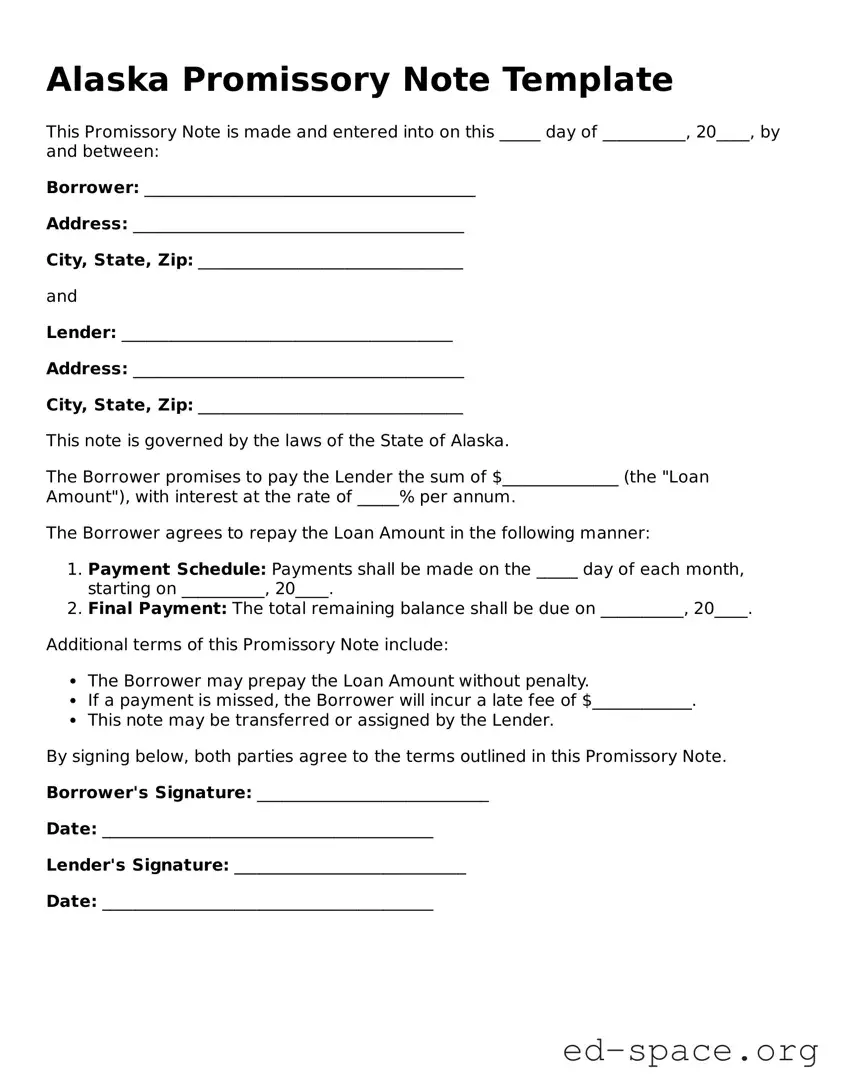
In the vast and diverse landscape of financial agreements, the Alaska Promissory Note stands out as a crucial tool for individuals and businesses alike. This legally binding document serves as a written promise from a borrower to repay a specified amount of money to a lender, under agreed-upon terms. Essential elements of the form include the principal amount, interest rate, payment schedule, and the duration of the loan, which collectively outline the obligations of the borrower. Additionally, it often includes provisions for late fees, default consequences, and the governing law, which in this case pertains to Alaska's regulations. By clearly delineating the rights and responsibilities of both parties, the Promissory Note helps to prevent misunderstandings and disputes, fostering a sense of trust and accountability. Understanding this form is vital for anyone looking to engage in lending or borrowing in Alaska, as it not only protects the interests of the lender but also provides the borrower with a clear framework for repayment.
Alaska Promissory Note Template
This Promissory Note is made and entered into on this _____ day of __________, 20____, by and between:
Borrower: ________________________________________
Address: ________________________________________
City, State, Zip: ________________________________
and
Lender: ________________________________________
Address: ________________________________________
City, State, Zip: ________________________________
This note is governed by the laws of the State of Alaska.
The Borrower promises to pay the Lender the sum of $______________ (the "Loan Amount"), with interest at the rate of _____% per annum.
The Borrower agrees to repay the Loan Amount in the following manner:
Additional terms of this Promissory Note include:
By signing below, both parties agree to the terms outlined in this Promissory Note.
Borrower's Signature: ____________________________
Date: ________________________________________
Lender's Signature: ____________________________
Date: ________________________________________
| Fact Name | Details |
|---|---|
| Definition | An Alaska Promissory Note is a written promise to pay a specified amount of money to a designated party at a specified time or on demand. |
| Governing Law | The Alaska Uniform Commercial Code (UCC) governs promissory notes in Alaska. |
| Parties Involved | The note involves two primary parties: the maker (borrower) and the payee (lender). |
| Interest Rate | The interest rate can be fixed or variable, and it must be clearly stated in the note. |
| Payment Terms | Payment terms should specify the due date, payment schedule, and any late fees if applicable. |
| Signatures | Both the maker and the payee must sign the promissory note for it to be legally binding. |
Once you have the Alaska Promissory Note form in hand, you'll need to fill it out carefully. Make sure to have all necessary information ready to ensure a smooth process.
After completing the form, make sure to keep a copy for your records. It’s important to have documentation of the agreement. If you have any questions, consider reaching out for further assistance.
What is a promissory note in Alaska?
A promissory note is a written promise to pay a specific amount of money to a designated person or entity at a specified time. In Alaska, as in other states, it serves as a legally binding contract between the borrower and the lender, detailing the terms of the loan, including interest rates and repayment schedules.
What information is required in an Alaska promissory note?
An Alaska promissory note should include the names and addresses of the borrower and lender, the principal amount, the interest rate, repayment terms, and the date of the agreement. It may also include provisions for late fees, prepayment penalties, and any collateral securing the loan.
Is a promissory note enforceable in Alaska?
Yes, a properly executed promissory note is enforceable in Alaska. To be enforceable, it must meet certain legal requirements, such as being in writing and signed by the borrower. If the borrower fails to repay, the lender can seek legal remedies to recover the owed amount.
Do I need to notarize a promissory note in Alaska?
Notarization is not required for a promissory note to be legally binding in Alaska. However, having the note notarized can provide an additional layer of security and may help in proving its authenticity in case of a dispute.
Can a promissory note be modified in Alaska?
Yes, a promissory note can be modified if both parties agree to the changes. It is advisable to document any modifications in writing and have both parties sign the revised agreement to avoid potential misunderstandings in the future.
What happens if the borrower defaults on the promissory note?
If the borrower defaults, the lender may pursue legal action to recover the owed amount. This could involve filing a lawsuit or seeking a judgment. The lender may also have the right to claim any collateral specified in the note, depending on the terms agreed upon.
Are there specific laws governing promissory notes in Alaska?
Yes, promissory notes in Alaska are governed by both state laws and the Uniform Commercial Code (UCC), which provides a framework for commercial transactions. It is important for both borrowers and lenders to be aware of these laws to ensure compliance and protect their rights.
Can a promissory note be used for personal loans?
Yes, promissory notes are commonly used for personal loans, including loans between family members or friends. They help clarify the terms of the loan and can prevent misunderstandings. It is still advisable to formalize the agreement in writing to ensure both parties are clear on their obligations.
Where can I find a template for an Alaska promissory note?
Templates for Alaska promissory notes can be found online through legal document services, or you may consult an attorney for a customized document. It is important to ensure that any template used complies with Alaska law and meets the specific needs of the transaction.
Not including all necessary details. Many people forget to fill in crucial information such as the date, the amount borrowed, and the names of both the borrower and lender. Omitting these details can lead to confusion later on.
Using unclear language. Some individuals write vague terms or conditions. It’s important to be clear about repayment terms, interest rates, and any penalties for late payments. Ambiguity can create disputes down the line.
Failing to sign the document. A promissory note is not legally binding unless it is signed by both parties. Forgetting to sign can render the document useless, leaving the lender without legal recourse.
Not having a witness or notary. While not always required, having a witness or notary can add an extra layer of legitimacy to the note. Many people overlook this step, which can be important in case of a dispute.
Ignoring state-specific requirements. Each state may have different laws regarding promissory notes. Failing to adhere to Alaska's specific requirements can lead to issues with enforceability.
Neglecting to keep copies. After filling out the form, it’s essential to keep a copy for personal records. Some forget this step, which can create problems if the terms of the note need to be referenced later.
When entering into a financial agreement, such as a loan, various forms and documents may accompany the Alaska Promissory Note. Each of these documents serves a specific purpose and helps clarify the terms of the agreement, ensuring both parties understand their rights and obligations. Below is a list of commonly used forms that often accompany a promissory note.
Understanding these accompanying documents can enhance your knowledge of financial agreements. Each plays a crucial role in ensuring clarity and protection for all parties involved in the lending process. When entering into a loan agreement, consider reviewing these documents carefully to safeguard your interests.
When filling out the Alaska Promissory Note form, it is important to follow certain guidelines to ensure accuracy and compliance. Below is a list of things you should and shouldn't do.
Things You Should Do:
Things You Shouldn't Do:
When it comes to the Alaska Promissory Note form, there are several misconceptions that can lead to confusion. Here are four common misunderstandings:
Many people believe that promissory notes are only necessary for significant amounts of money. In reality, they can be used for loans of any size. Even small personal loans can benefit from having a written agreement.
Some think that a verbal agreement is sufficient for a loan. However, having a written promissory note provides clear evidence of the terms and helps prevent disputes down the line.
This is a common misconception. Promissory notes can vary significantly based on state laws and specific terms. Using the correct form for Alaska ensures compliance with local regulations.
People often believe that a signed promissory note is set in stone. In fact, parties can agree to modify the terms, but any changes should be documented in writing to avoid future misunderstandings.
When filling out and using the Alaska Promissory Note form, it is essential to understand several key points. Here are ten important takeaways:
By following these guidelines, individuals can effectively use the Alaska Promissory Note form, ensuring clarity and protection for both the borrower and the lender.