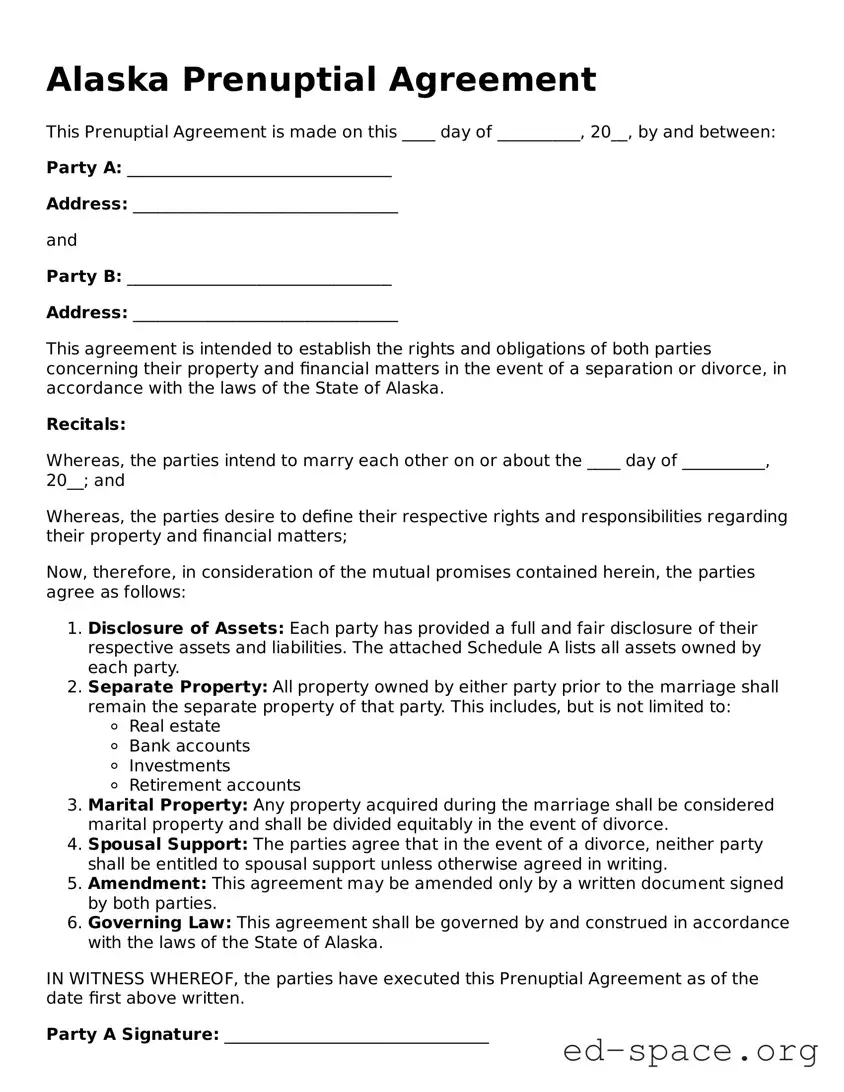
When couples in Alaska decide to marry, they often consider the importance of planning for their financial future. One tool that can help them navigate this aspect is the Alaska Prenuptial Agreement form. This document outlines how assets and debts will be handled in the event of a divorce or separation. It allows partners to define their individual property rights, ensuring that both parties have a clear understanding of their financial responsibilities. Additionally, the agreement can address issues such as spousal support and the division of property acquired during the marriage. By discussing these matters before tying the knot, couples can foster open communication and build a stronger foundation for their relationship. Understanding the details of the prenuptial agreement form is essential for anyone considering this proactive approach to marriage. It not only protects individual interests but also promotes transparency and trust between partners.
Alaska Prenuptial Agreement
This Prenuptial Agreement is made on this ____ day of __________, 20__, by and between:
Party A: ________________________________
Address: ________________________________
and
Party B: ________________________________
Address: ________________________________
This agreement is intended to establish the rights and obligations of both parties concerning their property and financial matters in the event of a separation or divorce, in accordance with the laws of the State of Alaska.
Recitals:
Whereas, the parties intend to marry each other on or about the ____ day of __________, 20__; and
Whereas, the parties desire to define their respective rights and responsibilities regarding their property and financial matters;
Now, therefore, in consideration of the mutual promises contained herein, the parties agree as follows:
IN WITNESS WHEREOF, the parties have executed this Prenuptial Agreement as of the date first above written.
Party A Signature: ________________________________
Date: ________________________________
Party B Signature: ________________________________
Date: ________________________________
Witness Signature: ________________________________
Date: ________________________________
Witness Signature: ________________________________
Date: ________________________________
| Fact Name | Description |
|---|---|
| Definition | An Alaska Prenuptial Agreement is a legal document that couples create before marriage to outline the division of assets and debts in the event of divorce or separation. |
| Governing Law | The agreement is governed by Alaska Statutes, specifically Title 25, Chapter 25. This law provides the framework for prenuptial agreements in the state. |
| Enforceability | For the agreement to be enforceable, both parties must voluntarily sign it, and it should be fair and reasonable at the time of execution. |
| Disclosure Requirement | Full financial disclosure is essential. Each party should provide a complete picture of their assets and liabilities to ensure fairness. |
| Modification | Couples can modify or revoke a prenuptial agreement at any time, but this must be done in writing and signed by both parties. |
Completing the Alaska Prenuptial Agreement form is an important step for couples planning to marry. This process ensures that both parties understand their rights and responsibilities regarding their assets and finances. Follow the steps below to fill out the form accurately.
What is a prenuptial agreement in Alaska?
A prenuptial agreement, often referred to as a "prenup," is a legal document that couples create before getting married. It outlines how assets and debts will be handled in the event of a divorce or separation. In Alaska, this agreement can cover various aspects, including property division, spousal support, and even debt responsibility. It serves to protect both parties and clarify expectations, promoting transparency in the marriage.
Why should I consider a prenuptial agreement?
Many couples opt for a prenuptial agreement to safeguard their individual assets and ensure that their financial rights are clearly defined. This can be particularly important for individuals entering a marriage with significant assets, business interests, or children from previous relationships. A prenup can help prevent potential conflicts and provide peace of mind, knowing that both parties have agreed on financial matters before marriage.
What can be included in an Alaska prenuptial agreement?
In Alaska, a prenuptial agreement can include a wide range of topics. Common inclusions are the division of property acquired during the marriage, management of existing debts, and provisions for spousal support. Additionally, couples may address inheritance rights, the handling of business interests, and even the financial responsibilities related to children from previous relationships. However, it's essential to note that certain topics, such as child custody and child support, cannot be predetermined in a prenup.
How do we create a prenuptial agreement in Alaska?
Creating a prenuptial agreement in Alaska involves several steps. First, both parties should openly discuss their financial situations and future goals. Next, it is advisable to consult with separate legal professionals to ensure that both parties fully understand their rights and the implications of the agreement. Once the terms are negotiated and agreed upon, the document should be drafted, signed, and notarized to ensure its legal validity.
Is a prenuptial agreement enforceable in Alaska?
Yes, a prenuptial agreement is enforceable in Alaska, provided it meets specific legal requirements. The agreement must be in writing and signed by both parties. Additionally, it should be entered into voluntarily, without coercion or duress. Full disclosure of assets and liabilities is also necessary to ensure fairness. If these conditions are met, the courts generally uphold the terms of the agreement during divorce proceedings.
Can a prenuptial agreement be modified or revoked in Alaska?
Yes, a prenuptial agreement can be modified or revoked in Alaska. Both parties must agree to any changes, and it is advisable to document these modifications in writing. A revocation can also be executed in writing, which should be signed by both parties. It is crucial to ensure that any alterations are made with the same level of formality as the original agreement to maintain their enforceability.
What happens if we do not have a prenuptial agreement?
If a couple does not have a prenuptial agreement and later divorces, Alaska's default laws regarding property division and spousal support will apply. This means that assets acquired during the marriage may be subject to equitable distribution, which does not necessarily mean equal division. Without a prenup, the court will determine how to divide property and debts, which may not align with either party's preferences.
Are there any restrictions on what can be included in a prenuptial agreement?
Yes, certain restrictions exist regarding what can be included in a prenuptial agreement in Alaska. For instance, agreements that involve illegal activities or that attempt to limit child support or custody arrangements are not enforceable. Additionally, any provisions that are deemed unconscionable or unfair at the time of enforcement may be challenged in court. It is essential to ensure that the agreement is reasonable and fair to both parties.
How much does it cost to create a prenuptial agreement in Alaska?
The cost of creating a prenuptial agreement in Alaska can vary widely based on several factors. Legal fees, which typically range from a few hundred to several thousand dollars, depend on the complexity of the agreement and the attorney's experience. Couples may also incur additional costs for consultations, drafting, and notarization. Investing in a well-crafted prenup can save both parties significant time and money in the event of a divorce.
Do we need lawyers to draft a prenuptial agreement?
While it is not legally required to have lawyers draft a prenuptial agreement in Alaska, it is highly recommended. Each party should have independent legal representation to ensure that their rights are protected and that they fully understand the implications of the agreement. Having legal counsel can help prevent misunderstandings and ensure that the prenup is fair, comprehensive, and enforceable.
Incomplete Information: One common mistake is not providing all necessary details. Ensure that both parties fully disclose their assets, debts, and income. Missing information can lead to disputes later.
Not Consulting Legal Professionals: Some individuals attempt to fill out the form without seeking legal advice. Consulting with an attorney can help clarify rights and obligations, ensuring that the agreement is fair and enforceable.
Failing to Update the Agreement: Life circumstances change. Failing to revisit and update the prenuptial agreement after significant life events, such as the birth of a child or changes in income, can render it outdated.
Ignoring State Laws: Each state has its own laws regarding prenuptial agreements. Not being aware of Alaska's specific requirements may lead to invalidation of the agreement.
Not Having Both Parties Sign: A prenuptial agreement must be signed by both parties to be valid. Forgetting to include one party’s signature can result in the agreement being unenforceable.
A prenuptial agreement is an important document for couples planning to marry. Alongside this agreement, several other forms and documents may be useful. Here is a list of some common documents that often accompany a prenuptial agreement in Alaska.
Understanding these documents can help couples navigate their financial and legal responsibilities more effectively. Each document serves a specific purpose and can contribute to a clearer understanding of rights and obligations within a marriage.
When preparing to fill out the Alaska Prenuptial Agreement form, it’s important to approach the process with care and attention to detail. Here are five things you should and shouldn’t do:
By following these guidelines, you can create a prenuptial agreement that protects both parties and reflects your mutual understanding.
When it comes to prenuptial agreements in Alaska, several misconceptions can lead to confusion. Understanding the truth behind these myths is essential for anyone considering a prenup. Here are five common misconceptions:
By debunking these misconceptions, couples can make informed decisions about prenuptial agreements and ensure their financial futures are protected.
When considering a prenuptial agreement in Alaska, it is essential to understand the key components and implications of the form. Below are important takeaways to keep in mind:
Understanding these points can help ensure that the prenuptial agreement serves its intended purpose and provides clarity for both parties.