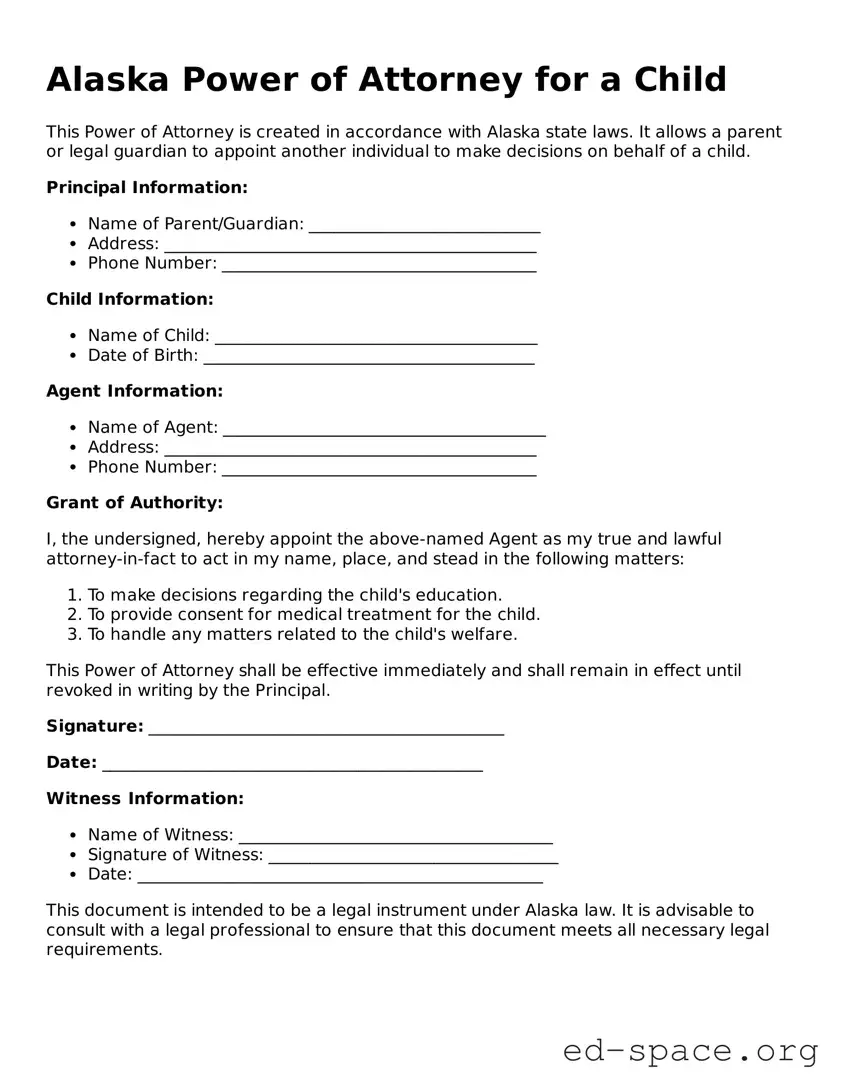
In the state of Alaska, the Power of Attorney for a Child form serves as a vital legal instrument that allows a parent or legal guardian to designate another individual to make decisions on behalf of their child. This form is particularly useful in situations where the parent may be temporarily unavailable due to travel, illness, or other circumstances. The designated individual, often referred to as the "agent," can be granted authority to handle a range of responsibilities, including medical decisions, educational matters, and day-to-day care. It is important to note that this power can be limited to specific tasks or can encompass broader responsibilities, depending on the needs of the child and the preferences of the parent. Additionally, the form requires the signature of the parent or guardian, as well as the agent, to ensure that all parties are in agreement with the arrangement. The Power of Attorney for a Child form is not only a practical solution for immediate caregiving needs but also offers peace of mind, knowing that the child's welfare is in capable hands during the parent's absence.
Alaska Power of Attorney for a Child
This Power of Attorney is created in accordance with Alaska state laws. It allows a parent or legal guardian to appoint another individual to make decisions on behalf of a child.
Principal Information:
Child Information:
Agent Information:
Grant of Authority:
I, the undersigned, hereby appoint the above-named Agent as my true and lawful attorney-in-fact to act in my name, place, and stead in the following matters:
This Power of Attorney shall be effective immediately and shall remain in effect until revoked in writing by the Principal.
Signature: ___________________________________________
Date: ______________________________________________
Witness Information:
This document is intended to be a legal instrument under Alaska law. It is advisable to consult with a legal professional to ensure that this document meets all necessary legal requirements.
| Fact Name | Description |
|---|---|
| Purpose | The Alaska Power of Attorney for a Child form allows a parent or legal guardian to grant temporary authority to another adult to make decisions on behalf of their child. |
| Duration | This power of attorney can be effective for a specified period, typically up to 12 months, unless revoked earlier. |
| Eligibility | Any adult can be appointed as an agent, provided they are trustworthy and capable of making decisions in the child's best interest. |
| Governing Law | The form is governed by Alaska Statutes, specifically AS 13.26.335, which outlines the authority and limitations of powers of attorney. |
| Revocation | A parent or guardian can revoke the power of attorney at any time by providing written notice to the agent and any relevant parties. |
| Healthcare Decisions | While the form can grant broad authority, it may not automatically include healthcare decision-making unless explicitly stated. |
| Notarization | To be legally binding, the form must be signed in the presence of a notary public, ensuring authenticity and validity. |
Filling out the Alaska Power of Attorney for a Child form is a straightforward process that allows you to designate someone to make decisions on behalf of your child when you are unable to do so. After completing the form, ensure that you keep a copy for your records and provide the designated individual with their own copy. This will help facilitate any necessary actions on behalf of your child.
What is a Power of Attorney for a Child in Alaska?
A Power of Attorney for a Child in Alaska is a legal document that allows a parent or legal guardian to grant authority to another adult to make decisions on behalf of their child. This can include decisions related to education, healthcare, and general welfare when the parent or guardian is unavailable.
Who can serve as an agent in this Power of Attorney?
Any responsible adult can serve as an agent. This may include relatives, family friends, or trusted neighbors. The key requirement is that the agent must be someone who can act in the best interest of the child.
What decisions can the agent make?
The agent can make various decisions regarding the child’s education, healthcare, and general welfare. However, the specific powers granted can be tailored to the needs of the child and the preferences of the parent or guardian.
How long does the Power of Attorney for a Child last?
The duration of the Power of Attorney can be specified in the document. It can be effective for a limited time or until revoked by the parent or guardian. If no end date is specified, it typically remains in effect until the child reaches the age of majority, which is 18 in Alaska.
Do I need to notarize the document?
Yes, in Alaska, the Power of Attorney for a Child must be signed in the presence of a notary public. This ensures that the document is legally binding and helps prevent any disputes regarding its authenticity.
Can I revoke the Power of Attorney?
Yes, you can revoke the Power of Attorney at any time. To do so, you must provide written notice to the agent and any relevant parties. It is advisable to document the revocation formally to avoid any confusion.
Is there a specific form I need to use?
While there is no official state form, it is recommended to use a well-drafted template that complies with Alaska laws. This ensures that all necessary elements are included and that the document is valid.
What should I do if I have more questions?
If you have further questions about the Power of Attorney for a Child, consider consulting with a legal professional. They can provide guidance tailored to your specific situation and help ensure that your document meets all legal requirements.
Not Specifying the Duration: One common mistake is failing to clearly define the duration of the power of attorney. Without specifying how long the authority lasts, it may lead to confusion or unintended consequences.
Omitting Important Details: Individuals often overlook the importance of including specific details about the child and the agent. Missing information, such as the child's full name or date of birth, can invalidate the document.
Not Signing or Dating the Document: A frequent oversight is neglecting to sign and date the form. Without a signature and date, the document may not be recognized as valid by schools or medical facilities.
Failing to Notify the Agent: Some people forget to inform the appointed agent about their responsibilities. Without proper communication, the agent may be unprepared to act when needed.
Ignoring State-Specific Requirements: Each state may have unique requirements for a power of attorney. Ignoring Alaska's specific rules, such as witness signatures or notarization, can render the document ineffective.
When creating a Power of Attorney for a Child in Alaska, there are several other documents that may be useful. These documents can help clarify roles, responsibilities, and ensure that the child's needs are met. Below is a list of commonly used forms that often accompany the Power of Attorney for a Child.
These documents work together to provide a comprehensive framework for the care and support of a child. By having these forms prepared, parents and guardians can ensure that the child's needs are met in various situations.
Filling out a Power of Attorney for a Child form in Alaska can be straightforward if you follow some essential guidelines. Here are six things you should and shouldn't do during the process:
Understanding the Alaska Power of Attorney for a Child form is crucial for parents and guardians. However, several misconceptions can lead to confusion. Below are six common misconceptions along with clarifications.
This form can be used by any parent or legal guardian who wishes to delegate authority to another individual, regardless of their ability to care for the child.
While legal assistance can be beneficial, it is not mandatory. The form is designed to be user-friendly and can be completed by parents or guardians on their own.
In fact, the Power of Attorney can be revoked at any time by the parent or guardian, as long as they are of sound mind.
This form does not transfer custody. It simply allows the designated individual to make decisions on behalf of the child in specific situations.
While the form is specific to Alaska, it may be recognized in other states, depending on local laws. It is advisable to check the regulations in the relevant state.
The Power of Attorney for a Child is intended for specific purposes, such as medical decisions or educational matters. Its scope should be clearly defined in the document.
Clarifying these misconceptions can help ensure that parents and guardians make informed decisions regarding the care and welfare of their children.
Filling out and using the Alaska Power of Attorney for a Child form can be a straightforward process, but it is essential to understand its implications and requirements. Here are some key takeaways: