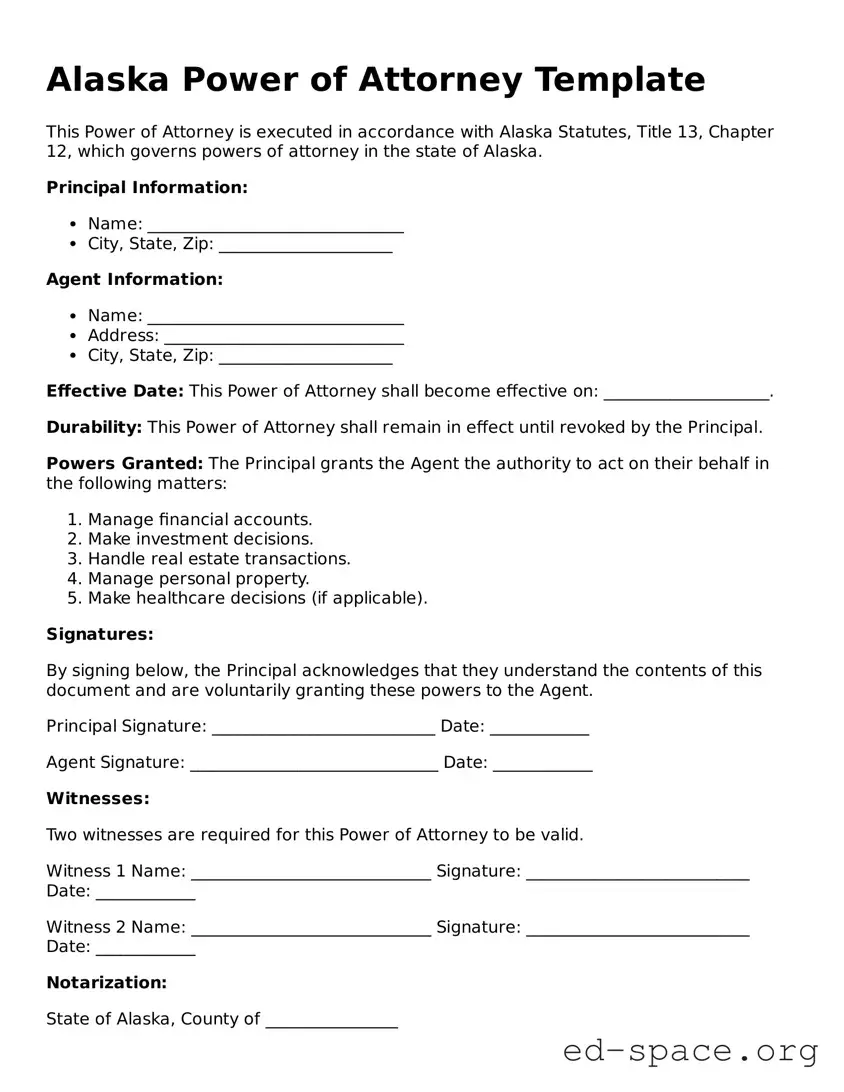
In Alaska, the Power of Attorney (POA) form serves as a crucial legal document that allows individuals to appoint someone else to make decisions on their behalf. This can be particularly important in situations where a person may become incapacitated or unable to handle their affairs. The form outlines the specific powers granted to the designated agent, which can include managing financial transactions, making healthcare decisions, or handling real estate matters. Importantly, Alaska recognizes both durable and non-durable POAs, giving individuals the flexibility to choose the type that best suits their needs. A durable POA remains effective even if the principal becomes incapacitated, while a non-durable POA is valid only during the principal's competency. Additionally, the form must be signed in the presence of a notary public to ensure its validity, providing an extra layer of protection for all parties involved. Understanding the nuances of the Alaska Power of Attorney form can empower individuals to make informed choices about their future and ensure that their wishes are respected, no matter the circumstances.
Alaska Power of Attorney Template
This Power of Attorney is executed in accordance with Alaska Statutes, Title 13, Chapter 12, which governs powers of attorney in the state of Alaska.
Principal Information:
Agent Information:
Effective Date: This Power of Attorney shall become effective on: ____________________.
Durability: This Power of Attorney shall remain in effect until revoked by the Principal.
Powers Granted: The Principal grants the Agent the authority to act on their behalf in the following matters:
Signatures:
By signing below, the Principal acknowledges that they understand the contents of this document and are voluntarily granting these powers to the Agent.
Principal Signature: ___________________________ Date: ____________
Agent Signature: ______________________________ Date: ____________
Witnesses:
Two witnesses are required for this Power of Attorney to be valid.
Witness 1 Name: _____________________________ Signature: ___________________________ Date: ____________
Witness 2 Name: _____________________________ Signature: ___________________________ Date: ____________
Notarization:
State of Alaska, County of ________________
Subscribed and sworn to before me this ____ day of ____________, 20__.
Notary Public Signature: ___________________________
My commission expires: ____________________________
| Fact Name | Details |
|---|---|
| Definition | The Alaska Power of Attorney form allows an individual to grant authority to another person to act on their behalf in legal and financial matters. |
| Governing Law | Alaska Statutes, Title 13, Chapter 12 governs the use of Power of Attorney in Alaska. |
| Types | There are several types of Power of Attorney, including General, Limited, and Durable Power of Attorney. |
| Durability | A Durable Power of Attorney remains effective even if the principal becomes incapacitated. |
| Requirements | The form must be signed by the principal and witnessed by two individuals or notarized. |
| Revocation | The principal can revoke the Power of Attorney at any time, provided they are competent to do so. |
| Agent's Duties | The agent must act in the principal's best interests and follow any specific instructions outlined in the document. |
| Limitations | The Power of Attorney cannot be used to make medical decisions unless specifically granted in the document. |
Filling out the Alaska Power of Attorney form is an important step in designating someone to act on your behalf in various matters. Once the form is completed, you will need to ensure that it is signed, witnessed, and possibly notarized, depending on your specific needs. This will help to ensure that your intentions are clear and legally binding.
What is a Power of Attorney in Alaska?
A Power of Attorney (POA) in Alaska is a legal document that allows one person (the principal) to authorize another person (the agent) to act on their behalf in legal or financial matters. This can include managing bank accounts, signing documents, or making healthcare decisions, depending on the type of POA established.
What types of Power of Attorney are available in Alaska?
In Alaska, there are several types of Power of Attorney: General, Limited, Durable, and Medical. A General POA grants broad authority to the agent, while a Limited POA restricts the agent's powers to specific tasks. A Durable POA remains effective even if the principal becomes incapacitated, whereas a Medical POA specifically allows the agent to make healthcare decisions for the principal.
How do I create a Power of Attorney in Alaska?
To create a Power of Attorney in Alaska, the principal must complete a form that specifies the powers granted to the agent. The document must be signed by the principal in the presence of a notary public or two witnesses. It is essential to ensure that the form complies with Alaska state laws to be considered valid.
Can I revoke a Power of Attorney in Alaska?
Yes, a Power of Attorney can be revoked at any time by the principal, as long as they are mentally competent. To revoke a POA, the principal should create a written revocation document and notify the agent and any institutions or individuals relying on the original POA.
What happens if the principal becomes incapacitated?
If the principal becomes incapacitated, a Durable Power of Attorney remains effective, allowing the agent to continue making decisions on behalf of the principal. However, if a non-durable POA was established, it would become invalid upon the principal's incapacitation.
Do I need a lawyer to create a Power of Attorney in Alaska?
While it is not legally required to have a lawyer to create a Power of Attorney in Alaska, consulting with one can be beneficial. A lawyer can help ensure that the document meets all legal requirements and accurately reflects the principal's intentions.
What are the responsibilities of an agent under a Power of Attorney?
The agent has a fiduciary duty to act in the best interests of the principal. This includes managing the principal's finances responsibly, keeping accurate records, and avoiding conflicts of interest. The agent must also follow the specific instructions outlined in the POA document.
Can a Power of Attorney be used for real estate transactions in Alaska?
Yes, a Power of Attorney can be used for real estate transactions in Alaska. The agent can sign documents related to buying, selling, or managing real estate on behalf of the principal. It is crucial to ensure that the POA grants the agent the authority to handle real estate matters specifically.
Is a Power of Attorney valid in other states if created in Alaska?
A Power of Attorney created in Alaska is generally valid in other states, but it is advisable to check the specific laws of the other state. Some states may have different requirements for POAs, so it may be necessary to have the document reviewed or re-executed in the new state.
What should I do if my agent is not acting in my best interest?
If an agent is not acting in the principal's best interest, the principal can revoke the Power of Attorney. If the principal is incapacitated, a court may be petitioned to remove the agent and appoint a guardian or conservator to act on the principal's behalf.
Not specifying the powers granted: People often forget to clearly outline what powers they are giving to the agent. This can lead to confusion and limit the agent's ability to act effectively.
Failing to date the document: Without a date, the validity of the Power of Attorney can be questioned. Always include the date when you sign the form.
Not having witnesses or notarization: In Alaska, some situations require the document to be witnessed or notarized. Skipping this step can invalidate the Power of Attorney.
Choosing the wrong agent: Selecting someone who is not trustworthy or capable can lead to problems. Take time to choose an agent who understands your wishes.
Leaving sections blank: Blank sections can create ambiguity. Fill out all relevant parts of the form to avoid misunderstandings.
Not reviewing the document after completion: Failing to double-check the form for errors or omissions can lead to complications later. Always review the entire document before finalizing.
When creating a Power of Attorney in Alaska, it is often beneficial to consider additional documents that can complement this legal instrument. These documents can help ensure that your wishes are clear and legally enforceable in various situations. Below is a list of commonly used forms and documents that may accompany the Alaska Power of Attorney form.
Each of these documents serves a unique purpose and can provide clarity and security in various legal situations. When combined with the Alaska Power of Attorney form, they create a comprehensive plan for managing both health and financial matters effectively.
The Power of Attorney (POA) form is a powerful legal document that allows one person to act on behalf of another in various matters. Several other documents share similarities with the POA, each serving specific purposes while empowering individuals to make decisions or manage affairs for someone else. Below are eight documents that are similar to the Power of Attorney, along with explanations of how they relate.
When filling out the Alaska Power of Attorney form, it’s important to approach the task with care. Here are some guidelines to help ensure that the process goes smoothly.
Understanding the Alaska Power of Attorney form is essential for making informed decisions regarding your legal affairs. However, several misconceptions can lead to confusion. Below are five common misunderstandings about this important document.
Many people believe that a Power of Attorney is solely for handling financial transactions. In reality, this document can also grant authority over health care decisions, legal matters, and other personal affairs. It can be tailored to meet specific needs.
It is a common belief that only licensed attorneys can serve as agents under a Power of Attorney. However, anyone you trust can be appointed, including family members or friends, as long as they are of legal age and capable of managing the responsibilities.
Some individuals think that once a Power of Attorney is established, it remains in effect indefinitely. This is not true. You can revoke or change the document at any time, as long as you are mentally competent to do so.
Another misconception is that the agent has unlimited power to make decisions on your behalf. In fact, you can specify the extent of the authority granted, including any limitations or conditions that you wish to impose.
Many believe that only seniors or those with health issues need a Power of Attorney. However, anyone, regardless of age or health status, can benefit from having this document in place. It provides peace of mind and ensures that your wishes are honored in case of unforeseen circumstances.
By addressing these misconceptions, individuals can better understand the importance and functionality of the Alaska Power of Attorney form. It serves as a vital tool for ensuring that your preferences are respected and that your affairs are managed according to your wishes.
Understanding the Alaska Power of Attorney form is crucial for anyone looking to manage their financial and legal affairs effectively. Here are some key takeaways to keep in mind:
By keeping these points in mind, you can navigate the process of creating and using a Power of Attorney in Alaska with greater confidence.