The Alaska Operating Agreement form plays a crucial role in the establishment and management of limited liability companies (LLCs) within the state. This document outlines the internal workings of an LLC, detailing how the business will operate, the rights and responsibilities of its members, and the procedures for decision-making. It typically includes information about capital contributions, profit distribution, and the process for admitting new members or handling the departure of existing ones. Additionally, the agreement may address how disputes will be resolved and the procedures for amending the agreement itself. By providing a clear framework for operations, the Alaska Operating Agreement helps to ensure that all members are on the same page, thereby minimizing potential conflicts and misunderstandings. Understanding the key components of this form is essential for anyone looking to form an LLC in Alaska, as it not only protects the interests of the members but also enhances the overall stability and credibility of the business.
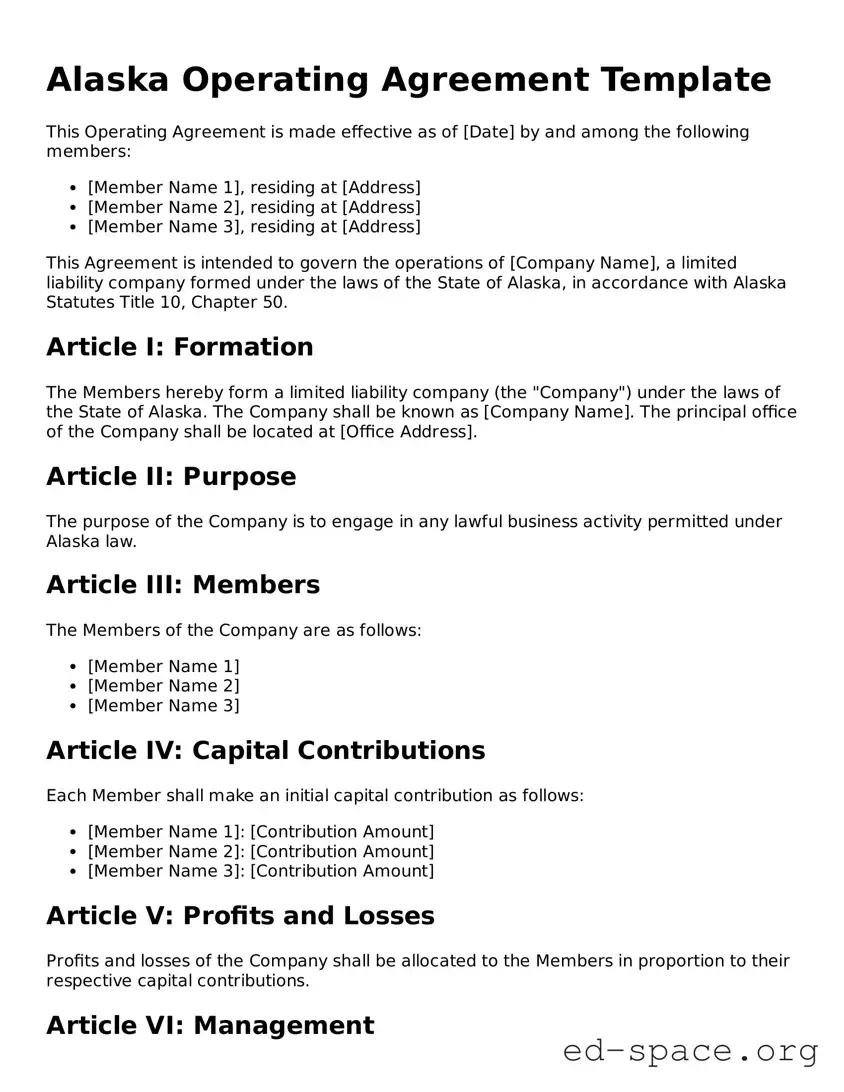
Alaska Operating Agreement Template
This Operating Agreement is made effective as of [Date] by and among the following members:
This Agreement is intended to govern the operations of [Company Name], a limited liability company formed under the laws of the State of Alaska, in accordance with Alaska Statutes Title 10, Chapter 50.
Article I: Formation
The Members hereby form a limited liability company (the "Company") under the laws of the State of Alaska. The Company shall be known as [Company Name]. The principal office of the Company shall be located at [Office Address].
Article II: Purpose
The purpose of the Company is to engage in any lawful business activity permitted under Alaska law.
Article III: Members
The Members of the Company are as follows:
Article IV: Capital Contributions
Each Member shall make an initial capital contribution as follows:
Article V: Profits and Losses
Profits and losses of the Company shall be allocated to the Members in proportion to their respective capital contributions.
Article VI: Management
The management of the Company shall be vested in the Members. Decisions shall be made by a majority vote of the Members, unless otherwise specified in this Agreement.
Article VII: Indemnification
The Company shall indemnify any Member or former Member for any act performed on behalf of the Company, except in cases of gross negligence or willful misconduct.
Article VIII: Amendments
This Operating Agreement may be amended only by a written agreement signed by all Members.
Article IX: Governing Law
This Agreement shall be governed by and construed in accordance with the laws of the State of Alaska.
IN WITNESS WHEREOF, the Members have executed this Operating Agreement as of the date first above written.
__________________________
[Member Name 1]
__________________________
[Member Name 2]
__________________________
[Member Name 3]
| Fact Name | Description |
|---|---|
| Purpose | The Alaska Operating Agreement form outlines the management structure and operational procedures for a limited liability company (LLC) in Alaska. |
| Governing Law | This form is governed by the Alaska Limited Liability Company Act, which provides the legal framework for LLCs in the state. |
| Members' Rights | The agreement specifies the rights and responsibilities of each member, ensuring clarity in ownership and management roles. |
| Amendments | Members can amend the operating agreement as needed, provided all parties agree to the changes. |
| Dispute Resolution | The form often includes provisions for resolving disputes among members, which can help avoid lengthy litigation. |
| Filing Requirements | While the operating agreement itself does not need to be filed with the state, it is crucial for internal governance and compliance. |
Filling out the Alaska Operating Agreement form is an important step in establishing your business. After completing the form, you will be able to proceed with the necessary steps to officially register your business and ensure compliance with state regulations.
What is an Alaska Operating Agreement?
An Alaska Operating Agreement is a legal document that outlines the management structure and operational procedures of a limited liability company (LLC) in Alaska. This agreement serves as a foundational framework for how the LLC will operate, detailing the rights and responsibilities of its members.
Who needs an Operating Agreement in Alaska?
While Alaska law does not require LLCs to have an Operating Agreement, it is highly recommended. This document helps clarify the roles of members, prevents misunderstandings, and provides a clear plan for decision-making processes, which is crucial for the smooth operation of the business.
What should be included in the Alaska Operating Agreement?
An effective Operating Agreement typically includes several key components. These may consist of the LLC's name and principal address, the purpose of the business, the management structure, member contributions, profit and loss distribution, and procedures for adding or removing members. Additionally, it should outline the process for resolving disputes and the procedure for dissolution of the LLC.
Can I modify the Operating Agreement after it is created?
Yes, the Operating Agreement can be amended. Members of the LLC must agree on any changes, and the process for amending the agreement should be clearly outlined within the document itself. This flexibility allows the LLC to adapt to changing business needs or member circumstances.
How does an Operating Agreement affect liability protection?
An Operating Agreement plays a crucial role in maintaining the liability protection offered by an LLC. By clearly defining the business's operations and member roles, it helps to establish the LLC as a separate legal entity. This separation is essential in protecting personal assets from business liabilities.
Is an Operating Agreement required to open a business bank account?
Many banks require an Operating Agreement to open a business bank account for an LLC. This document helps the bank understand the structure of the company and confirms that the individuals opening the account have the authority to do so. It is advisable to check with the specific bank for their requirements.
What happens if we do not have an Operating Agreement?
Without an Operating Agreement, the LLC will be governed by Alaska’s default laws regarding LLCs. These laws may not reflect the members' intentions or the specific needs of the business. This can lead to misunderstandings among members and potential legal disputes, as the default rules may not provide the flexibility or structure that a customized agreement would offer.
Can a single-member LLC have an Operating Agreement?
Yes, a single-member LLC can and should have an Operating Agreement. Even though there is only one member, having this document helps clarify the management structure and can provide additional legal protections. It is especially useful in establishing the LLC as a separate entity for liability purposes.
How can I create an Alaska Operating Agreement?
Creating an Alaska Operating Agreement can be done in several ways. Members can draft the agreement themselves using templates available online, or they can consult with a legal professional to ensure that all necessary provisions are included. It is essential to tailor the agreement to fit the specific needs of the LLC and its members.
Where should I keep the Operating Agreement?
The Operating Agreement should be kept in a safe and accessible location, such as a secure file cabinet or a digital storage system. All members should have access to it, as it is a critical document for the operation of the LLC. Regularly reviewing the agreement can also help ensure that it remains relevant and accurate.
Failing to include all members of the LLC. It is essential to list every member involved in the business. Omitting a member can lead to disputes and legal complications.
Not specifying the percentage of ownership. Each member should have their ownership percentage clearly stated. This clarity helps prevent misunderstandings regarding profit sharing and decision-making.
Neglecting to outline the management structure. The agreement should specify whether the LLC will be member-managed or manager-managed. This decision affects how the business operates on a day-to-day basis.
Overlooking the process for adding or removing members. It is important to include procedures for changes in membership. This can help avoid conflicts in the future.
Ignoring state-specific requirements. Each state may have different rules regarding LLC operating agreements. It is crucial to ensure compliance with Alaska's regulations to avoid potential issues.
Not having the agreement reviewed by a legal professional. While it may seem straightforward, having an attorney review the agreement can help identify potential pitfalls and ensure that all necessary elements are included.
The Alaska Operating Agreement is an essential document for LLCs, outlining the management structure and operational procedures. Along with this agreement, several other forms and documents are commonly used to ensure compliance and smooth operation of the business. Here is a list of these documents:
Utilizing these documents alongside the Alaska Operating Agreement helps maintain clarity and organization within the LLC. Proper documentation fosters effective communication and compliance with state regulations, contributing to the overall success of the business.
The Operating Agreement is a crucial document for limited liability companies (LLCs) that outlines the management structure and operational guidelines. Several other documents share similarities with the Operating Agreement in terms of purpose and function. Below is a list of nine such documents:
When filling out the Alaska Operating Agreement form, it's important to follow certain guidelines to ensure accuracy and compliance. Here’s a list of things to do and avoid:
Understanding the Alaska Operating Agreement form is crucial for anyone involved in business partnerships or limited liability companies (LLCs) in the state. However, several misconceptions often cloud its importance and functionality. Here’s a list of ten common misconceptions:
Addressing these misconceptions can empower business owners and members to create effective operating agreements that serve their interests and promote healthy business relationships.
When filling out and using the Alaska Operating Agreement form, it is essential to understand several key aspects to ensure compliance and effectiveness. Here are five important takeaways:
By keeping these takeaways in mind, you can effectively utilize the Alaska Operating Agreement form to establish a solid foundation for your business operations.