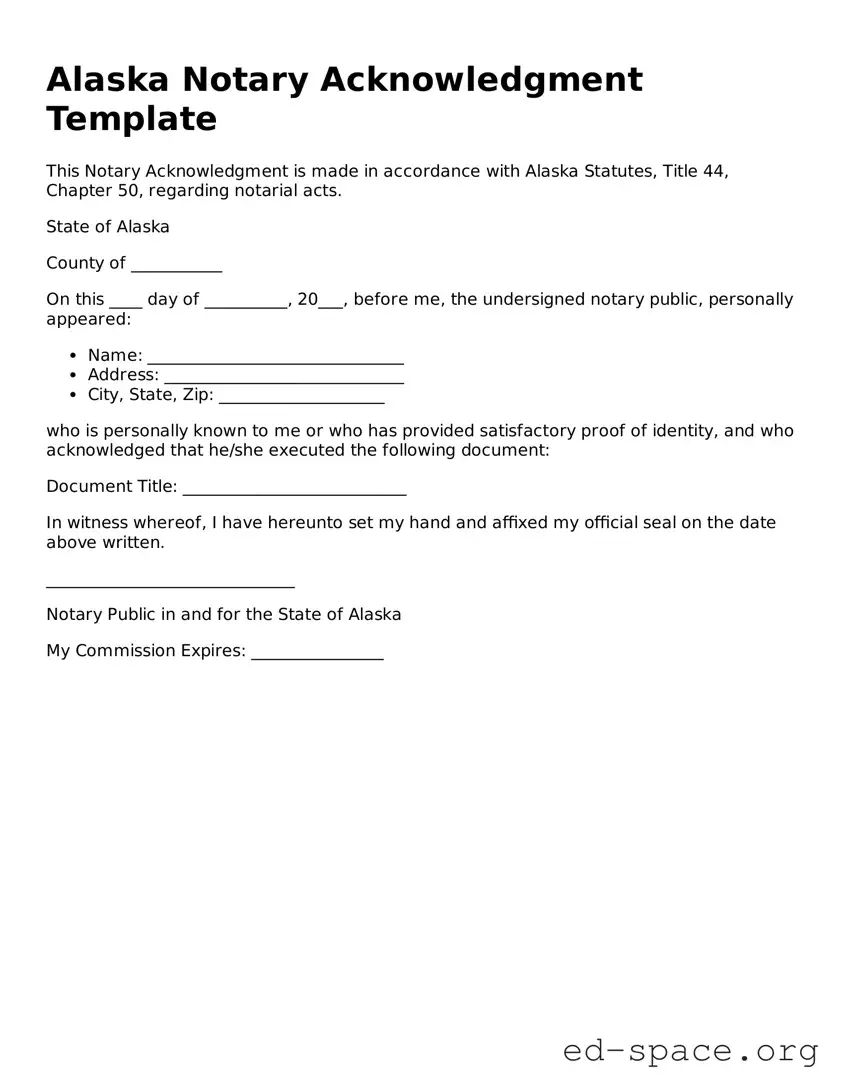
The Alaska Notary Acknowledgment form plays a vital role in the notarization process, providing a formal declaration that a person has willingly signed a document in the presence of a notary public. This form serves several important functions, including verifying the identity of the signer and ensuring that they understand the contents of the document being signed. It is commonly used for various legal documents, such as contracts, deeds, and affidavits, to enhance their authenticity and enforceability. The form typically includes essential information, such as the name of the signer, the date of the acknowledgment, and the notary's official seal. Understanding the significance of this form can help individuals navigate legal processes with greater confidence, ensuring that their documents are properly executed and recognized by the courts. By adhering to the requirements outlined in the Alaska Notary Acknowledgment form, individuals can protect their rights and interests in various legal matters.
Alaska Notary Acknowledgment Template
This Notary Acknowledgment is made in accordance with Alaska Statutes, Title 44, Chapter 50, regarding notarial acts.
State of Alaska
County of ___________
On this ____ day of __________, 20___, before me, the undersigned notary public, personally appeared:
who is personally known to me or who has provided satisfactory proof of identity, and who acknowledged that he/she executed the following document:
Document Title: ___________________________
In witness whereof, I have hereunto set my hand and affixed my official seal on the date above written.
______________________________
Notary Public in and for the State of Alaska
My Commission Expires: ________________
| Fact Name | Details |
|---|---|
| Purpose | The Alaska Notary Acknowledgment form is used to verify the identity of individuals signing a document and to confirm that they signed it willingly. |
| Governing Law | This form is governed by Alaska Statutes, specifically AS 44.50.040 and AS 44.50.050. |
| Required Information | The form must include the signer's name, the date of signing, and the notary's signature and seal. |
| Usage | It is commonly used in various legal documents, including deeds, contracts, and affidavits. |
After completing the Alaska Notary Acknowledgment form, you will need to submit it according to the requirements of your specific situation. Make sure to check any additional steps that may be necessary for your document to be fully processed.
What is the purpose of the Alaska Notary Acknowledgement form?
The Alaska Notary Acknowledgement form is used to verify the identity of a signer and confirm that they willingly signed a document. This form provides legal assurance that the signer is who they claim to be and that they understood the contents of the document before signing it. It is commonly used in various legal and financial transactions, such as real estate deals and contract agreements.
Who can act as a notary public in Alaska?
In Alaska, a notary public must be at least 18 years old, a resident of the state, and possess the ability to read and write in English. They must also complete the application process and obtain a notary commission from the state. Once commissioned, notaries are authorized to perform notarial acts, including acknowledgments, oaths, and affirmations.
What information is required on the Alaska Notary Acknowledgement form?
The form typically requires the name of the signer, the date of the acknowledgment, and a description of the document being signed. Additionally, the notary public will include their name, signature, and seal. This information ensures that the acknowledgment is properly documented and can be referenced in the future if needed.
Is the Alaska Notary Acknowledgement form mandatory for all documents?
No, the use of the Notary Acknowledgement form is not mandatory for all documents. However, many institutions and legal processes require notarization to ensure authenticity and prevent fraud. It is important to check the specific requirements for the type of document you are signing to determine if notarization is necessary.
How do I find a notary public in Alaska?
You can find a notary public in Alaska through various means. Many banks, law offices, and government offices offer notary services. Additionally, online directories and local business listings can help you locate a notary in your area. Always confirm that the notary is currently commissioned and in good standing before proceeding.
What should I bring when I meet with a notary public?
When meeting with a notary public, it is essential to bring a valid form of identification, such as a driver's license or passport, to verify your identity. You should also have the document that needs to be notarized ready for signing. If there are multiple signers, ensure that everyone is present and has their identification available.
Incorrect Date Entry: One common mistake is failing to enter the correct date. Notaries need to ensure that the date of the acknowledgment matches the date when the signer appeared before them. If the date is missing or incorrect, it can lead to complications down the line.
Missing Signatures: Sometimes, individuals forget to sign the form. The notary must witness the signature of the person whose document is being acknowledged. If the signature is absent, the acknowledgment is not valid.
Improper Identification: Notaries are required to verify the identity of the signer. Failing to provide adequate identification can invalidate the acknowledgment. It's essential to present a government-issued ID that includes a photo and signature.
Inaccurate Notary Information: The notary must fill in their own information accurately. This includes their name, commission number, and expiration date. Any errors in this section can lead to questions about the authenticity of the acknowledgment.
The Alaska Notary Acknowledgement form serves as a crucial document in verifying the authenticity of signatures on various legal instruments. When engaging in transactions that require notarization, several other forms and documents often accompany this acknowledgment to ensure compliance and clarity. Below are five commonly used forms that are frequently associated with the Alaska Notary Acknowledgement form.
Understanding these associated documents can facilitate smoother transactions and ensure that all legal requirements are met. Proper notarization plays a vital role in maintaining the integrity of these documents and the agreements they represent.
The Notary Acknowledgment form serves a specific purpose in legal transactions, particularly in verifying the identity of signers and the authenticity of their signatures. Several other documents share similarities with the Notary Acknowledgment form in terms of their function and use. Here’s a list of seven such documents:
Each of these documents plays a crucial role in ensuring the integrity of legal transactions. Their similarities with the Notary Acknowledgment form highlight the importance of notarization in safeguarding against fraud and ensuring that all parties are properly identified.
When filling out the Alaska Notary Acknowledgement form, it is important to follow certain guidelines to ensure the document is completed correctly. Here are four things to do and four things to avoid:
Understanding the Alaska Notary Acknowledgement form is crucial for anyone involved in legal documentation. However, several misconceptions can lead to confusion. Here are ten common misunderstandings:
Being aware of these misconceptions can help individuals navigate the notarization process more effectively. Always consult with a qualified professional if there are any uncertainties regarding the requirements or procedures involved.
Filling out and using the Alaska Notary Acknowledgement form is a crucial process for ensuring the validity of various documents. Here are some key takeaways to keep in mind:
By following these guidelines, you can ensure that the Alaska Notary Acknowledgement form is filled out correctly and serves its intended purpose effectively.