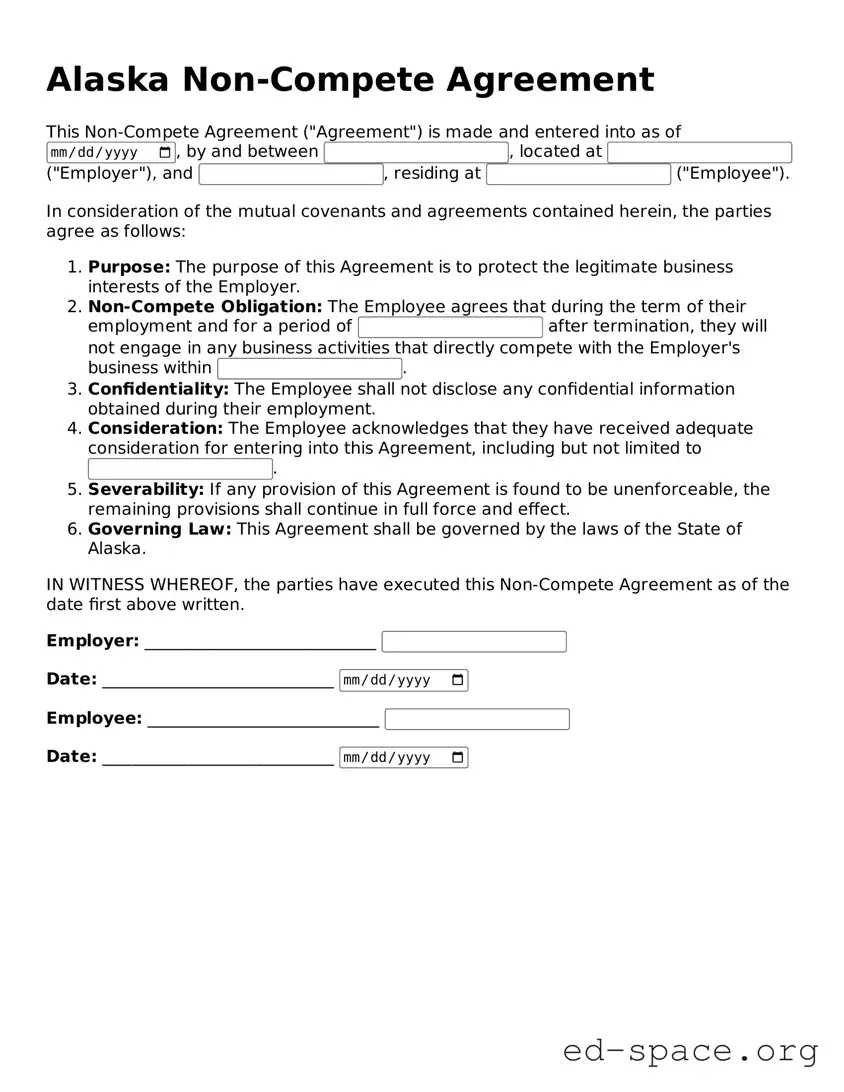
In Alaska, the Non-compete Agreement form serves as a crucial tool for employers looking to protect their business interests while also outlining the boundaries for employees after their tenure. This form typically includes essential elements such as the duration of the non-compete period, the geographical scope of the restrictions, and the specific activities that are prohibited. By clearly defining these parameters, the agreement aims to prevent employees from using confidential information or trade secrets to benefit competitors. Additionally, the form may address the consequences of violating the agreement, ensuring that both parties understand their rights and obligations. It's important for employers to draft this document carefully, as overly restrictive terms may not hold up in court. At the same time, employees should be aware of what they are signing, as these agreements can significantly impact their future job opportunities. Understanding the nuances of the Alaska Non-compete Agreement is essential for both employers and employees navigating the professional landscape.
Alaska Non-Compete Agreement
This Non-Compete Agreement ("Agreement") is made and entered into as of , by and between , located at ("Employer"), and , residing at ("Employee").
In consideration of the mutual covenants and agreements contained herein, the parties agree as follows:
IN WITNESS WHEREOF, the parties have executed this Non-Compete Agreement as of the date first above written.
Employer: ____________________________
Date: ____________________________
Employee: ____________________________
Date: ____________________________
| Fact Name | Description |
|---|---|
| Definition | An Alaska Non-compete Agreement restricts an employee from working for competitors after leaving a job. |
| Governing Law | The agreement is governed by Alaska Statutes, specifically AS 45.50.645. |
| Enforceability | Non-compete agreements in Alaska are enforceable only if they are reasonable in scope and duration. |
| Duration | Agreements typically should not exceed two years to be considered reasonable. |
| Geographic Scope | The geographic area covered by the agreement must be clearly defined and reasonable. |
| Consideration | There must be valid consideration, such as a job offer or promotion, for the agreement to be enforceable. |
| Industry Restrictions | Certain industries may have specific regulations regarding non-compete agreements. |
| Employee Rights | Employees have the right to negotiate the terms of the non-compete agreement. |
| Legal Review | It is advisable for both parties to seek legal advice before signing the agreement. |
| Judicial Scrutiny | Alaska courts will closely examine non-compete agreements to ensure they protect legitimate business interests. |
Completing the Alaska Non-compete Agreement form is an important step in ensuring that both parties understand their rights and responsibilities. After filling out the form, it will be necessary to review the document carefully before signing. This ensures that all information is accurate and that both parties are in agreement with the terms laid out.
What is a Non-compete Agreement in Alaska?
A Non-compete Agreement is a contract between an employer and an employee. It restricts the employee from working for competitors or starting a competing business for a specified period after leaving the company. In Alaska, these agreements must be reasonable in scope, duration, and geographic area to be enforceable.
Are Non-compete Agreements enforceable in Alaska?
Yes, Non-compete Agreements can be enforceable in Alaska, but they must meet certain criteria. The agreement must protect legitimate business interests, such as trade secrets or client relationships. Additionally, the restrictions should not impose an undue hardship on the employee or be contrary to public policy.
How long can a Non-compete Agreement last in Alaska?
The duration of a Non-compete Agreement in Alaska should be reasonable. Typically, agreements lasting one to two years are more likely to be upheld in court. However, the specific circumstances of each case can affect this duration, so it’s essential to tailor the agreement accordingly.
What should be included in a Non-compete Agreement?
A Non-compete Agreement should clearly outline the scope of the restrictions, including the specific activities prohibited, the duration of the agreement, and the geographic area covered. It’s also important to define what constitutes a competitor and any exceptions that may apply.
Can I negotiate the terms of a Non-compete Agreement?
Yes, you can negotiate the terms of a Non-compete Agreement. It’s advisable to discuss any concerns or desired changes with your employer before signing. Negotiating can lead to a more balanced agreement that protects both the employer's interests and your future career opportunities.
Not Understanding the Terms: Many individuals rush through the form without fully comprehending the implications of the agreement. It's crucial to grasp how a non-compete agreement affects future employment opportunities.
Failing to Specify Duration: The duration of the non-compete clause can significantly impact its enforceability. Leaving this section vague or incomplete may lead to misunderstandings later on.
Ignoring Geographic Limitations: A common oversight is neglecting to define the geographic scope of the non-compete. Without clear boundaries, the agreement may become overly broad, making it harder to enforce.
Not Including Consideration: A non-compete agreement must offer something in return for the restrictions imposed. Failing to mention this consideration can render the agreement unenforceable.
Overlooking State-Specific Laws: Each state has its own rules regarding non-compete agreements. Ignoring Alaska's specific legal standards can lead to invalidation of the agreement.
Rushing the Signing Process: Signing the agreement without taking the time to review it thoroughly can lead to regret. Individuals should always read the document carefully and consider seeking advice before signing.
When preparing a Non-compete Agreement in Alaska, several other forms and documents may be beneficial to ensure clarity and legal compliance. Each of these documents serves a specific purpose in the context of employment and contractual relationships.
Utilizing these documents alongside the Non-compete Agreement can provide a comprehensive framework for both employers and employees. Each document contributes to a clear understanding of rights and responsibilities, helping to foster a professional relationship.
A Non-compete Agreement is a legal document that restricts an individual from engaging in business activities that compete with their employer after leaving the company. Several other documents share similarities with this agreement in terms of purpose and function. Below are five such documents:
When filling out the Alaska Non-compete Agreement form, it is important to approach the process with care. Below are five recommendations that can help ensure the form is completed accurately and effectively.
Following these guidelines can help protect your rights and interests when entering into a non-compete agreement in Alaska.
Non-compete agreements can often be misunderstood, especially in a unique state like Alaska. Here are seven common misconceptions about the Alaska Non-compete Agreement form:
Many people believe that all non-compete agreements hold up in court. In Alaska, like in many states, these agreements must meet certain criteria to be enforceable. If they are overly broad or unreasonable, a court may refuse to enforce them.
Some think that only high-level employees need to sign non-compete agreements. However, any employee who has access to sensitive information or trade secrets may be subject to such agreements, regardless of their position.
This is not entirely true. While a non-compete may restrict you from working for a specific competitor or in a certain area for a limited time, it does not ban you from your profession entirely. The restrictions should be reasonable and specific.
These two types of agreements serve different purposes. A non-compete agreement prevents you from working with competitors, while a non-disclosure agreement protects confidential information. Understanding this distinction is crucial.
Non-compete agreements can vary significantly in terms of scope, duration, and geographical limitations. Each agreement should be tailored to the specific situation and needs of the employer and employee.
In Alaska, employers typically need to provide consideration, such as a job offer or a raise, in exchange for signing a non-compete agreement. Simply presenting one without any benefit may not hold up legally.
This is a misconception. Non-compete agreements can be renegotiated or amended if both parties agree to the changes. Communication is key in these situations.
When considering a non-compete agreement in Alaska, it is essential to understand the implications and requirements of the form. Here are some key takeaways to keep in mind:
Understanding these key aspects can help both employers and employees navigate the complexities of non-compete agreements in Alaska more effectively.