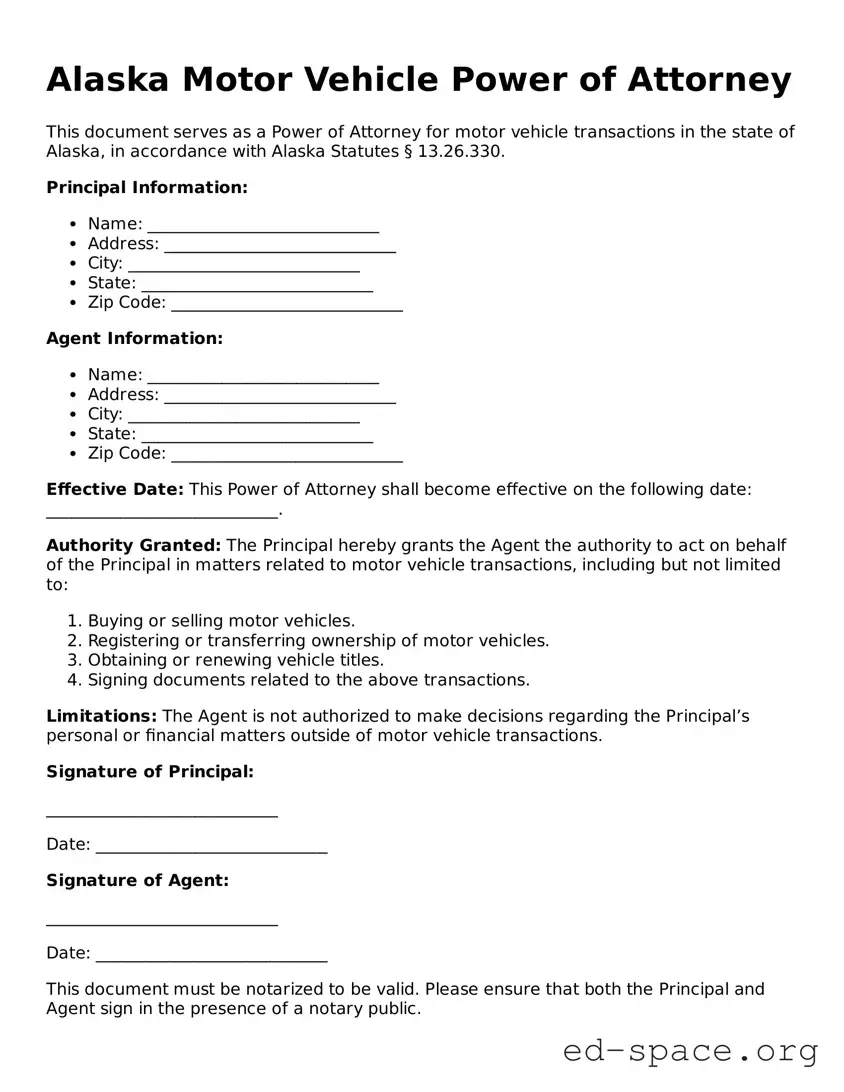
The Alaska Motor Vehicle Power of Attorney form serves as a crucial legal document that allows an individual, referred to as the principal, to designate another person, known as the agent, to act on their behalf concerning motor vehicle transactions. This form is particularly important for those who may be unable to attend to their vehicle-related matters due to various reasons, such as being out of state or having health issues. The agent gains the authority to perform tasks like signing titles, transferring ownership, and handling registration processes. By clearly outlining the powers granted to the agent, the form helps ensure that the principal's interests are protected while facilitating smoother transactions. It is essential for both the principal and the agent to understand the responsibilities and limitations outlined in the document, as well as the legal implications of the authority being granted. Proper completion and notarization of the form are necessary steps to ensure its validity, thereby providing peace of mind for all parties involved.
Alaska Motor Vehicle Power of Attorney
This document serves as a Power of Attorney for motor vehicle transactions in the state of Alaska, in accordance with Alaska Statutes § 13.26.330.
Principal Information:
Agent Information:
Effective Date: This Power of Attorney shall become effective on the following date: ____________________________.
Authority Granted: The Principal hereby grants the Agent the authority to act on behalf of the Principal in matters related to motor vehicle transactions, including but not limited to:
Limitations: The Agent is not authorized to make decisions regarding the Principal’s personal or financial matters outside of motor vehicle transactions.
Signature of Principal:
____________________________
Date: ____________________________
Signature of Agent:
____________________________
Date: ____________________________
This document must be notarized to be valid. Please ensure that both the Principal and Agent sign in the presence of a notary public.
| Fact Name | Description |
|---|---|
| Purpose | The Alaska Motor Vehicle Power of Attorney form allows an individual to designate another person to handle motor vehicle transactions on their behalf. |
| Governing Law | This form is governed by Alaska Statutes, specifically AS 13.26.330. |
| Signature Requirements | The form must be signed by the principal (the person granting authority) and may require notarization to be valid. |
| Revocation | The power of attorney can be revoked at any time by the principal, provided the revocation is in writing. |
After obtaining the Alaska Motor Vehicle Power of Attorney form, it’s essential to complete it accurately to ensure proper authorization. Follow these steps carefully to fill out the form correctly.
Once you have completed the form, review it for any errors or omissions before submitting it to the appropriate authorities.
What is the Alaska Motor Vehicle Power of Attorney form?
The Alaska Motor Vehicle Power of Attorney form is a legal document that allows one person to authorize another individual to act on their behalf regarding motor vehicle matters. This can include tasks such as transferring ownership, registering a vehicle, or handling any related transactions with the Alaska Division of Motor Vehicles (DMV).
Who can be designated as an attorney-in-fact?
Any adult individual can be designated as an attorney-in-fact in the Alaska Motor Vehicle Power of Attorney form. This person should be someone you trust to handle your vehicle-related matters responsibly. It could be a family member, friend, or even a professional service, as long as they are legally capable of performing the tasks assigned to them.
Do I need to have the form notarized?
Yes, the Alaska Motor Vehicle Power of Attorney form typically needs to be notarized to be considered valid. Notarization helps to verify the identities of the parties involved and ensures that the document was signed willingly and without coercion. It adds an extra layer of protection for both the principal and the attorney-in-fact.
What powers can I grant to my attorney-in-fact?
You can grant a variety of powers to your attorney-in-fact regarding your motor vehicle. This may include the ability to sell or transfer ownership of the vehicle, register the vehicle, obtain or renew license plates, and handle any other necessary paperwork with the DMV. It’s important to be clear about what powers you are granting to avoid any misunderstandings.
Can I revoke the Power of Attorney once it is established?
Yes, you can revoke the Power of Attorney at any time as long as you are mentally competent to do so. To revoke it, you should complete a revocation form and notify your attorney-in-fact and any relevant parties, such as the DMV. It’s advisable to keep a copy of the revocation for your records.
Is there a specific format for the Alaska Motor Vehicle Power of Attorney form?
While there may not be a strict template, the form should clearly state your intentions, identify both you and your attorney-in-fact, and detail the specific powers you are granting. It’s a good idea to follow any guidelines provided by the Alaska DMV to ensure that the form meets all necessary requirements.
What should I do if my attorney-in-fact cannot fulfill their duties?
If your attorney-in-fact is unable to perform their duties, you have a couple of options. You can either revoke the existing Power of Attorney and appoint a new attorney-in-fact or, if the situation allows, you can have a conversation with the current attorney-in-fact to see if they can still fulfill their responsibilities. Communication is key in these situations.
Where can I obtain the Alaska Motor Vehicle Power of Attorney form?
The Alaska Motor Vehicle Power of Attorney form can typically be obtained from the Alaska Division of Motor Vehicles website or their local offices. Additionally, many legal stationery stores or online legal document services may offer this form. Always ensure you are using the most current version of the form to avoid any issues.
Not including all required information: It’s crucial to provide complete details about both the principal and the agent. Missing names, addresses, or signatures can render the form invalid.
Using incorrect dates: Ensure that all dates are accurate and reflect the current year. An outdated date can lead to complications when the form is presented.
Failing to specify the powers granted: Clearly outline what powers the agent will have. Vague descriptions can lead to misunderstandings about the authority being granted.
Not signing the form: Both the principal and the agent must sign the document. Without these signatures, the form will not be legally binding.
Neglecting to have the form notarized: In Alaska, notarization may be required for the document to be valid. Always check local requirements to ensure compliance.
Overlooking state-specific requirements: Each state may have unique rules regarding Power of Attorney forms. Familiarize yourself with Alaska’s specific requirements to avoid issues.
The Alaska Motor Vehicle Power of Attorney form allows one person to grant another the authority to handle vehicle-related matters on their behalf. When using this form, there are several other documents that may be relevant. Below is a list of additional forms and documents that are often used in conjunction with the Power of Attorney.
These documents can help facilitate various transactions related to vehicle ownership and management. It is advisable to ensure that all necessary forms are completed accurately to avoid any issues in the future.
The Motor Vehicle Power of Attorney (POA) form allows you to designate someone else to handle specific tasks related to your vehicle on your behalf. This document shares similarities with several other legal forms, each serving a unique purpose while empowering individuals to delegate authority. Here’s a list of ten documents that resemble the Motor Vehicle Power of Attorney form:
Understanding these documents can help you navigate the process of delegating authority effectively, ensuring that your interests are protected in various aspects of your life.
When filling out the Alaska Motor Vehicle Power of Attorney form, it's important to follow certain guidelines to ensure the process goes smoothly. Here are six things to consider:
By adhering to these guidelines, you can help ensure that the Power of Attorney is executed correctly and serves its intended purpose.
When dealing with the Alaska Motor Vehicle Power of Attorney form, several misconceptions can lead to confusion. Here are four common misunderstandings:
Many people think this form is limited to transferring ownership during a sale. In reality, it can also grant authority for tasks like registration, titling, and even handling insurance matters.
While legal assistance can be helpful, it’s not necessary. Individuals can complete the form on their own as long as they provide the required information accurately.
Some believe that notarization is a must for this form. However, in Alaska, notarization is not required for the Power of Attorney to be effective, though it may be beneficial in certain situations.
This form does not have a built-in expiration date. It remains valid until the principal revokes it or the specific task it was created for is completed.
When dealing with the Alaska Motor Vehicle Power of Attorney form, it’s important to understand its key elements. Here are seven essential takeaways:
Understanding these points will help ensure that your use of the Alaska Motor Vehicle Power of Attorney form is effective and legally sound.