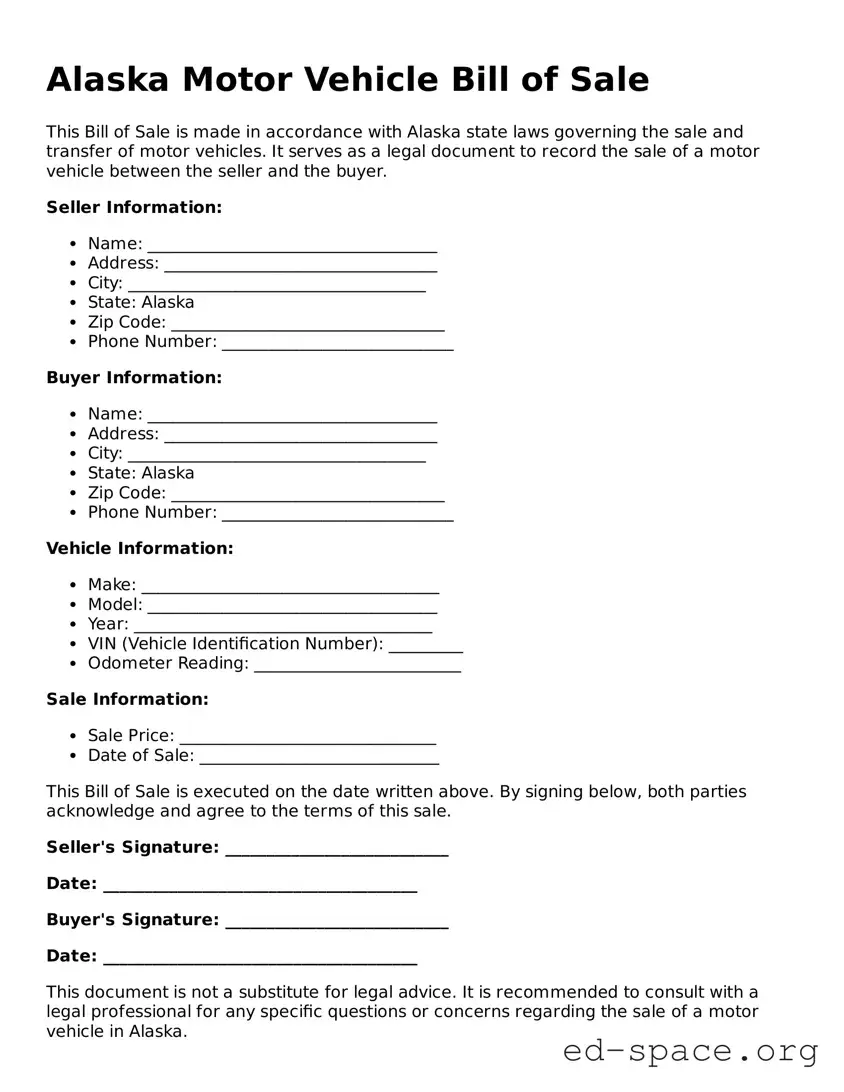
The Alaska Motor Vehicle Bill of Sale form serves as a crucial document in the process of transferring ownership of a vehicle within the state. This form captures essential information about the buyer and seller, including their names, addresses, and signatures, ensuring that both parties are clearly identified in the transaction. It also details the vehicle's specifics, such as the make, model, year, and Vehicle Identification Number (VIN), which are vital for accurate record-keeping and future reference. The form typically includes the sale price, providing a clear understanding of the transaction's financial aspects. Additionally, it may contain sections for odometer disclosure, which helps to protect buyers from potential fraud related to vehicle mileage. Properly completing this form not only facilitates a smooth transfer of ownership but also serves as a legal record that can be referenced in the event of disputes or future sales. Understanding the significance and requirements of the Alaska Motor Vehicle Bill of Sale is essential for anyone involved in buying or selling a vehicle in the state.
Alaska Motor Vehicle Bill of Sale
This Bill of Sale is made in accordance with Alaska state laws governing the sale and transfer of motor vehicles. It serves as a legal document to record the sale of a motor vehicle between the seller and the buyer.
Seller Information:
Buyer Information:
Vehicle Information:
Sale Information:
This Bill of Sale is executed on the date written above. By signing below, both parties acknowledge and agree to the terms of this sale.
Seller's Signature: ___________________________
Date: ______________________________________
Buyer's Signature: ___________________________
Date: ______________________________________
This document is not a substitute for legal advice. It is recommended to consult with a legal professional for any specific questions or concerns regarding the sale of a motor vehicle in Alaska.
| Fact Name | Description |
|---|---|
| Purpose | The Alaska Motor Vehicle Bill of Sale form is used to document the sale of a motor vehicle between a buyer and a seller. |
| Governing Law | This form is governed by Alaska Statutes, specifically AS 45.29.101-103. |
| Required Information | It requires details such as the vehicle's make, model, year, VIN, and the sale price. |
| Signatures | Both the buyer and seller must sign the form to validate the transaction. |
| Notarization | Notarization is not required but is recommended for added legal protection. |
| Transfer of Ownership | The form serves as proof of ownership transfer for the vehicle. |
| Record Keeping | Both parties should keep a copy of the completed form for their records. |
| Usage Beyond Sales | This form can also be used for gifting a vehicle or transferring ownership in other scenarios. |
| Filing with DMV | While the form itself is not filed with the DMV, it may be required for vehicle registration by the new owner. |
| Availability | The Alaska Motor Vehicle Bill of Sale form can be obtained online or at local DMV offices. |
Once you have obtained the Alaska Motor Vehicle Bill of Sale form, you will need to provide specific information about the vehicle and the transaction. This document serves as a record of the sale and is important for both the buyer and seller.
After completing the form, both parties should keep a copy for their records. This document will be essential for registering the vehicle and ensuring a smooth transfer of ownership.
What is the purpose of the Alaska Motor Vehicle Bill of Sale form?
The Alaska Motor Vehicle Bill of Sale form serves as a legal document that records the sale of a motor vehicle between a buyer and a seller. It provides essential details about the transaction, including the vehicle's identification, the sale price, and the parties involved. This form is important for both parties, as it can help establish ownership and protect against future disputes.
Who needs to complete the Bill of Sale?
Both the buyer and the seller of the vehicle need to complete the Bill of Sale. The seller must provide accurate information about the vehicle and confirm the sale, while the buyer should ensure that the details match the vehicle they are purchasing. Completing this form is a critical step in the vehicle transfer process.
What information is required on the Bill of Sale?
The Bill of Sale typically requires several key pieces of information. This includes the names and addresses of both the buyer and the seller, the vehicle's make, model, year, and Vehicle Identification Number (VIN). Additionally, the sale price and the date of the transaction should be included. Some forms may also request the odometer reading at the time of sale.
Is the Bill of Sale required for all vehicle sales in Alaska?
While it is not legally required to have a Bill of Sale for every vehicle sale in Alaska, it is highly recommended. Having this document can provide valuable proof of the transaction and can simplify the process of transferring ownership with the Alaska Division of Motor Vehicles. It may also be required by some lenders or insurance companies.
Can the Bill of Sale be used for gifting a vehicle?
Yes, the Bill of Sale can also be used for gifting a vehicle. In such cases, the sale price can be indicated as "gift" or a nominal amount. It is still advisable to complete the form to document the transfer of ownership and avoid any potential disputes in the future.
What should I do after completing the Bill of Sale?
After completing the Bill of Sale, both the buyer and the seller should keep a copy for their records. The buyer will need to present the Bill of Sale when registering the vehicle with the Alaska Division of Motor Vehicles. It is also wise to ensure that the title is transferred properly to reflect the new ownership.
Are there any fees associated with the Bill of Sale?
There are no fees specifically associated with completing the Bill of Sale itself. However, when registering the vehicle or transferring the title with the Alaska Division of Motor Vehicles, there may be associated fees. It is advisable to check with the DMV for the most current fee schedule.
What if there are discrepancies in the Bill of Sale?
If discrepancies arise in the Bill of Sale, it is important to address them immediately. Both parties should review the document to ensure all information is accurate and reflects the agreement made during the sale. If necessary, the Bill of Sale can be amended, and both parties should initial any changes made to the document.
Failing to include the date of sale. This is crucial for record-keeping and legal purposes.
Not providing complete buyer and seller information. Ensure that names, addresses, and contact details are accurate and up to date.
Omitting the vehicle identification number (VIN). This number uniquely identifies the vehicle and must be included to avoid complications.
Incorrectly stating the purchase price. This amount should reflect the actual transaction to prevent issues with taxes or future registrations.
Not signing the form. Both the buyer and seller must sign the document for it to be legally binding.
Leaving out the odometer reading. This information is essential for the buyer and is required by law.
Failing to make copies of the completed form. Both parties should keep a copy for their records in case of future disputes.
When buying or selling a vehicle in Alaska, the Motor Vehicle Bill of Sale is an essential document. However, there are several other forms and documents that can be equally important in ensuring a smooth transaction. Here’s a brief overview of five common forms that often accompany the Bill of Sale.
Having these documents ready can streamline the buying or selling process, making it less stressful for everyone involved. Being organized not only helps ensure compliance with state regulations but also builds trust between buyers and sellers.
The Motor Vehicle Bill of Sale form serves as an important document in the transfer of vehicle ownership. It is similar to several other documents that facilitate transactions or provide proof of ownership. Below are six documents that share similarities with the Motor Vehicle Bill of Sale:
Each of these documents plays a critical role in their respective transactions, ensuring clarity and legal standing for both parties involved.
When filling out the Alaska Motor Vehicle Bill of Sale form, attention to detail is crucial. This document serves as a legal record of the sale and transfer of ownership of a vehicle. Here are some key dos and don'ts to consider:
By following these guidelines, you can help ensure a smooth transaction and avoid potential issues down the road.
When it comes to the Alaska Motor Vehicle Bill of Sale form, several misconceptions often arise. Understanding the truth behind these myths can help individuals navigate the process more smoothly.
Many people believe that a verbal agreement is sufficient. However, having a written Bill of Sale is essential for documenting the transaction and protecting both the buyer and seller.
Some think that notarization is required for the Bill of Sale to be valid. In Alaska, notarization is not necessary, but it can add an extra layer of security to the document.
This is not true. The Bill of Sale can be used for both new and used vehicles. It serves as proof of ownership regardless of the vehicle's age.
Some people underestimate the role of the Bill of Sale in transferring the title. It is a crucial document that helps establish the new owner's rights and responsibilities.
While there is flexibility in how a Bill of Sale can be structured, it is advisable to use a form that meets Alaska's legal requirements. This ensures that all necessary information is included and reduces the risk of issues down the line.
When filling out and using the Alaska Motor Vehicle Bill of Sale form, there are several important aspects to keep in mind. These key takeaways will help ensure a smooth transaction and proper documentation.
By following these guidelines, individuals can navigate the process of buying or selling a vehicle in Alaska with confidence and clarity.