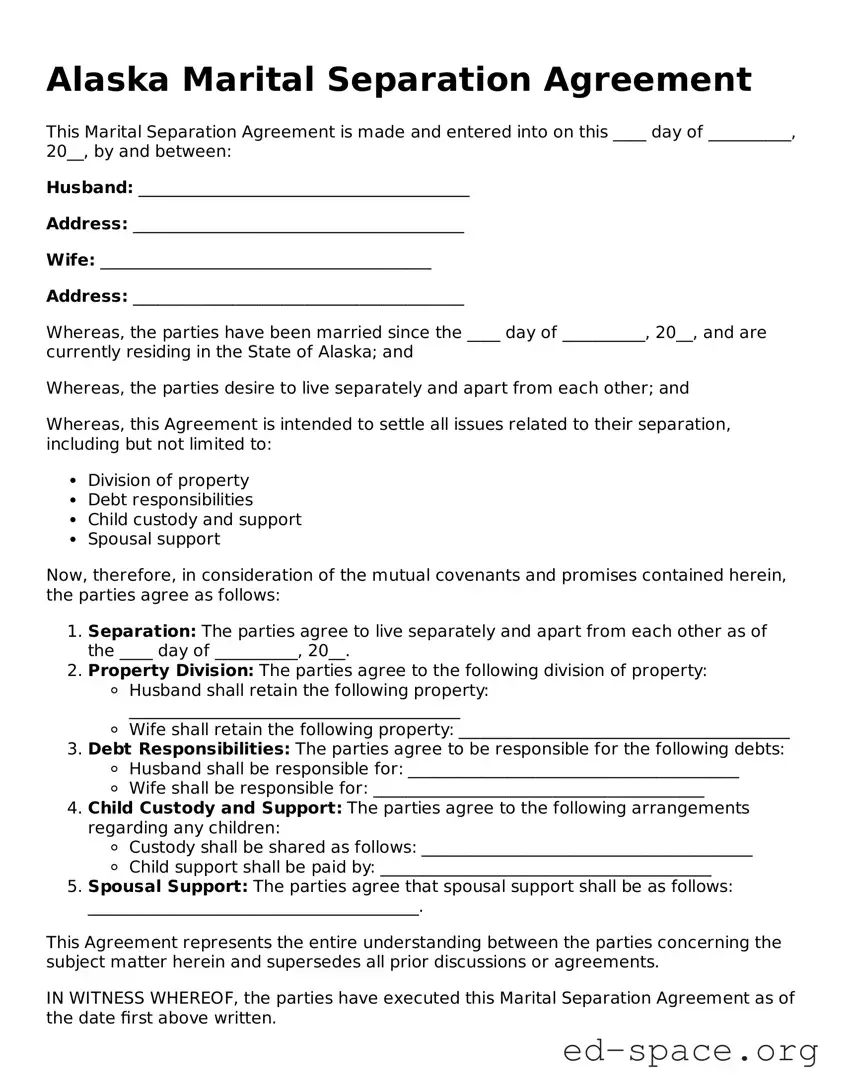
The Alaska Marital Separation Agreement form serves as a crucial document for couples navigating the complexities of separation. This agreement outlines the terms under which the parties will live apart, addressing key issues such as division of property, child custody, and spousal support. By clearly defining the rights and responsibilities of each party, the form aims to minimize conflicts and provide a structured approach to separation. It is essential for both parties to understand their obligations and entitlements, as these provisions can have long-lasting implications. Moreover, the agreement must comply with Alaska state laws to ensure its enforceability in court. Completing this form requires careful consideration of various factors, including financial arrangements and the welfare of any children involved. This document not only facilitates a smoother transition during a difficult time but also helps maintain clarity and fairness in the separation process.
Alaska Marital Separation Agreement
This Marital Separation Agreement is made and entered into on this ____ day of __________, 20__, by and between:
Husband: ________________________________________
Address: ________________________________________
Wife: ________________________________________
Address: ________________________________________
Whereas, the parties have been married since the ____ day of __________, 20__, and are currently residing in the State of Alaska; and
Whereas, the parties desire to live separately and apart from each other; and
Whereas, this Agreement is intended to settle all issues related to their separation, including but not limited to:
Now, therefore, in consideration of the mutual covenants and promises contained herein, the parties agree as follows:
This Agreement represents the entire understanding between the parties concerning the subject matter herein and supersedes all prior discussions or agreements.
IN WITNESS WHEREOF, the parties have executed this Marital Separation Agreement as of the date first above written.
Husband's Signature: ___________________________ Date: ____________
Wife's Signature: ___________________________ Date: ____________
Witnessed by:
Witness Name: _______________________________
Signature: _______________________________ Date: ____________
| Fact Name | Description |
|---|---|
| Purpose | The Alaska Marital Separation Agreement form outlines the terms of separation between spouses, addressing issues such as property division, child custody, and support obligations. |
| Governing Law | This form is governed by Alaska Statutes, specifically Title 25, which deals with domestic relations and family law. |
| Voluntary Agreement | The agreement must be signed voluntarily by both parties, ensuring that both spouses understand and accept the terms laid out in the document. |
| Enforceability | Once signed and notarized, the agreement can be enforced in court, provided it meets the legal requirements set forth by Alaska law. |
Once you have your Alaska Marital Separation Agreement form ready, you can begin filling it out. This form is essential for outlining the terms of your separation. Take your time to ensure all information is accurate and complete.
After completing the form, you may want to consult with a legal professional to review the agreement. This step can help ensure that your rights are protected and that the terms are fair to both parties.
What is a Marital Separation Agreement in Alaska?
A Marital Separation Agreement is a legal document that outlines the terms of a couple's separation. It addresses issues such as property division, debt responsibilities, child custody, and support obligations. This agreement helps both parties understand their rights and responsibilities during the separation period.
Do I need an attorney to create a Marital Separation Agreement?
How does a Marital Separation Agreement affect child custody?
The Marital Separation Agreement can include specific terms regarding child custody and visitation. Parents can outline how they will share parenting responsibilities, including decision-making and time spent with the children. This agreement can help minimize conflicts and provide a clear framework for co-parenting.
Can a Marital Separation Agreement be modified?
Yes, a Marital Separation Agreement can be modified if both parties agree to the changes. It is essential to document any modifications in writing and have both parties sign the updated agreement. This ensures that the changes are legally recognized.
What happens if one party does not follow the Marital Separation Agreement?
If one party fails to comply with the terms of the Marital Separation Agreement, the other party can seek legal enforcement. This may involve filing a motion in court to compel compliance or seeking remedies for any violations. Courts generally take these agreements seriously, as they are meant to protect the interests of both parties.
Is a Marital Separation Agreement the same as a divorce?
No, a Marital Separation Agreement is not the same as a divorce. A separation agreement allows couples to live apart while remaining legally married. In contrast, a divorce legally ends the marriage. Couples may choose separation as a step before deciding to divorce.
How long does it take to finalize a Marital Separation Agreement?
The time it takes to finalize a Marital Separation Agreement can vary. It depends on how quickly both parties can agree on the terms. If both parties communicate effectively and are willing to negotiate, the process can be completed relatively quickly. However, if there are disputes, it may take longer to reach an agreement.
Are there any filing fees associated with a Marital Separation Agreement?
There are typically no filing fees specifically for a Marital Separation Agreement in Alaska, as it is a private contract between the parties. However, if you choose to file the agreement with the court or if it is part of a divorce proceeding, there may be associated court fees. It is advisable to check with the local court for any specific costs.
Failing to provide complete personal information. It is important to include full names, addresses, and contact information for both parties.
Not specifying the date of separation. This date is crucial for legal and financial purposes.
Overlooking the division of property. Clearly outline how assets and debts will be divided to avoid future disputes.
Ignoring child custody arrangements. If children are involved, it is essential to detail custody and visitation rights.
Neglecting to include spousal support terms. Clearly state any agreements regarding alimony or support payments.
Using vague language. Be specific in all terms to ensure clarity and prevent misunderstandings.
Failing to sign and date the agreement. Both parties must sign and date the document to make it legally binding.
Not consulting with a legal professional. It is advisable to seek legal advice to ensure all aspects of the agreement are covered.
When navigating a marital separation in Alaska, several forms and documents may accompany the Marital Separation Agreement. Each of these documents serves a specific purpose and can help clarify the terms of separation for both parties involved.
Understanding these additional documents can facilitate a smoother separation process. Each one plays a vital role in clarifying responsibilities and expectations, ultimately leading to a more amicable resolution.
When filling out the Alaska Marital Separation Agreement form, it’s important to follow certain guidelines to ensure accuracy and compliance. Here are some things to do and avoid:
When it comes to the Alaska Marital Separation Agreement form, several misconceptions can lead to confusion. Understanding these myths can help individuals make informed decisions. Here are eight common misconceptions:
By dispelling these myths, individuals can approach the Alaska Marital Separation Agreement with clarity and confidence. Understanding the purpose and implications of the agreement is essential for making informed choices during a challenging time.
When filling out and using the Alaska Marital Separation Agreement form, it is important to keep several key points in mind. Below are some essential takeaways that can help guide you through the process:
Taking these steps can help ensure that the process is smoother and that both parties feel heard and respected during this challenging time.