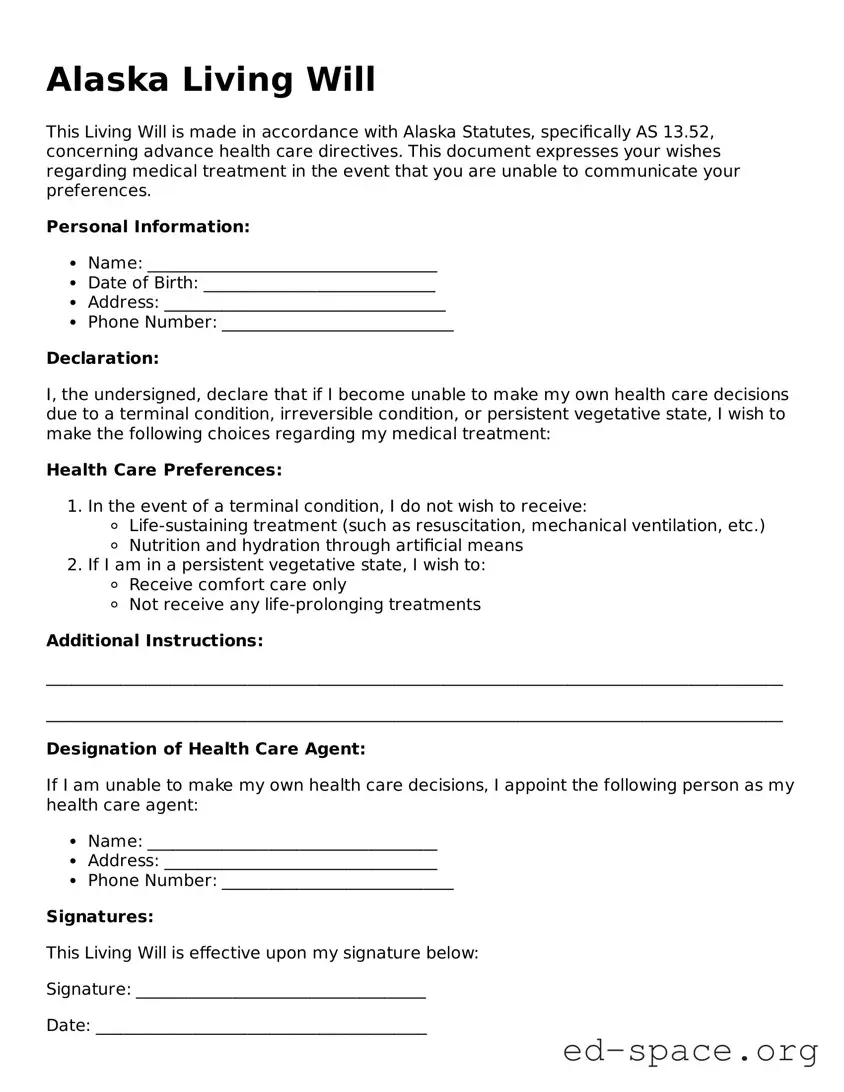
In the state of Alaska, the Living Will form serves as a crucial document that allows individuals to express their preferences regarding medical treatment in the event they become unable to communicate their wishes. This form empowers individuals to outline specific healthcare decisions, ensuring that their values and desires are respected during critical moments. Key components of the Alaska Living Will include directives about life-sustaining treatments, resuscitation efforts, and the use of artificial nutrition and hydration. By completing this form, individuals can provide clear guidance to their loved ones and healthcare providers, reducing the burden of decision-making during emotionally challenging times. Furthermore, the Living Will can complement other advance directives, such as a durable power of attorney for healthcare, creating a comprehensive plan for medical care that aligns with personal beliefs and preferences. Understanding the importance of this document can help Alaskans take proactive steps in managing their healthcare choices, ultimately promoting peace of mind for themselves and their families.
Alaska Living Will
This Living Will is made in accordance with Alaska Statutes, specifically AS 13.52, concerning advance health care directives. This document expresses your wishes regarding medical treatment in the event that you are unable to communicate your preferences.
Personal Information:
Declaration:
I, the undersigned, declare that if I become unable to make my own health care decisions due to a terminal condition, irreversible condition, or persistent vegetative state, I wish to make the following choices regarding my medical treatment:
Health Care Preferences:
Additional Instructions:
_________________________________________________________________________________________
_________________________________________________________________________________________
Designation of Health Care Agent:
If I am unable to make my own health care decisions, I appoint the following person as my health care agent:
Signatures:
This Living Will is effective upon my signature below:
Signature: ___________________________________
Date: ________________________________________
Witnesses:
This document must be signed in the presence of two witnesses who are not related to you and who will not inherit from you:
| Fact Name | Description |
|---|---|
| Definition | An Alaska Living Will is a legal document that outlines an individual's wishes regarding medical treatment in the event they become unable to communicate their preferences. |
| Governing Law | The Alaska Living Will is governed by Alaska Statutes Title 13, Chapter 12. |
| Eligibility | Any adult who is at least 18 years old and of sound mind can create a Living Will in Alaska. |
| Witness Requirement | The document must be signed in the presence of two witnesses, who cannot be related to the individual or entitled to any part of their estate. |
| Durability | A Living Will remains effective even if the individual becomes incapacitated. |
| Revocation | Individuals can revoke their Living Will at any time, as long as they are mentally competent to do so. |
| Healthcare Proxy | A Living Will can be combined with a healthcare proxy, allowing individuals to appoint someone to make medical decisions on their behalf. |
| Specific Instructions | Individuals can provide specific instructions regarding life-sustaining treatments, such as resuscitation or artificial nutrition. |
| Storage and Accessibility | It is important to store the Living Will in a safe yet accessible location and to inform family members and healthcare providers about its existence. |
| Legal Advice | While it is not required, seeking legal advice when creating a Living Will can help ensure that it meets all legal requirements and accurately reflects the individual's wishes. |
Completing the Alaska Living Will form is an important step in expressing your healthcare preferences. After filling out the form, it will serve as a legal document that communicates your wishes regarding medical treatment in the event that you cannot make decisions for yourself. It is essential to ensure that the form is filled out accurately to reflect your intentions.
What is a Living Will in Alaska?
A Living Will in Alaska is a legal document that allows individuals to outline their preferences for medical treatment in the event they become unable to communicate their wishes. It primarily addresses end-of-life care, specifying what types of medical interventions a person does or does not want. This document can provide clarity for family members and healthcare providers during difficult times, ensuring that a person's wishes are honored.
Who can create a Living Will in Alaska?
Any adult who is at least 18 years old and of sound mind can create a Living Will in Alaska. This includes individuals who are facing serious health issues or those who simply want to prepare for the future. It’s important to understand that the individual must be able to comprehend the implications of their decisions when they create the document.
How does one properly execute a Living Will in Alaska?
To properly execute a Living Will in Alaska, the document must be signed by the individual creating it. It should also be witnessed by at least two adults who are not related to the individual and do not stand to benefit from the individual's estate. While notarization is not required, it can add an extra layer of validity to the document. It’s advisable to keep copies of the Living Will in accessible locations and share them with family members and healthcare providers.
Can a Living Will be changed or revoked in Alaska?
Yes, a Living Will can be changed or revoked at any time as long as the individual is competent. To make changes, the individual should create a new Living Will that explicitly states the updated wishes. It is also important to inform any relevant parties, such as family members and healthcare providers, about the changes. If a person decides to revoke their Living Will, they can do so verbally or in writing, but it is best to document the revocation to avoid any confusion.
Not Clearly Specifying Medical Preferences: One common mistake is failing to clearly outline specific medical treatments or interventions. It's important to be explicit about what you want and don’t want in terms of life-sustaining measures.
Neglecting to Update the Document: Life circumstances change. People often forget to revise their Living Will as their health, values, or family situations evolve. Regularly reviewing and updating your wishes is crucial.
Not Discussing Wishes with Family: A Living Will is not just a personal document; it can affect loved ones. Failing to have open conversations with family members can lead to confusion and conflict when decisions need to be made.
Missing Required Signatures: A Living Will must be signed to be valid. Some people overlook the necessity of having their signature and the signatures of witnesses or a notary, which can render the document unenforceable.
Using Outdated Forms: Laws can change, and so can the forms themselves. Relying on an outdated version of the Living Will form can lead to legal complications, so always ensure you have the most current version.
Assuming It’s Only for the Elderly: Many believe that Living Wills are only for older adults. However, unexpected medical emergencies can happen at any age. It’s wise for everyone to consider having a Living Will in place.
A Living Will is an essential document that outlines an individual's preferences regarding medical treatment in the event they become unable to communicate their wishes. In Alaska, this form is often used alongside other important documents to ensure comprehensive planning for healthcare decisions. Below are four additional forms and documents that are commonly associated with the Alaska Living Will.
Using these documents in conjunction with the Alaska Living Will can help ensure that an individual's healthcare preferences are honored. Properly completed forms provide peace of mind for both the individual and their loved ones, facilitating clear communication about medical wishes during challenging times.
The Living Will form shares similarities with several other important legal documents that address health care decisions and end-of-life preferences. Below are six documents that are comparable to a Living Will, along with a brief explanation of their similarities.
When filling out the Alaska Living Will form, it is essential to approach the task with care. Here are some important dos and don’ts to keep in mind:
By following these guidelines, you can ensure that your Living Will accurately reflects your preferences and provides clarity for your loved ones and healthcare providers.
There are several misconceptions about the Alaska Living Will form that can lead to confusion. Here are eight common misunderstandings:
A Living Will outlines your wishes regarding medical treatment, while a Power of Attorney designates someone to make decisions on your behalf.
You can complete a Living Will on your own without legal assistance, as long as you follow the state guidelines.
Anyone over the age of 18 can create a Living Will to ensure their wishes are known, regardless of age or health status.
This document can guide decisions in various healthcare settings, including nursing homes and at home.
You can update or revoke your Living Will at any time, as long as you follow the proper procedures.
While a Living Will is valid in Alaska, other states may have different laws. It's essential to check the requirements in each state.
It can also address your preferences for treatment in various medical situations, not just at the end of life.
Healthcare providers are obligated to follow your Living Will as long as it is valid and clear, regardless of family opinions.
When considering the Alaska Living Will form, it is essential to understand its purpose and how to effectively complete it. Here are key takeaways to keep in mind:
Understanding these key points can help ensure that your Living Will accurately reflects your wishes and provides guidance for your healthcare decisions.