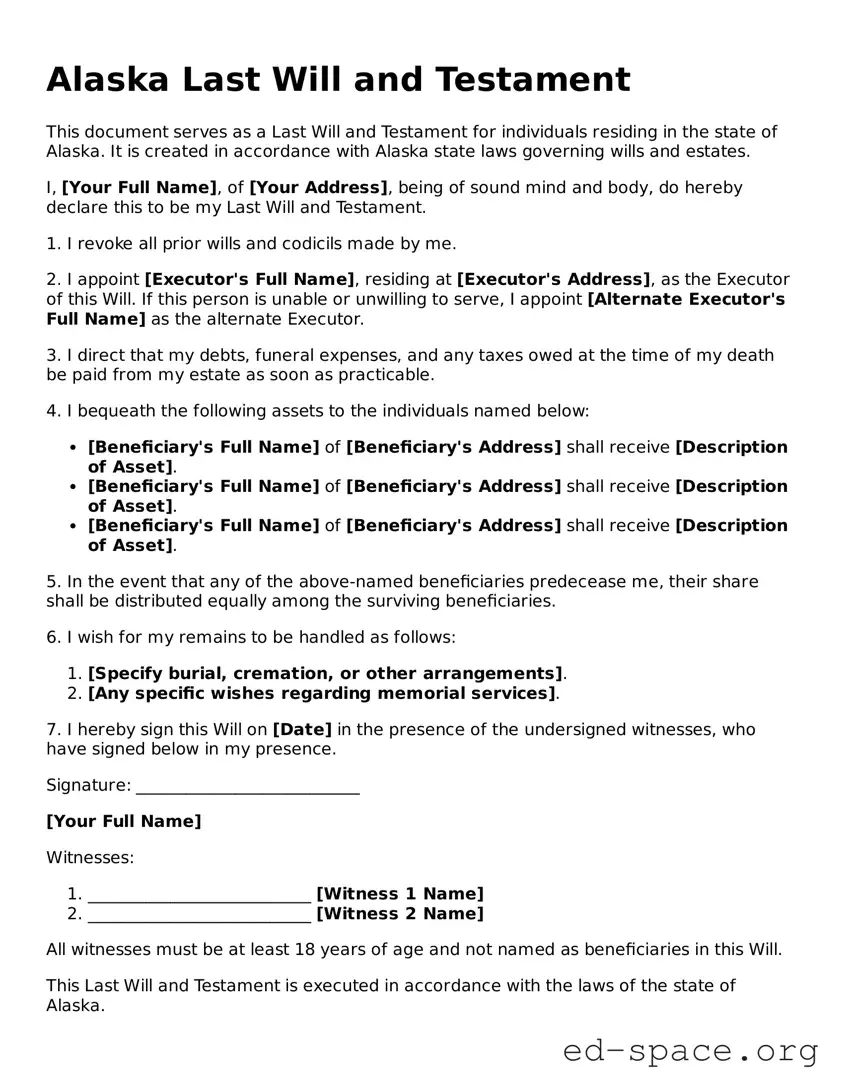
In the vast expanse of Alaska, where the rugged terrain meets the spirit of independence, the Last Will and Testament form serves as a crucial tool for individuals wishing to outline their final wishes. This legal document provides a structured way for a person, known as the testator, to specify how their assets should be distributed upon their passing. Essential components of the form include the identification of beneficiaries, who will receive the testator's property, and the appointment of an executor, responsible for ensuring that the will is executed according to the testator's desires. Additionally, the form typically requires the testator's signature and the signatures of witnesses to validate its authenticity. In Alaska, as in many states, the will can be handwritten or typed, but adhering to specific formalities is vital for it to be legally binding. Understanding these elements is key for anyone looking to secure peace of mind regarding their estate and to ensure that their wishes are honored after they are gone.
Alaska Last Will and Testament
This document serves as a Last Will and Testament for individuals residing in the state of Alaska. It is created in accordance with Alaska state laws governing wills and estates.
I, [Your Full Name], of [Your Address], being of sound mind and body, do hereby declare this to be my Last Will and Testament.
1. I revoke all prior wills and codicils made by me.
2. I appoint [Executor's Full Name], residing at [Executor's Address], as the Executor of this Will. If this person is unable or unwilling to serve, I appoint [Alternate Executor's Full Name] as the alternate Executor.
3. I direct that my debts, funeral expenses, and any taxes owed at the time of my death be paid from my estate as soon as practicable.
4. I bequeath the following assets to the individuals named below:
5. In the event that any of the above-named beneficiaries predecease me, their share shall be distributed equally among the surviving beneficiaries.
6. I wish for my remains to be handled as follows:
7. I hereby sign this Will on [Date] in the presence of the undersigned witnesses, who have signed below in my presence.
Signature: ___________________________
[Your Full Name]
Witnesses:
All witnesses must be at least 18 years of age and not named as beneficiaries in this Will.
This Last Will and Testament is executed in accordance with the laws of the state of Alaska.
| Fact Name | Description |
|---|---|
| Governing Law | The Alaska Last Will and Testament is governed by Alaska Statutes Title 13, Chapter 12. |
| Age Requirement | Testators must be at least 18 years old to create a valid will in Alaska. |
| Witness Requirement | A will must be signed by at least two witnesses who are present at the same time. |
| Revocation | A will can be revoked by creating a new will or by physically destroying the original document. |
| Self-Proving Will | Alaska allows for self-proving wills, which simplify the probate process. |
| Holographic Wills | Handwritten wills, known as holographic wills, are recognized in Alaska if they are signed by the testator. |
Completing the Alaska Last Will and Testament form is an important step in ensuring your wishes are respected after your passing. Once the form is filled out, it will need to be signed and witnessed according to state requirements to be legally valid.
What is a Last Will and Testament in Alaska?
A Last Will and Testament is a legal document that outlines how a person wants their assets distributed after they pass away. In Alaska, this document helps ensure that your wishes are honored and can provide clarity for your loved ones during a difficult time.
Do I need a lawyer to create a Last Will and Testament in Alaska?
No, you don’t necessarily need a lawyer to create a Last Will and Testament in Alaska. You can draft your own will using templates or forms available online. However, consulting with a lawyer can help ensure that your will meets all legal requirements and accurately reflects your wishes.
What are the requirements for a valid will in Alaska?
In Alaska, for a will to be valid, it must be in writing, signed by the person making the will (the testator), and witnessed by at least two individuals. These witnesses must be present at the same time and should not be beneficiaries of the will to avoid any conflicts of interest.
Can I change my will after it has been created?
Yes, you can change your will at any time while you are still alive. You can do this by creating a new will or by adding a codicil, which is an amendment to your existing will. Just remember that any changes must also meet the legal requirements to be valid.
What happens if I die without a will in Alaska?
If you die without a will, you are considered to have died "intestate." In this case, Alaska's intestacy laws will determine how your assets are distributed. This process may not reflect your wishes and can lead to complications for your family.
Can I revoke my will in Alaska?
Yes, you can revoke your will in Alaska. This can be done by creating a new will that states your intention to revoke the previous one, or by physically destroying the old will. It's important to ensure that your intentions are clear to avoid confusion later.
Is it necessary to have my will notarized in Alaska?
No, notarization is not required for a will to be valid in Alaska. However, having your will notarized can help strengthen its validity and may make the probate process smoother. It can also serve as evidence that you were of sound mind when you created the will.
How often should I review my will?
It’s a good idea to review your will every few years or after major life events, such as marriage, divorce, or the birth of a child. Keeping your will updated ensures that it reflects your current wishes and circumstances.
Not being clear about their wishes: Individuals often fail to articulate their intentions clearly. This can lead to confusion and disputes among heirs.
Forgetting to sign the document: A will must be signed to be valid. Many people neglect this crucial step, rendering their will ineffective.
Not having witnesses: In Alaska, having at least two witnesses sign the will is essential. Omitting this can invalidate the document.
Failing to update the will: Life changes, such as marriage, divorce, or the birth of children, necessitate updates to the will. Neglecting to do so can lead to unintended consequences.
Using vague language: Ambiguous terms can create confusion. It’s important to be specific about assets and beneficiaries.
Overlooking debts and taxes: People often forget to account for outstanding debts and taxes. This can affect the distribution of assets and leave heirs with unexpected liabilities.
Not considering guardianship: Parents must designate guardians for their minor children. Failing to address this can leave children in uncertain situations.
Ignoring state-specific requirements: Each state has its own laws regarding wills. Ignoring these can lead to complications and potential invalidation of the will.
When creating a comprehensive estate plan in Alaska, it’s important to consider several other documents that can complement your Last Will and Testament. Each of these documents serves a unique purpose and can help ensure that your wishes are honored and your loved ones are cared for after your passing.
Having these documents in place can provide peace of mind and clarity for you and your loved ones. They work together with your Last Will and Testament to create a well-rounded estate plan that reflects your wishes and protects your family's future.
When filling out the Alaska Last Will and Testament form, it's important to keep certain guidelines in mind. Here are five things you should and shouldn't do:
Following these guidelines can help ensure that your will is valid and reflects your wishes accurately.
This belief is misleading. Everyone, regardless of their financial status, can benefit from having a will. A will ensures that your wishes are honored regarding the distribution of your assets and the care of your dependents after your passing.
In Alaska, a handwritten will, also known as a holographic will, can be valid if it is signed by the testator and the material provisions are in their handwriting. However, it is advisable to follow formal requirements to avoid disputes.
This is not true. A will can be amended or revoked at any time, as long as the person who created it is of sound mind. Changes can be made through a codicil or by drafting a new will entirely.
Many people believe that having a will allows them to bypass the probate process. However, a will must go through probate, which is the legal process of validating the will and distributing the estate. While having a will can streamline the process, it does not eliminate it.
When filling out and using the Alaska Last Will and Testament form, keep these key points in mind:
By following these guidelines, you can create a will that accurately reflects your wishes and meets legal requirements in Alaska.