In Alaska, families opting for homeschooling must navigate a straightforward yet essential process to ensure compliance with state regulations. Central to this process is the Homeschool Letter of Intent form, which serves as a formal declaration of a parent's or guardian's intention to educate their child at home. This document requires specific information, including the names and ages of the children being homeschooled, as well as the educational curriculum or approach that will be utilized. It is crucial for parents to submit this letter to their local school district within a designated timeframe, typically at the beginning of the school year or upon deciding to homeschool. Additionally, the form may include provisions for updating the district should there be any changes in the educational plan or family circumstances. Understanding the requirements and ensuring timely submission can significantly contribute to a smooth homeschooling experience, allowing families to focus on providing a tailored education that meets their children's unique needs.
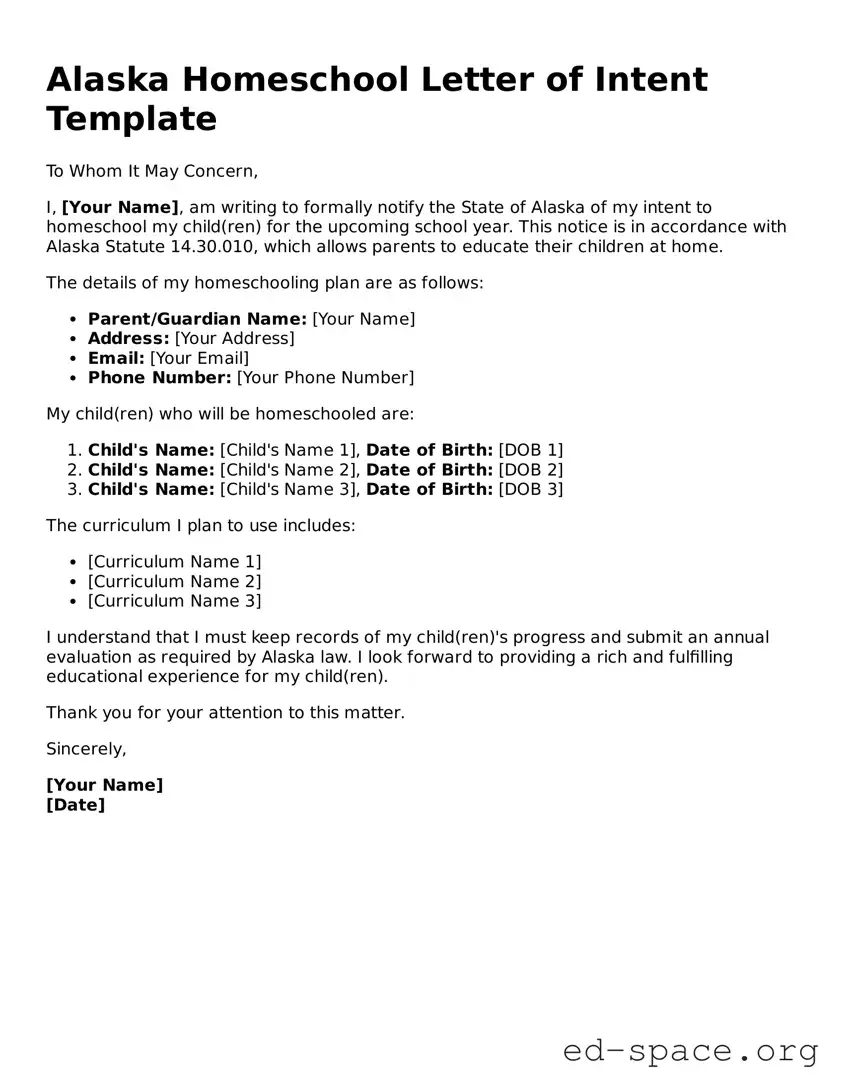
Alaska Homeschool Letter of Intent Template
To Whom It May Concern,
I, [Your Name], am writing to formally notify the State of Alaska of my intent to homeschool my child(ren) for the upcoming school year. This notice is in accordance with Alaska Statute 14.30.010, which allows parents to educate their children at home.
The details of my homeschooling plan are as follows:
My child(ren) who will be homeschooled are:
The curriculum I plan to use includes:
I understand that I must keep records of my child(ren)'s progress and submit an annual evaluation as required by Alaska law. I look forward to providing a rich and fulfilling educational experience for my child(ren).
Thank you for your attention to this matter.
Sincerely,
[Your Name]
[Date]
| Fact Name | Description |
|---|---|
| Governing Law | The Alaska Homeschool Letter of Intent is governed by Alaska Statutes Title 14, Chapter 30. |
| Purpose | This form notifies the state of a parent's intent to homeschool their child. |
| Who Must File | Parents or guardians of children aged 7 to 16 must file this form. |
| Filing Deadline | The Letter of Intent must be submitted by September 1st of each school year. |
| Required Information | The form requires the child's name, age, and the address of the homeschooling location. |
| Annual Renewal | Parents must renew the Letter of Intent annually to continue homeschooling. |
| Submission Method | The form can be submitted via mail or in person to the local school district. |
| Record Keeping | Parents are advised to keep a copy of the submitted form for their records. |
| Additional Requirements | Some school districts may have additional requirements or guidelines for homeschooling. |
| Contact Information | For questions, parents can contact their local school district for assistance. |
After completing the Alaska Homeschool Letter of Intent form, you will submit it to your local school district. This step is essential to inform the district of your intent to homeschool your child. Ensure that you keep a copy for your records.
What is the Alaska Homeschool Letter of Intent form?
The Alaska Homeschool Letter of Intent form is a document that parents or guardians must submit to inform their local school district of their decision to homeschool their children. This form is essential for legally establishing a homeschool program in Alaska. By submitting this letter, parents communicate their intent to provide an educational experience outside of the traditional school system.
Who needs to fill out the Letter of Intent?
Any parent or guardian who wishes to homeschool their child in Alaska must complete the Letter of Intent. This includes families with children who are of school age and those who may have previously attended public or private schools. It's important to submit this form for each child you plan to homeschool, ensuring that all necessary information is provided to the school district.
When should the Letter of Intent be submitted?
The Letter of Intent should be submitted at the beginning of the school year or as soon as you decide to homeschool your child. If you are starting mid-year, it’s still important to submit the letter promptly to comply with state regulations. Doing so helps to avoid any potential issues regarding your child's educational status.
What information is required on the Letter of Intent?
The Letter of Intent typically requires basic information about the child, such as their name, age, and grade level. Additionally, parents may need to provide their contact information and the name of the homeschool program they plan to use. Some districts may have specific requirements, so it’s a good idea to check with your local school district for any additional information that may be needed.
Incomplete Information: One common mistake is failing to provide all required information. The form requests specific details about the student, including their name, age, and address. Omitting any of this information can lead to delays or rejection of the application.
Incorrect Dates: Another frequent error involves the dates. Parents often miscalculate the school year start and end dates. Ensure that the dates align with local school district requirements to avoid any confusion.
Not Signing the Form: It may seem trivial, but some individuals forget to sign the Letter of Intent. A signature is necessary to validate the document. Without it, the form is considered incomplete.
Failure to Submit on Time: Timing is crucial. Submitting the form after the deadline can result in complications. Make sure to check the local regulations and submit the form well in advance of the start of the school year.
When families in Alaska decide to homeschool their children, they must complete the Homeschool Letter of Intent form. This form serves as a notification to the local school district of the family's intent to provide home education. However, there are several other important documents and forms that may accompany this letter to ensure compliance with state regulations and to facilitate the homeschooling process. Below is a list of these forms and documents, each serving a specific purpose in the homeschooling journey.
Each of these documents plays a crucial role in the homeschooling process in Alaska. They help ensure that families meet educational standards while also providing a structured approach to learning at home. Being organized and prepared with these forms can greatly enhance the homeschooling experience for both parents and students.
When filling out the Alaska Homeschool Letter of Intent form, there are important steps to follow. Here are four things you should and shouldn't do:
When considering homeschooling in Alaska, many people hold misconceptions about the Letter of Intent form. Understanding the truth behind these misunderstandings can help parents navigate the homeschooling process more effectively.
This is not true. The Letter of Intent is simply a notification to the school district that you intend to homeschool your child. It does not create any legal obligations or contracts that would restrict your educational choices.
While it is common to submit the form at the start of the school year, it is not a strict requirement. Parents can file the Letter of Intent at any time during the year, allowing flexibility in starting a homeschooling journey.
In fact, the form only requires basic information such as the child's name and age. Detailed curriculum plans are not necessary at this stage, easing the burden on parents who may feel overwhelmed by curriculum choices.
This is incorrect. Parents have the right to change their educational plans at any time. If you decide to enroll your child in public school or change your homeschooling approach, you can do so without penalty.
Filling out and using the Alaska Homeschool Letter of Intent form is a straightforward process. Here are some key takeaways to keep in mind:
Following these guidelines will help ensure a smooth homeschooling experience in Alaska.