Homepage Free Hold Harmless Agreement Form for Alaska
Content Overview

The Alaska Hold Harmless Agreement form serves as a vital tool for individuals and organizations looking to mitigate liability risks in various situations. This agreement is designed to protect one party from legal claims or damages that may arise from the actions or negligence of another party. Typically used in contexts such as rental agreements, events, or services, it outlines the responsibilities of each party and clarifies the extent of liability. By signing this form, one party agrees to "hold harmless" the other, meaning they will not seek compensation for any injuries or damages that may occur. This arrangement can foster trust and cooperation, allowing parties to engage in activities with a clearer understanding of their legal protections. Understanding the nuances of the Alaska Hold Harmless Agreement is essential for anyone involved in agreements that carry potential risks, as it can significantly influence how liability is handled should issues arise.

Document Preview

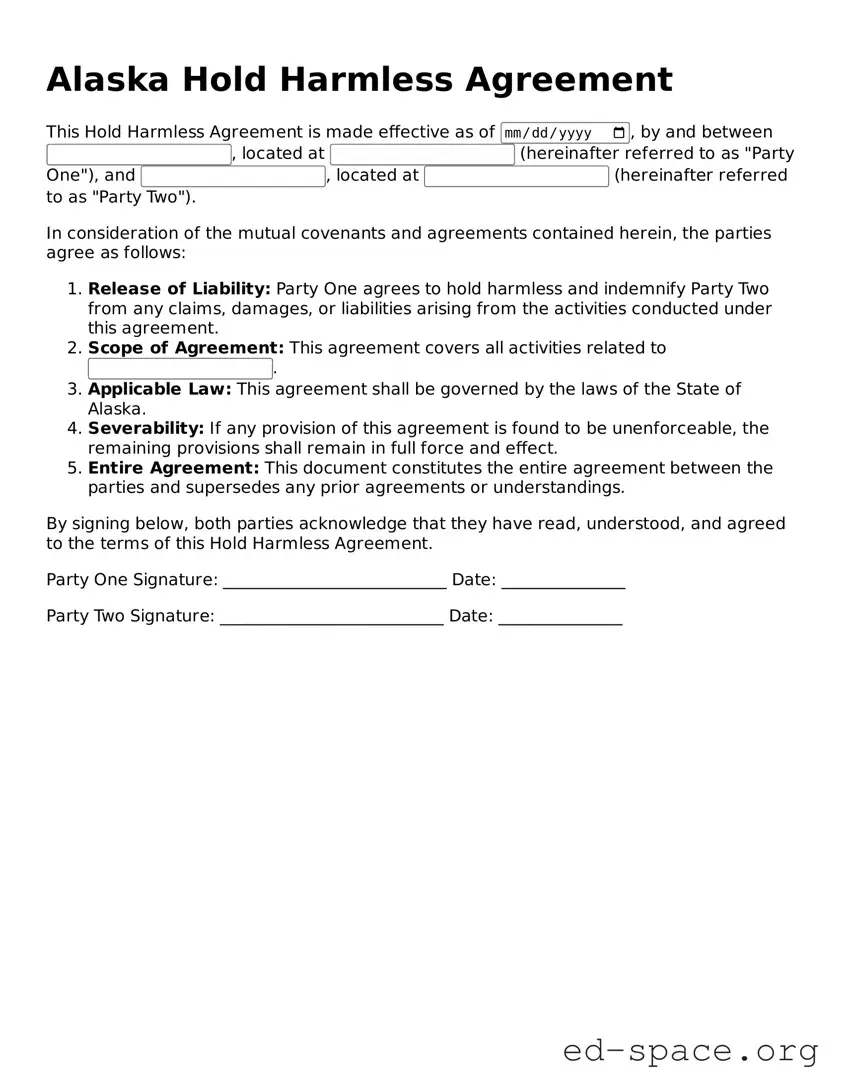
Alaska Hold Harmless Agreement

This Hold Harmless Agreement is made effective as of , by and between , located at (hereinafter referred to as "Party One"), and , located at (hereinafter referred to as "Party Two").

In consideration of the mutual covenants and agreements contained herein, the parties agree as follows:

  1. Release of Liability: Party One agrees to hold harmless and indemnify Party Two from any claims, damages, or liabilities arising from the activities conducted under this agreement.
  2. Scope of Agreement: This agreement covers all activities related to .
  3. Applicable Law: This agreement shall be governed by the laws of the State of Alaska.
  4. Severability: If any provision of this agreement is found to be unenforceable, the remaining provisions shall remain in full force and effect.
  5. Entire Agreement: This document constitutes the entire agreement between the parties and supersedes any prior agreements or understandings.

By signing below, both parties acknowledge that they have read, understood, and agreed to the terms of this Hold Harmless Agreement.

Party One Signature: ___________________________ Date: _______________

Party Two Signature: ___________________________ Date: _______________

PDF Form Details

Fact Name Details
Purpose The Alaska Hold Harmless Agreement is designed to protect one party from legal liability for damages or injuries incurred by another party.
Parties Involved This agreement typically involves two parties: the indemnitor (the party agreeing to hold harmless) and the indemnitee (the party being protected).
Governing Law The agreement is governed by the laws of the State of Alaska, ensuring compliance with state-specific regulations.
Usage Context Commonly used in various contexts, such as rental agreements, event planning, and construction contracts.
Enforceability For the agreement to be enforceable, it must be clear, specific, and mutually agreed upon by both parties.

Alaska Hold Harmless Agreement: Usage Guidelines

Filling out the Alaska Hold Harmless Agreement form is a straightforward process that requires careful attention to detail. After completing the form, you will be ready to submit it as required. Here’s how to fill it out step by step:

  1. Begin by downloading the Alaska Hold Harmless Agreement form from the appropriate website or source.
  2. Read through the entire form to familiarize yourself with the sections and requirements.
  3. In the first section, provide your full name and contact information. Ensure that your details are accurate.
  4. Next, enter the date on which you are filling out the form. This helps in tracking the timeline of the agreement.
  5. In the following section, describe the event or activity for which you are requesting the Hold Harmless Agreement. Be specific about the nature of the event.
  6. Identify any parties involved in the agreement, including organizations or individuals. List their names clearly.
  7. Review the terms outlined in the form. Make sure you understand your responsibilities and the implications of signing.
  8. Sign the form where indicated. Your signature indicates that you agree to the terms and conditions.
  9. Finally, date your signature to confirm when you signed the agreement.

Once you have completed these steps, make sure to keep a copy for your records before submitting the form to the designated recipient. This will help you stay organized and informed about your agreement.

Your Questions, Answered

What is the purpose of the Alaska Hold Harmless Agreement?

The Alaska Hold Harmless Agreement is designed to protect one party from legal liability for any injuries or damages that may occur during a specific activity or event. By signing this agreement, one party agrees not to hold the other responsible for any claims that arise. This is particularly useful in situations where risks are involved, such as outdoor events, sports activities, or community gatherings. It ensures that all parties understand their responsibilities and the potential risks involved.

Who needs to sign the Hold Harmless Agreement?

Are there any specific requirements for the Alaska Hold Harmless Agreement?

What happens if someone does not sign the Hold Harmless Agreement?

Common mistakes

  1. Incomplete Information: Many individuals fail to provide all required personal details, such as full name, address, and contact information. This can lead to delays or issues in processing the agreement.

  2. Incorrect Dates: Filling in the wrong dates can invalidate the agreement. It is crucial to ensure that all dates are accurate and correspond to the intended time frame of the agreement.

  3. Failure to Read the Terms: Some people overlook the terms and conditions outlined in the agreement. Understanding these terms is essential to avoid unintended liabilities.

  4. Missing Signatures: Not signing the form or having the required witnesses sign can render the agreement ineffective. Each party involved must provide their signature where indicated.

  5. Not Keeping Copies: After submitting the form, individuals often neglect to keep a copy for their records. Retaining a copy is important for future reference and verification.

  6. Ignoring Legal Advice: Some individuals choose to fill out the agreement without consulting a legal professional. Seeking advice can help clarify any uncertainties and ensure the form is completed correctly.

Documents used along the form

When engaging in agreements that involve liability and risk management, several forms and documents often accompany the Alaska Hold Harmless Agreement. Each of these documents serves a specific purpose and helps to clarify the responsibilities and expectations of the parties involved. Below is a list of commonly used documents that may be relevant in conjunction with the Hold Harmless Agreement.

  • Liability Waiver: This document releases one party from legal liability for any injuries or damages that may occur during a specific activity. It is often used in recreational settings or events.
  • Indemnity Agreement: Similar to a Hold Harmless Agreement, this document outlines the obligation of one party to compensate another for certain losses or damages. It often includes more detailed terms regarding the indemnification process.
  • Insurance Certificate: This document proves that a party has active insurance coverage. It is often required to ensure that adequate protection is in place against potential claims.
  • Release of Liability Form: This form is used to inform participants of the risks involved in an activity and to secure their agreement not to hold the organizer responsible for any injuries that may occur.
  • Contract for Services: This document outlines the terms of a service agreement between parties, including deliverables, timelines, and payment terms, ensuring clarity and mutual understanding.
  • Event Permit: Required for organizing public events, this document ensures compliance with local regulations and may include stipulations regarding liability and safety measures.
  • Participant Agreement: This agreement is used to set the expectations for participants in an event or program, detailing their rights and responsibilities, as well as any waivers they must sign.
  • Safety Plan: This document outlines the safety protocols and procedures in place for an event or activity, helping to mitigate risks and ensure the well-being of all participants.
  • Confidentiality Agreement: Also known as a Non-Disclosure Agreement (NDA), this document protects sensitive information shared between parties during the course of their engagement.

Understanding these documents can help individuals and organizations navigate their legal obligations and protect themselves from potential liabilities. Each form plays a vital role in ensuring that all parties are aware of their rights and responsibilities, ultimately fostering a safer and more transparent environment for all involved.

Similar forms

The Hold Harmless Agreement form shares similarities with several other legal documents. Each of these documents serves to protect parties from liability or outline responsibilities. The following list details six documents that are comparable to the Hold Harmless Agreement:

  • Indemnity Agreement: This document outlines the obligation of one party to compensate another for certain damages or losses, similar to how a Hold Harmless Agreement protects one party from liability.
  • Liability Waiver: A liability waiver releases one party from legal claims, much like a Hold Harmless Agreement, which prevents one party from holding another responsible for certain risks.
  • Release of Liability: This document allows an individual to relinquish their right to pursue legal action against another party, similar to the protective measures in a Hold Harmless Agreement.
  • Service Agreement: Often includes clauses that limit liability for service providers, paralleling the intent of a Hold Harmless Agreement to define responsibility and liability limits.
  • Contractual Risk Transfer Agreement: This agreement transfers the risk of loss or damage from one party to another, akin to the way a Hold Harmless Agreement reallocates liability.
  • Insurance Policy: While not a legal agreement in the same sense, it provides protection against certain liabilities, similar to the intent of a Hold Harmless Agreement to shield parties from financial loss.

Dos and Don'ts

When filling out the Alaska Hold Harmless Agreement form, it's important to approach the task with care. This document serves to protect one party from liability for certain actions or events. Here’s a list of things you should and shouldn’t do:

  • Do read the entire agreement carefully before signing. Understanding the terms is crucial.
  • Do provide accurate information. Ensure that all names, dates, and details are correct.
  • Do consult a legal professional if you have questions. Seeking advice can clarify any uncertainties.
  • Do keep a copy of the signed agreement for your records. Documentation is key in any legal context.
  • Do sign and date the agreement in the appropriate places. This step is essential for the document's validity.
  • Don’t rush through the form. Taking your time can prevent mistakes that might have serious implications.
  • Don’t leave any sections blank unless instructed. Incomplete forms can lead to confusion or rejection.
  • Don’t ignore any specific instructions provided with the form. These guidelines are there for a reason.
  • Don’t sign the agreement if you don’t fully understand it. Your signature indicates consent to the terms.
  • Don’t forget to check for any required witnesses or notarization. Some agreements may need additional verification.

Misconceptions

Many people have misunderstandings about the Alaska Hold Harmless Agreement form. Here are four common misconceptions:

  • It completely eliminates liability. Some believe that signing this agreement removes all responsibility for negligence. However, it only limits liability in specific circumstances, not in cases of gross negligence or willful misconduct.
  • It is only for businesses. While often used by businesses, individuals can also utilize this agreement. Anyone entering into a situation with potential risks can benefit from its protections.
  • It is a one-size-fits-all document. Many think the form is generic and can be used without modification. In reality, the agreement should be tailored to fit the specific situation and needs of the parties involved.
  • Signing means you cannot seek compensation. Some assume that signing this agreement means they waive all rights to compensation. This is not true; it only affects claims related to the specific risks outlined in the agreement.

Key takeaways

When filling out and using the Alaska Hold Harmless Agreement form, keep these key takeaways in mind:

  1. Understand the Purpose: This agreement protects one party from legal liability for any injuries or damages that occur during an event or activity.
  2. Identify the Parties: Clearly list all parties involved in the agreement. This includes the individual or organization being held harmless and the party agreeing to hold them harmless.
  3. Be Specific: Clearly outline the activities or events covered by the agreement. This helps prevent misunderstandings about what is included.
  4. Review Insurance Requirements: Ensure that any necessary insurance coverage is in place. This may be a requirement for the agreement to be valid.
  5. Consult Legal Counsel: If unsure about any terms or implications, seek legal advice. This can help avoid potential issues down the line.
  6. Keep Records: Maintain a copy of the signed agreement for your records. This can be useful in case of disputes or claims.