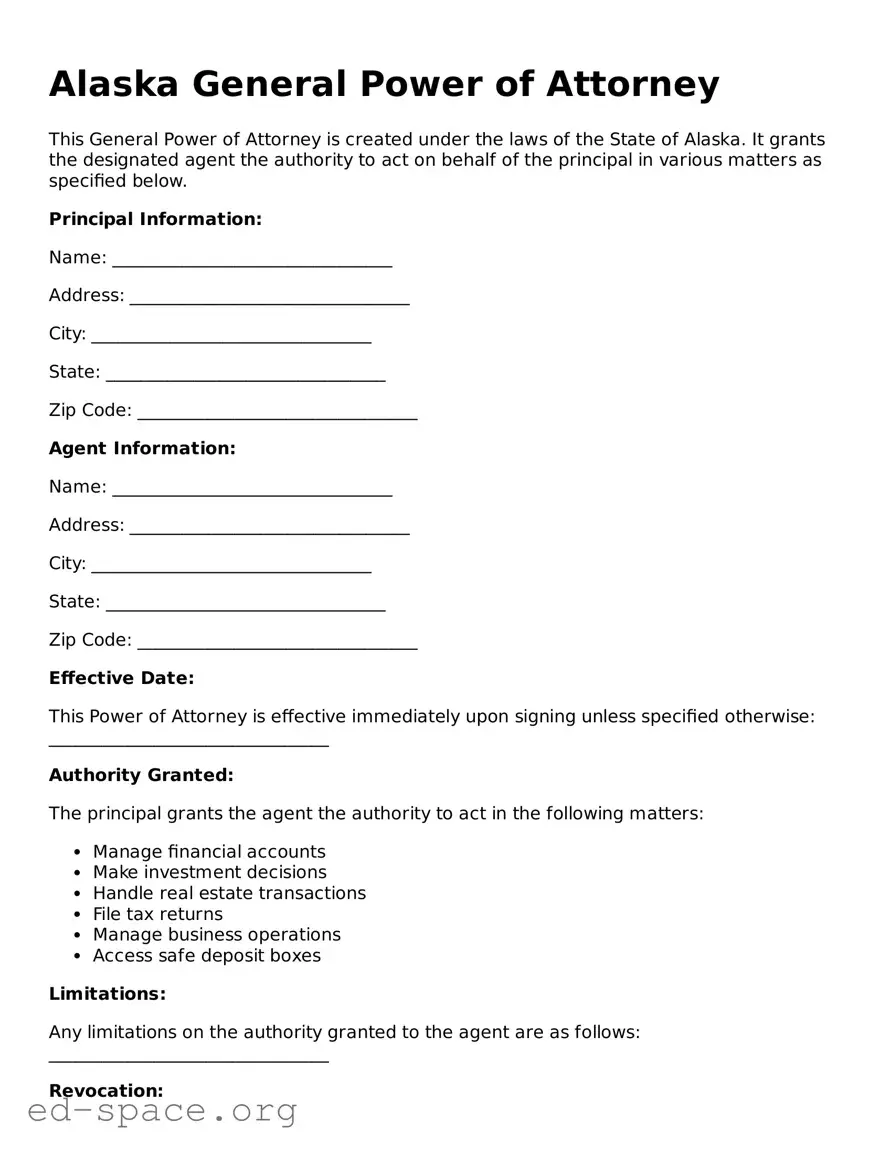
The Alaska General Power of Attorney form is an important legal document that allows one person, known as the principal, to appoint another person, called the agent or attorney-in-fact, to make decisions on their behalf. This form can be used for a variety of purposes, including managing financial affairs, handling real estate transactions, and making healthcare decisions. It grants the agent the authority to act in the principal's best interests, ensuring that their wishes are carried out even when they are unable to do so themselves. The document is versatile and can be tailored to fit specific needs, whether for a limited time or for ongoing situations. It is crucial for the principal to choose a trustworthy agent, as this person will have significant power over their affairs. Furthermore, the form must be properly signed and notarized to be legally valid in Alaska. Understanding the key components and implications of the Alaska General Power of Attorney form is essential for anyone considering this important legal tool.
Alaska General Power of Attorney
This General Power of Attorney is created under the laws of the State of Alaska. It grants the designated agent the authority to act on behalf of the principal in various matters as specified below.
Principal Information:
Name: ________________________________
Address: ________________________________
City: ________________________________
State: ________________________________
Zip Code: ________________________________
Agent Information:
Name: ________________________________
Address: ________________________________
City: ________________________________
State: ________________________________
Zip Code: ________________________________
Effective Date:
This Power of Attorney is effective immediately upon signing unless specified otherwise: ________________________________
Authority Granted:
The principal grants the agent the authority to act in the following matters:
Limitations:
Any limitations on the authority granted to the agent are as follows: ________________________________
Revocation:
This Power of Attorney may be revoked by the principal at any time, provided that the revocation is in writing and delivered to the agent.
Signatures:
In witness whereof, the principal has executed this General Power of Attorney on this ____ day of ____________, 20__.
_____________________________
Principal Signature
_____________________________
Agent Signature
_____________________________
Witness Signature
_____________________________
Witness Signature
| Fact Name | Details |
|---|---|
| Definition | The Alaska General Power of Attorney form allows an individual (the principal) to appoint another person (the agent) to manage their financial affairs. |
| Governing Law | This form is governed by Alaska Statutes Title 13, Chapter 26, which outlines the laws regarding powers of attorney. |
| Durability | The general power of attorney can be made durable, meaning it remains effective even if the principal becomes incapacitated. |
| Agent's Authority | The agent can handle various financial matters, including banking transactions, real estate management, and tax filings. |
| Revocation | The principal can revoke the power of attorney at any time, as long as they are mentally competent to do so. |
| Signature Requirement | The form must be signed by the principal and witnessed by at least one person or notarized to be valid. |
| Limitations | Some actions, such as making a will or changing beneficiaries on life insurance, cannot be delegated through this form. |
| Effective Date | The power of attorney can take effect immediately upon signing or can be set to activate at a later date or upon a specific event. |
Once you have the Alaska General Power of Attorney form in front of you, it’s important to take your time to fill it out carefully. This document allows you to designate someone to act on your behalf in various matters, so accuracy is essential. Below are the steps to guide you through the process of completing the form.
After completing the form, keep a copy for your records. It is also wise to provide a copy to your agent and any relevant parties who may need to rely on this document in the future.
What is a General Power of Attorney in Alaska?
A General Power of Attorney in Alaska is a legal document that allows one person, known as the principal, to grant another person, called the agent or attorney-in-fact, the authority to act on their behalf. This authority can include managing financial affairs, making legal decisions, and handling other important matters when the principal is unable to do so themselves.
Who can be appointed as an agent in a General Power of Attorney?
Any competent adult can be appointed as an agent in a General Power of Attorney. This includes family members, friends, or professionals such as attorneys or financial advisors. It is important to choose someone trustworthy, as they will have significant control over your affairs.
Does a General Power of Attorney need to be notarized in Alaska?
Yes, in Alaska, a General Power of Attorney must be notarized to be legally valid. This means that the principal must sign the document in front of a notary public, who will then acknowledge the signature. Notarization helps ensure that the document is authentic and can be trusted by third parties.
Can a General Power of Attorney be revoked?
Yes, a General Power of Attorney can be revoked at any time by the principal, as long as they are still competent. To revoke the document, the principal should create a written notice of revocation and provide it to the agent and any relevant institutions or individuals who may have relied on the original document.
What happens if the principal becomes incapacitated?
If the principal becomes incapacitated, the General Power of Attorney remains in effect unless it is specifically stated that it is only valid while the principal is competent. This means the agent can continue to make decisions on behalf of the principal. However, it is advisable to have a durable power of attorney if the intention is for the agent to act during periods of incapacity.
Can I limit the powers granted in a General Power of Attorney?
Yes, the powers granted in a General Power of Attorney can be limited. The principal has the option to specify which powers the agent can exercise and which actions they cannot take. It is important to clearly outline these limitations in the document to avoid any misunderstandings in the future.
Inaccurate Information: Individuals often provide incorrect personal details, such as names, addresses, or dates of birth. This can lead to complications in the future, especially when the document needs to be validated.
Not Specifying Powers: Some people fail to clearly outline the specific powers they wish to grant. A vague description may lead to misunderstandings about what the agent can or cannot do on their behalf.
Omitting Signatures: It is common for individuals to forget to sign the document or have it signed by the agent. Without proper signatures, the power of attorney may be deemed invalid.
Ignoring Witness Requirements: Alaska requires that certain powers of attorney be witnessed. Neglecting this requirement can render the document ineffective.
Failure to Date the Document: Not including the date on which the document was signed can create confusion about its validity and when the powers take effect.
Not Reviewing State-Specific Laws: Each state has unique laws governing powers of attorney. Failing to familiarize oneself with Alaska’s specific requirements can lead to errors that compromise the document.
Neglecting to Inform the Agent: After completing the form, some individuals forget to discuss the arrangement with their designated agent. This lack of communication can result in the agent being unprepared to act when needed.
A General Power of Attorney (POA) in Alaska allows one person to grant another the authority to act on their behalf in various matters. While this document is essential, it often works in conjunction with other forms and documents to ensure comprehensive management of personal and financial affairs. Below is a list of additional documents that are commonly used alongside the Alaska General Power of Attorney form.
Using these documents in conjunction with the Alaska General Power of Attorney form helps individuals ensure that their affairs are managed according to their wishes. Each document plays a specific role, providing clarity and direction in various situations. Properly executed, they can offer peace of mind to both the principal and the agent.
A General Power of Attorney (GPOA) is a powerful legal document that grants someone the authority to act on your behalf in a variety of matters. However, it’s not the only document of its kind. Here are seven other documents that share similarities with a GPOA:
Understanding these documents can help you make informed decisions about your legal and financial needs. Each serves a unique purpose, yet they all share the common goal of ensuring your wishes are honored when you cannot act for yourself.
When filling out the Alaska General Power of Attorney form, it’s important to ensure that the document is completed accurately to avoid any potential issues. Here’s a list of things you should and shouldn’t do:
When considering the Alaska General Power of Attorney form, many people have misconceptions that can lead to confusion. Here are ten common misunderstandings:
Many believe that a General Power of Attorney only allows for financial decisions. In reality, it can also cover legal, medical, and other personal matters, depending on how it is drafted.
Some think that a General Power of Attorney continues to be effective after the principal's death. This is incorrect; it automatically becomes void when the principal passes away.
There is a misconception that once a General Power of Attorney is signed, it cannot be revoked. In fact, the principal can revoke it at any time as long as they are mentally competent.
While notarization is recommended for a General Power of Attorney to ensure its acceptance, it is not strictly required in Alaska. Witness signatures may suffice in some situations.
People often think that a General Power of Attorney grants unlimited authority to the agent. However, the principal can specify the powers granted, limiting the agent's authority as needed.
It is a common belief that any person can serve as an agent. In reality, the agent must be of sound mind and legal age, typically 18 years or older.
Many assume that only seniors need a General Power of Attorney. However, anyone can benefit from having one, especially in situations where they may become incapacitated.
Some people think a General Power of Attorney and a Durable Power of Attorney are the same. The key difference is that a Durable Power of Attorney remains effective even if the principal becomes incapacitated.
There is a misconception that a General Power of Attorney is a standard form that fits all needs. In reality, it should be tailored to reflect the specific wishes and circumstances of the principal.
Many believe that a General Power of Attorney is only valid in Alaska. However, it can be recognized in other states, provided it complies with their laws.
Understanding these misconceptions can help individuals make informed decisions about using the Alaska General Power of Attorney form effectively.
When considering the Alaska General Power of Attorney form, it is important to understand its implications and requirements. Here are seven key takeaways to keep in mind: