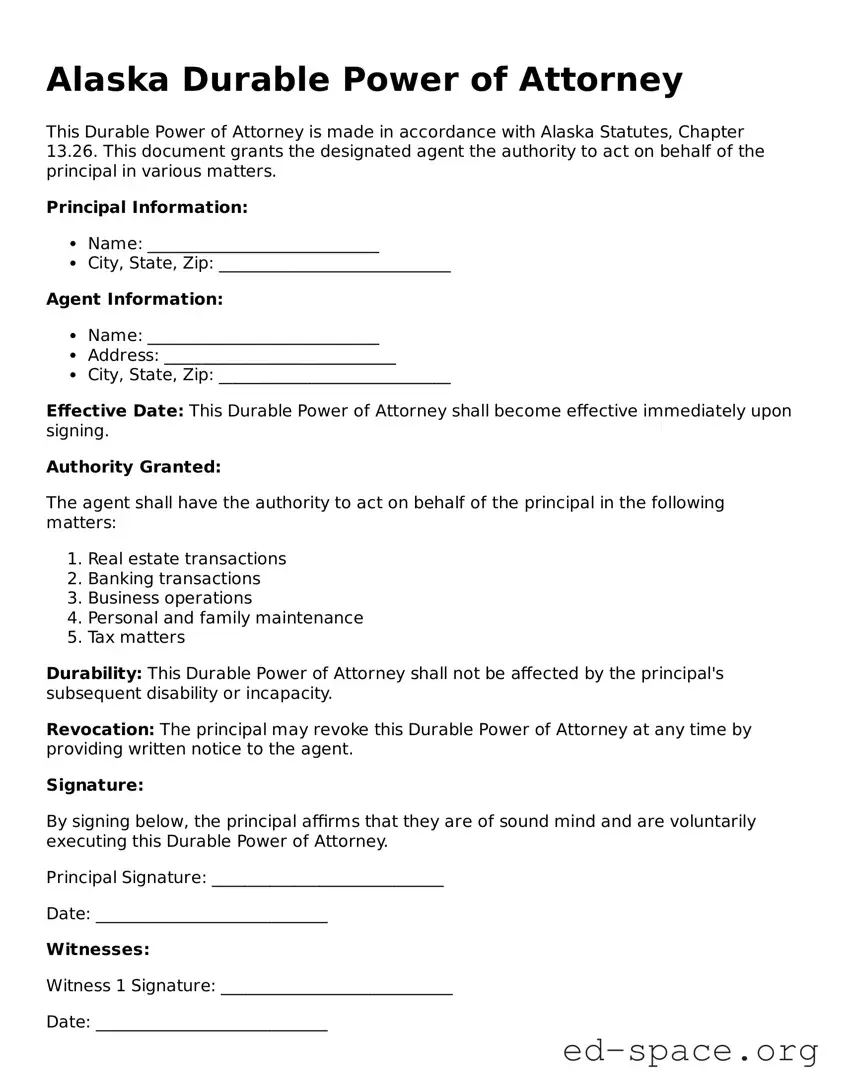
The Alaska Durable Power of Attorney form is an essential legal document that allows individuals to designate someone they trust to make financial and legal decisions on their behalf. This form is particularly useful for those who want to ensure that their affairs are managed according to their wishes in the event of incapacity or unavailability. The document remains effective even if the person who created it becomes incapacitated, providing a layer of security and peace of mind. Key aspects of the form include the ability to specify the powers granted to the agent, the option to include specific limitations or instructions, and the requirement for the principal's signature, which must be notarized to ensure its validity. Additionally, individuals can choose to revoke the power of attorney at any time, as long as they are mentally competent. Understanding the implications and responsibilities associated with this form is crucial for both the principal and the designated agent, making it a vital tool in personal and financial planning.
Alaska Durable Power of Attorney
This Durable Power of Attorney is made in accordance with Alaska Statutes, Chapter 13.26. This document grants the designated agent the authority to act on behalf of the principal in various matters.
Principal Information:
Agent Information:
Effective Date: This Durable Power of Attorney shall become effective immediately upon signing.
Authority Granted:
The agent shall have the authority to act on behalf of the principal in the following matters:
Durability: This Durable Power of Attorney shall not be affected by the principal's subsequent disability or incapacity.
Revocation: The principal may revoke this Durable Power of Attorney at any time by providing written notice to the agent.
Signature:
By signing below, the principal affirms that they are of sound mind and are voluntarily executing this Durable Power of Attorney.
Principal Signature: ____________________________
Date: ____________________________
Witnesses:
Witness 1 Signature: ____________________________
Date: ____________________________
Witness 2 Signature: ____________________________
Date: ____________________________
| Fact Name | Description |
|---|---|
| Purpose | The Alaska Durable Power of Attorney form allows an individual to designate someone to make financial decisions on their behalf if they become incapacitated. |
| Durability | This form remains effective even if the principal becomes mentally incompetent. |
| Governing Law | The form is governed by Alaska Statutes, specifically AS 13.26.330 - 13.26.360. |
| Principal's Authority | The principal can grant broad or limited powers to the agent, depending on their needs. |
| Agent's Responsibilities | The agent must act in the best interest of the principal and manage their affairs responsibly. |
| Revocation | The principal can revoke the Durable Power of Attorney at any time, as long as they are mentally competent. |
Filling out the Alaska Durable Power of Attorney form is a straightforward process that requires careful attention to detail. Once the form is completed, it will allow you to designate someone to make financial or legal decisions on your behalf if you become unable to do so. This document is crucial for ensuring that your wishes are respected and that your affairs are managed according to your preferences.
What is a Durable Power of Attorney in Alaska?
A Durable Power of Attorney (DPOA) is a legal document that allows you to appoint someone to make decisions on your behalf if you become unable to do so. This can include financial decisions, medical choices, or other important matters. The "durable" aspect means that the authority continues even if you become incapacitated.
Who can be appointed as an agent under a Durable Power of Attorney?
You can choose anyone you trust to be your agent. This could be a family member, a close friend, or a professional such as an attorney. It's important to select someone who understands your wishes and will act in your best interest.
How do I create a Durable Power of Attorney in Alaska?
To create a DPOA, you need to fill out the appropriate form. You can find templates online or consult with an attorney for assistance. Once completed, you must sign the document in front of a notary public. This ensures that the form is legally binding and recognized by institutions.
Can I revoke a Durable Power of Attorney once it is created?
Yes, you can revoke a DPOA at any time as long as you are mentally competent. To do this, you should create a written notice stating that you are revoking the previous DPOA. It's also a good idea to inform your agent and any institutions that may have a copy of the original document.
What happens if I do not have a Durable Power of Attorney?
If you do not have a DPOA and become incapacitated, the court may appoint a guardian or conservator to make decisions for you. This process can be lengthy and may not reflect your personal wishes. Having a DPOA in place can help avoid this situation and ensure your preferences are honored.
Not Clearly Identifying the Agent: Individuals often fail to provide the full name and contact information of their chosen agent. This can lead to confusion and delays in executing the power of attorney.
Inadequate Specification of Powers: Some people do not specify the powers granted to the agent. It is crucial to clearly outline what decisions the agent can make on your behalf, whether financial, medical, or both.
Neglecting to Sign and Date: A common oversight is forgetting to sign and date the document. Without a signature, the form may be considered invalid.
Failure to Have Witnesses or Notarization: In Alaska, certain powers of attorney require witnesses or notarization. Not adhering to these requirements can render the document ineffective.
Not Keeping Copies: After completing the form, individuals sometimes do not make copies for their records or for their agent. It is important to keep copies accessible for all parties involved.
A Durable Power of Attorney (DPOA) is an important legal document that allows someone to make decisions on behalf of another person. In Alaska, this form is often used alongside other documents to ensure comprehensive planning for financial and healthcare matters. Below are some common forms and documents that are frequently associated with a DPOA.
These documents work together to provide a clear plan for managing personal and financial affairs. By using a Durable Power of Attorney alongside these forms, individuals can ensure their wishes are respected and their affairs are handled appropriately in various situations.
When filling out the Alaska Durable Power of Attorney form, it is important to follow certain guidelines to ensure that the document is valid and meets your needs. Below is a list of things you should and shouldn't do.
Many people hold misconceptions about the Alaska Durable Power of Attorney form. Understanding these misconceptions is crucial for making informed decisions about legal and financial matters. Here are four common misunderstandings:
This is not true. While many people think of this document as something only older adults need, anyone can benefit from having a Durable Power of Attorney. Unexpected events can happen at any age, making it wise for young adults to consider this option.
This is misleading. The agent's authority is defined by the terms of the Durable Power of Attorney. The principal can specify what powers the agent has, which can range from handling financial matters to making healthcare decisions.
This is incorrect. A Durable Power of Attorney can be revoked or modified at any time, as long as the principal is mentally competent. It is essential to review and update the document as circumstances change.
This is a common confusion. A Durable Power of Attorney primarily deals with financial and legal decisions, while a Living Will focuses on healthcare preferences in the event of incapacity. Each serves a different purpose and should be considered separately.
Filling out and using the Alaska Durable Power of Attorney form is an important step in managing your financial and legal affairs. Here are some key takeaways to consider: