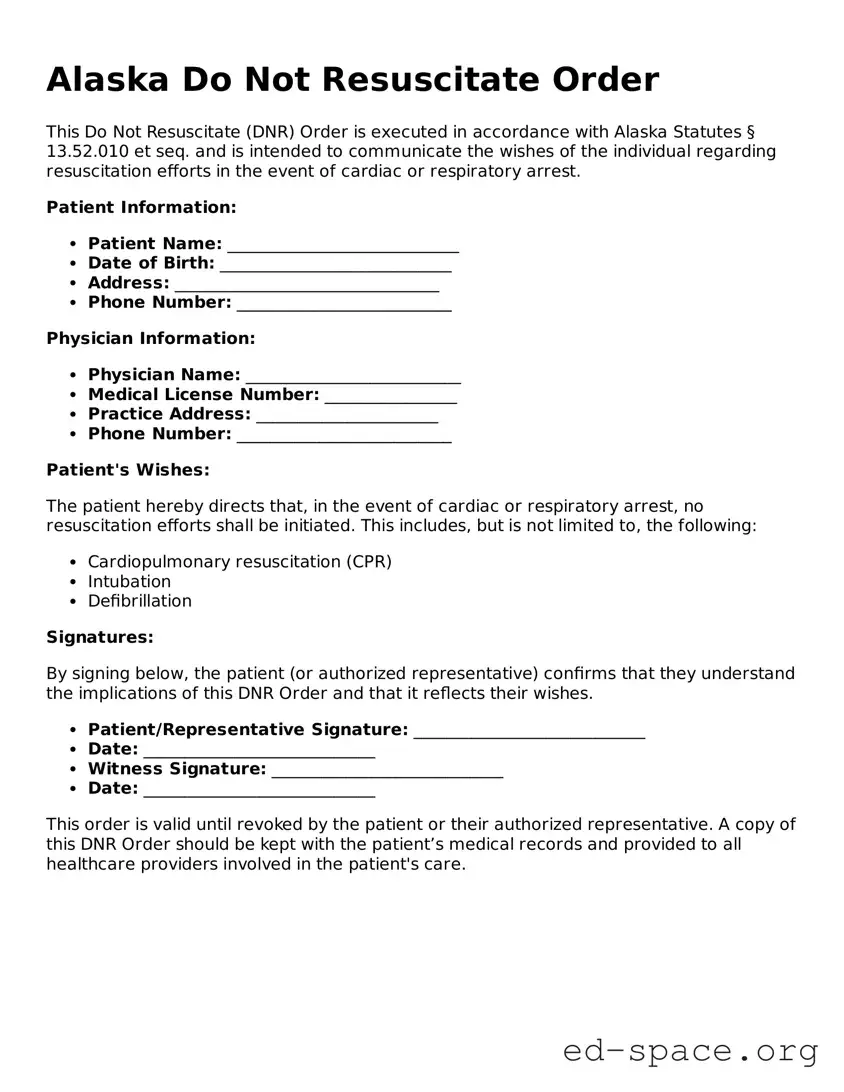
The Alaska Do Not Resuscitate Order (DNR) form is a critical document for individuals who wish to express their preferences regarding medical interventions in the event of a life-threatening situation. This form serves as a legal directive that informs healthcare providers about a patient's desire to forgo resuscitation efforts, such as cardiopulmonary resuscitation (CPR), in specific circumstances. It is essential for individuals to understand that completing this form requires careful consideration and a clear understanding of its implications. The DNR form must be signed by the patient or their legal representative and, in some cases, needs to be witnessed or notarized to ensure its validity. Furthermore, healthcare providers are obligated to honor the wishes outlined in the DNR order, which emphasizes the importance of communication between patients, families, and medical professionals. In Alaska, this form not only reflects personal values and choices but also aligns with state laws, ensuring that the patient's rights are respected during critical moments. Understanding the nuances of the DNR form can empower individuals to make informed decisions about their healthcare and end-of-life preferences.
Alaska Do Not Resuscitate Order
This Do Not Resuscitate (DNR) Order is executed in accordance with Alaska Statutes § 13.52.010 et seq. and is intended to communicate the wishes of the individual regarding resuscitation efforts in the event of cardiac or respiratory arrest.
Patient Information:
Physician Information:
Patient's Wishes:
The patient hereby directs that, in the event of cardiac or respiratory arrest, no resuscitation efforts shall be initiated. This includes, but is not limited to, the following:
Signatures:
By signing below, the patient (or authorized representative) confirms that they understand the implications of this DNR Order and that it reflects their wishes.
This order is valid until revoked by the patient or their authorized representative. A copy of this DNR Order should be kept with the patient’s medical records and provided to all healthcare providers involved in the patient's care.
| Fact Name | Details |
|---|---|
| Governing Law | The Alaska Do Not Resuscitate Order is governed by Alaska Statutes § 13.52.010 - § 13.52.120. |
| Purpose | This form allows a person to refuse resuscitation efforts in the event of a medical emergency. |
| Eligibility | Any adult who is capable of making medical decisions can complete the form. |
| Signature Requirement | The form must be signed by the individual or their legally authorized representative. |
| Witnesses | Two witnesses are required to sign the form, affirming the individual's decision. |
| Healthcare Provider Notification | Healthcare providers must be notified of the existence of the DNR order. |
| Form Validity | The DNR order remains valid until revoked by the individual or their representative. |
| Emergency Medical Services | Emergency medical services personnel must honor the DNR order in emergency situations. |
| Availability | The form can be obtained from healthcare facilities, legal offices, or online resources. |
Completing the Alaska Do Not Resuscitate Order form is an important step for individuals who wish to make their healthcare preferences clear. This document allows a person to express their wishes regarding resuscitation efforts in the event of a medical emergency. After filling out the form, it should be signed and dated, then shared with relevant healthcare providers and family members to ensure everyone is aware of these wishes.
What is an Alaska Do Not Resuscitate Order form?
The Alaska Do Not Resuscitate Order (DNR) form is a legal document that allows individuals to express their wishes regarding medical treatment in the event of a cardiac arrest or respiratory failure. By completing this form, a person can indicate that they do not wish to receive cardiopulmonary resuscitation (CPR) or other life-saving measures. This form is particularly important for those with terminal illnesses or advanced age who may wish to avoid aggressive medical interventions at the end of life.
Who can complete an Alaska DNR form?
Any adult who is capable of making their own medical decisions can complete an Alaska DNR form. This includes individuals who are at least 18 years old and are able to understand the implications of their choices. In some cases, a legally authorized representative may complete the form on behalf of an individual who is unable to do so due to a medical condition or cognitive impairment. It is essential that the person completing the form fully understands the consequences of refusing resuscitation.
How is the DNR form validated in Alaska?
To be valid, the Alaska DNR form must be signed by the individual or their authorized representative. Additionally, it should be signed by a physician who certifies that the individual has the capacity to make decisions regarding their medical care. Once completed, the form should be kept in a location that is easily accessible to emergency medical personnel. It is also advisable to provide copies to family members and healthcare providers to ensure that the individual's wishes are known and respected.
What happens if the DNR form is not available during a medical emergency?
If a DNR form is not available during a medical emergency, emergency medical personnel are generally required to perform resuscitation efforts unless they have prior knowledge of the individual's wishes. This can lead to unwanted medical interventions, which may not align with the individual's preferences. Therefore, it is crucial to ensure that the DNR form is readily accessible and that family members and healthcare providers are aware of its existence.
Can an Alaska DNR form be revoked or changed?
Yes, an individual can revoke or change their Alaska DNR form at any time. This can be done by destroying the existing form and completing a new one that reflects the individual's current wishes. It is important to inform healthcare providers and family members of any changes to ensure that the most recent directives are followed. Keeping an updated copy of the DNR form is essential for clarity in medical situations.
Failing to properly complete the patient identification section. This section is crucial as it ensures that the order is linked to the correct individual. Missing or incorrect information can lead to confusion and unintended consequences.
Not having the form signed by a physician. A valid Do Not Resuscitate Order must be signed by a licensed medical professional. Without this signature, the order may not be honored by emergency medical personnel.
Overlooking the need for a witness signature. In Alaska, some versions of the form require a witness signature to validate the document. Neglecting this step can render the order ineffective.
Using outdated forms. Medical regulations and forms can change. Always ensure you are using the most current version of the Alaska Do Not Resuscitate Order form to avoid complications.
When considering end-of-life care, individuals and families often encounter various forms and documents that work alongside the Alaska Do Not Resuscitate (DNR) Order form. These documents help ensure that a person's healthcare wishes are respected and that their preferences for medical treatment are clearly communicated. Below is a list of other important forms that may be used in conjunction with the DNR Order.
Having these documents in place can provide peace of mind and clarity during difficult times. They serve to protect individual rights and ensure that healthcare providers and family members understand and respect a person's wishes regarding medical treatment and end-of-life care.
A Do Not Resuscitate (DNR) Order form is an important document that outlines a person's wishes regarding medical treatment in the event of a cardiac arrest. Several other documents serve similar purposes in healthcare decision-making. Below are four such documents, each with a brief explanation of its similarities to a DNR Order.
When filling out the Alaska Do Not Resuscitate (DNR) Order form, it is crucial to follow specific guidelines to ensure that your wishes are clearly documented and respected. Here is a list of things you should and shouldn't do:
Understanding the Alaska Do Not Resuscitate (DNR) Order form is crucial for making informed decisions about end-of-life care. Here are nine common misconceptions about the DNR form, along with clarifications.
By addressing these misconceptions, individuals can better navigate the complexities of end-of-life decisions and ensure their wishes are respected.
Filling out and utilizing the Alaska Do Not Resuscitate (DNR) Order form is an important step in ensuring your healthcare wishes are respected. Here are some key takeaways to keep in mind:
Taking these steps can provide peace of mind, knowing that your healthcare preferences will be honored. Act promptly to ensure your wishes are documented and communicated effectively.