Homepage Free Divorce Settlement Agreement Form for Alaska
Content Overview

When navigating the complexities of divorce in Alaska, one critical document that couples must address is the Divorce Settlement Agreement form. This form serves as a comprehensive outline of the terms agreed upon by both parties regarding the division of assets, debts, and any arrangements concerning child custody and support. It is essential for ensuring that both individuals have a clear understanding of their rights and responsibilities post-divorce. The agreement typically covers various aspects, such as the distribution of marital property, alimony provisions, and parenting plans. By formalizing these agreements in writing, the form helps to prevent future disputes and provides a legal framework for the separation process. Understanding the components and implications of the Divorce Settlement Agreement is vital for anyone seeking to finalize their divorce in Alaska efficiently and fairly.

Document Preview

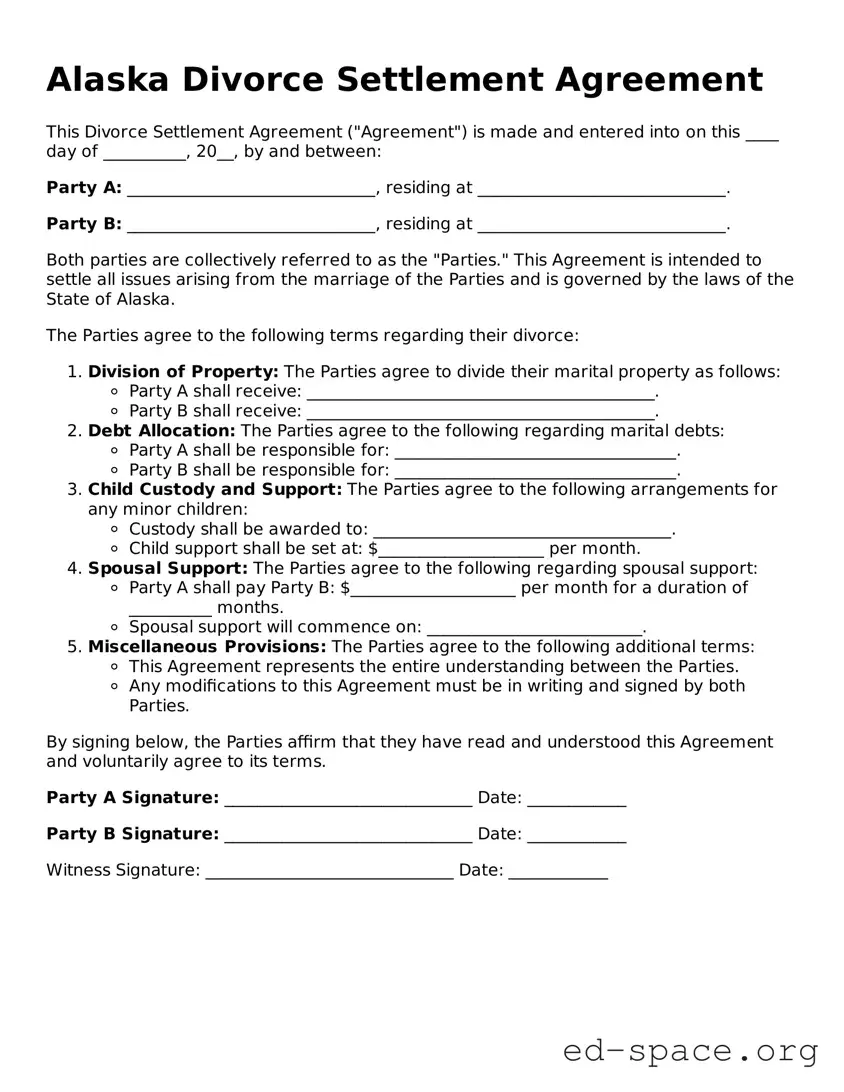
Alaska Divorce Settlement Agreement

This Divorce Settlement Agreement ("Agreement") is made and entered into on this ____ day of __________, 20__, by and between:

Party A: ______________________________, residing at ______________________________.

Party B: ______________________________, residing at ______________________________.

Both parties are collectively referred to as the "Parties." This Agreement is intended to settle all issues arising from the marriage of the Parties and is governed by the laws of the State of Alaska.

The Parties agree to the following terms regarding their divorce:

  1. Division of Property: The Parties agree to divide their marital property as follows:
    • Party A shall receive: __________________________________________.
    • Party B shall receive: __________________________________________.
  2. Debt Allocation: The Parties agree to the following regarding marital debts:
    • Party A shall be responsible for: __________________________________.
    • Party B shall be responsible for: __________________________________.
  3. Child Custody and Support: The Parties agree to the following arrangements for any minor children:
    • Custody shall be awarded to: ____________________________________.
    • Child support shall be set at: $____________________ per month.
  4. Spousal Support: The Parties agree to the following regarding spousal support:
    • Party A shall pay Party B: $____________________ per month for a duration of __________ months.
    • Spousal support will commence on: __________________________.
  5. Miscellaneous Provisions: The Parties agree to the following additional terms:
    • This Agreement represents the entire understanding between the Parties.
    • Any modifications to this Agreement must be in writing and signed by both Parties.

By signing below, the Parties affirm that they have read and understood this Agreement and voluntarily agree to its terms.

Party A Signature: ______________________________ Date: ____________

Party B Signature: ______________________________ Date: ____________

Witness Signature: ______________________________ Date: ____________

PDF Form Details

Fact Name Details
Governing Law The Alaska Divorce Settlement Agreement is governed by Alaska Statutes Title 25, specifically under Chapter 24 regarding dissolution of marriage.
Purpose This form is used to outline the terms of a divorce settlement between spouses, including property division, child custody, and support obligations.
Filing Requirement The completed agreement must be filed with the court as part of the divorce proceedings to ensure it is legally recognized.
Mutual Agreement Both parties must voluntarily agree to the terms outlined in the settlement for it to be valid and enforceable.
Modification Once approved by the court, the terms of the settlement can only be modified through a subsequent court order, ensuring stability for all parties involved.

Alaska Divorce Settlement Agreement: Usage Guidelines

After obtaining the Alaska Divorce Settlement Agreement form, you will need to carefully fill it out to reflect the terms of your divorce. This form is essential for outlining how you and your spouse have agreed to handle various aspects of your separation. Once completed, you will submit it to the court as part of your divorce proceedings.

  1. Start by entering your name and your spouse's name at the top of the form.
  2. Provide your current addresses, including city, state, and zip code.
  3. Fill in the date of your marriage and the date of separation.
  4. Indicate whether you have any children together. If so, list their names and ages.
  5. Detail the division of property. Specify which assets each party will receive.
  6. Outline any debts that need to be divided. Clearly state who is responsible for each debt.
  7. Discuss spousal support, if applicable. Note the amount and duration of support payments.
  8. If applicable, include child support details. Indicate the amount and payment schedule.
  9. Review the completed form for accuracy. Ensure all sections are filled out completely.
  10. Sign and date the form at the designated areas. Your spouse should also sign it if both parties agree.

Your Questions, Answered

What is an Alaska Divorce Settlement Agreement form?

The Alaska Divorce Settlement Agreement form is a legal document that outlines the terms and conditions agreed upon by both spouses during a divorce. This form typically includes details about the division of property, child custody arrangements, child support, and spousal support. It serves as a comprehensive guide to how both parties will handle their responsibilities and rights post-divorce, ensuring that everything is clear and agreed upon to avoid future disputes.

How do I fill out the Alaska Divorce Settlement Agreement form?

Filling out the Alaska Divorce Settlement Agreement form involves several steps. First, both spouses should discuss and agree on all relevant issues, such as asset division and custody arrangements. Once you have reached an agreement, you can begin completing the form. Be sure to provide accurate information about both parties, including financial details and any children involved. It’s important to read the form carefully to ensure that all sections are completed. If you have questions, seeking assistance from a legal professional can be beneficial.

Is the Divorce Settlement Agreement legally binding?

Yes, once both parties sign the Alaska Divorce Settlement Agreement form and it is submitted to the court, it becomes a legally binding document. This means that both spouses are obligated to adhere to the terms outlined in the agreement. If one party fails to comply, the other can seek enforcement through the court. It’s crucial to ensure that the agreement is fair and comprehensive before signing, as it will dictate the terms of your post-divorce life.

What happens if we cannot agree on the terms?

If you and your spouse cannot reach an agreement on the terms of the divorce, you may need to consider mediation or court intervention. Mediation involves a neutral third party who can help facilitate discussions and negotiations. If mediation fails, the case may go to court, where a judge will make decisions regarding asset division, child custody, and support. It’s advisable to remain open to negotiation and compromise, as this can lead to a more amicable resolution.

Common mistakes

  1. Failing to provide complete information. Individuals often leave sections blank or provide incomplete details, which can delay the processing of the agreement.

  2. Not disclosing all assets and debts. Parties may overlook certain assets or debts, leading to an unfair settlement.

  3. Using vague language. Ambiguous terms can create confusion regarding the intentions of the parties involved.

  4. Ignoring state-specific requirements. Each state has unique rules regarding divorce settlements, and failing to adhere to these can result in rejection of the agreement.

  5. Not including a parenting plan when children are involved. This is essential for outlining custody arrangements and visitation schedules.

  6. Forgetting to sign and date the document. An unsigned or undated agreement is not legally binding.

  7. Overlooking tax implications. Individuals may not consider how asset division will affect their tax situation.

  8. Failing to seek legal advice. Many people attempt to complete the form without consulting a legal professional, which can lead to mistakes.

  9. Not reviewing the agreement before submission. A thorough review can help catch errors or omissions.

  10. Using outdated forms. It's important to ensure that the most current version of the Divorce Settlement Agreement form is being used.

Documents used along the form

When navigating the process of divorce in Alaska, several key documents often accompany the Divorce Settlement Agreement. Each of these forms serves a specific purpose, helping to ensure that all aspects of the divorce are addressed comprehensively and fairly. Below is a list of some commonly used documents that may be relevant in conjunction with the Divorce Settlement Agreement.

  • Petition for Divorce: This is the initial document filed by one spouse to initiate the divorce process. It outlines the basic details of the marriage, the grounds for divorce, and any requests for relief, such as child custody or property division.
  • Financial Disclosure Statement: This form requires both parties to disclose their financial information, including income, expenses, assets, and debts. Transparency in finances is crucial for fair negotiations and settlements.
  • Child Custody Agreement: If children are involved, this document specifies the arrangements for custody, visitation, and parenting responsibilities. It aims to prioritize the best interests of the children while addressing both parents' rights.
  • Property Settlement Agreement: This form outlines how marital property and debts will be divided between the spouses. It details each party's rights and obligations regarding the distribution of assets and liabilities.
  • Final Judgment of Divorce: Once the divorce is finalized, this document is issued by the court. It officially ends the marriage and includes the terms of the settlement, custody arrangements, and any other court orders.

Understanding these documents can help individuals prepare for the divorce process more effectively. Each form plays a vital role in ensuring that the divorce is handled smoothly and that all parties' rights and responsibilities are clearly defined.

Similar forms

  • Separation Agreement: This document outlines the terms of separation between spouses. It covers similar topics like asset division, child custody, and support obligations.
  • Child Custody Agreement: Focused specifically on the arrangements for children, this document details custody arrangements and visitation schedules, akin to the child-related provisions in a Divorce Settlement Agreement.
  • Property Settlement Agreement: This agreement specifically addresses the division of property and debts, similar to the asset distribution section of the Divorce Settlement Agreement.
  • Marital Settlement Agreement: This document serves to settle all issues related to the marriage, including finances and child-related matters, much like a Divorce Settlement Agreement.
  • Postnuptial Agreement: Created after marriage, this document outlines how assets will be divided in the event of a divorce, similar to the provisions found in a Divorce Settlement Agreement.
  • Prenuptial Agreement: This agreement is established before marriage and outlines asset distribution, which can be referenced during divorce proceedings, mirroring aspects of a Divorce Settlement Agreement.
  • Alimony Agreement: This document specifically addresses spousal support, detailing the amount and duration of payments, similar to the support provisions in a Divorce Settlement Agreement.
  • Child Support Agreement: This outlines the financial support for children post-divorce, paralleling the child support aspects found in a Divorce Settlement Agreement.
  • Mutual Release Agreement: This document releases both parties from future claims against each other, similar to the finality established in a Divorce Settlement Agreement.
  • Final Judgment of Divorce: This court order finalizes the divorce and includes the terms agreed upon, similar to the legal enforceability of a Divorce Settlement Agreement.

Dos and Don'ts

When filling out the Alaska Divorce Settlement Agreement form, it’s important to follow some best practices to ensure accuracy and clarity. Here’s a helpful list of dos and don’ts:

  • Do read the instructions carefully before starting. Understanding the requirements can save time and prevent mistakes.
  • Do provide complete and accurate information. Double-check names, dates, and financial details to avoid any issues later.
  • Do keep a copy of the completed form for your records. This will be useful for future reference or if any questions arise.
  • Do seek legal advice if you have questions or concerns. A professional can help clarify complex issues.
  • Don't leave any sections blank unless instructed. Incomplete forms can lead to delays or rejections.
  • Don't use ambiguous language. Be clear and specific to ensure that your intentions are understood.
  • Don't rush through the process. Take your time to ensure that all information is accurate and complete.
  • Don't forget to sign and date the form. An unsigned document may not be considered valid.

Misconceptions

Understanding the Alaska Divorce Settlement Agreement form can be challenging, and several misconceptions often arise. Here are six common misunderstandings about this important document:

  • 1. It is only necessary for couples with children. Many believe that a Divorce Settlement Agreement is only relevant for those with children. However, this document is essential for all divorcing couples, regardless of whether they have kids. It outlines the division of assets, debts, and other important matters.
  • 2. The form is the same for all divorces in Alaska. Another misconception is that there is a one-size-fits-all form for divorce settlements. In reality, the specifics of the agreement can vary significantly based on individual circumstances, including the couple's assets and debts.
  • 3. You can’t modify the agreement once it’s signed. Some people think that once the Divorce Settlement Agreement is signed, it cannot be changed. While it is true that modifications can be challenging, they are possible under certain circumstances, especially if both parties agree to the changes.
  • 4. The court automatically approves the agreement. There is a belief that if both parties sign the agreement, the court will automatically approve it. In fact, the court reviews the agreement to ensure it is fair and complies with state laws before granting a divorce.
  • 5. Legal representation is not necessary. Many individuals think they can navigate the divorce process without legal help. While it is possible to complete the form without an attorney, having legal representation can help ensure that rights are protected and the agreement is comprehensive.
  • 6. The form is only about financial matters. Some may assume that the Divorce Settlement Agreement only addresses financial issues. However, it can also cover matters such as property division, spousal support, and other personal arrangements, making it a crucial document for both parties.

By addressing these misconceptions, individuals can better understand the importance of the Alaska Divorce Settlement Agreement form and navigate the divorce process more effectively.

Key takeaways

Filling out the Alaska Divorce Settlement Agreement form can seem daunting, but understanding the key points can simplify the process. Here are some important takeaways to keep in mind:

  1. Complete Information: Ensure that all personal details, including names and addresses, are accurately filled out. This helps avoid delays.
  2. Property Division: Clearly outline how you and your spouse will divide your assets and debts. This section is crucial for a fair settlement.
  3. Child Custody Arrangements: If children are involved, specify custody arrangements, visitation schedules, and child support obligations.
  4. Spousal Support: If applicable, include details about any spousal support, including the amount and duration of payments.
  5. Mutual Agreement: Both parties must agree to the terms outlined in the form. Ensure that both signatures are present before submission.
  6. Review Before Submission: Carefully review the entire document for errors or omissions. Small mistakes can lead to complications later.
  7. Legal Advice: Consider seeking legal advice, especially if there are complex issues involved. A professional can provide valuable guidance.
  8. File with the Court: After completing the form, file it with the appropriate court. Be aware of any filing fees that may apply.
  9. Keep Copies: Retain copies of the signed agreement and any related documents for your records. This ensures you have access to important information.

By following these key points, you can navigate the Alaska Divorce Settlement Agreement process with greater confidence and clarity.