When it comes to transferring property ownership in Alaska, understanding the Alaska Deed form is essential for both buyers and sellers. This legal document serves as a formal declaration that one party is transferring their interest in a property to another. The form includes critical details such as the names of the parties involved, a description of the property, and the terms of the transfer. It also requires signatures from both the grantor, who is giving up their rights, and the grantee, who is receiving them. Additionally, the Alaska Deed form must be notarized to ensure its authenticity and may need to be recorded with the local government to provide public notice of the change in ownership. Familiarity with this form not only helps streamline the property transfer process but also protects the rights of all parties involved, making it a vital tool in real estate transactions across the state.
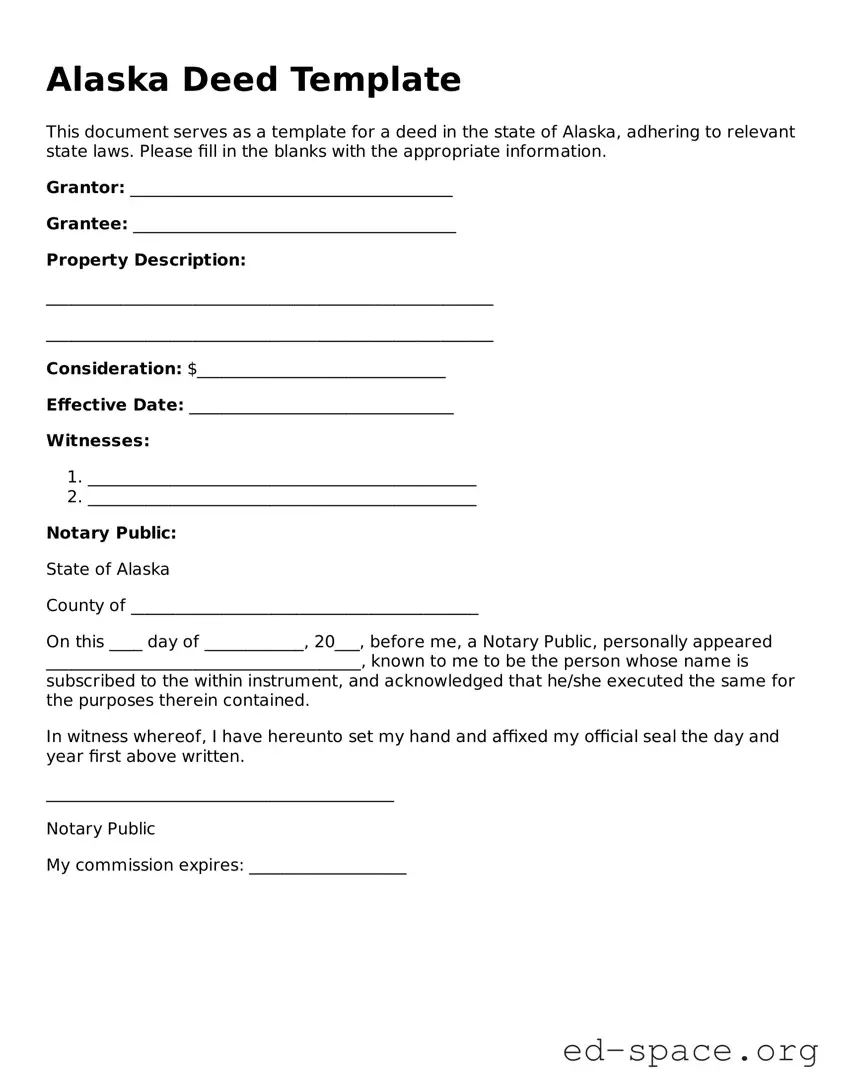
Alaska Deed Template
This document serves as a template for a deed in the state of Alaska, adhering to relevant state laws. Please fill in the blanks with the appropriate information.
Grantor: _______________________________________
Grantee: _______________________________________
Property Description:
______________________________________________________
______________________________________________________
Consideration: $______________________________
Effective Date: ________________________________
Witnesses:
Notary Public:
State of Alaska
County of __________________________________________
On this ____ day of ____________, 20___, before me, a Notary Public, personally appeared ______________________________________, known to me to be the person whose name is subscribed to the within instrument, and acknowledged that he/she executed the same for the purposes therein contained.
In witness whereof, I have hereunto set my hand and affixed my official seal the day and year first above written.
__________________________________________
Notary Public
My commission expires: ___________________
| Fact Name | Details |
|---|---|
| Governing Law | The Alaska Deed form is governed by Alaska Statutes, specifically Title 34, Chapter 15. |
| Types of Deeds | Alaska recognizes several types of deeds, including warranty deeds, quitclaim deeds, and special warranty deeds. |
| Transfer of Property | The deed serves as the legal document to transfer ownership of real property from one party to another. |
| Signature Requirements | For a deed to be valid in Alaska, it must be signed by the grantor (the person transferring the property). |
| Notarization | While notarization is not mandatory for all deeds in Alaska, it is highly recommended to ensure validity and acceptance. |
| Recording the Deed | To protect ownership rights, the deed should be recorded with the local recorder’s office in the district where the property is located. |
| Legal Description | The deed must include a legal description of the property being transferred, which accurately describes its boundaries. |
Once you have the Alaska Deed form in hand, it's important to ensure that all necessary information is filled out accurately. This form is essential for transferring property ownership, so taking the time to complete it correctly will help avoid complications later on.
What is an Alaska Deed form?
An Alaska Deed form is a legal document used to transfer ownership of real property in the state of Alaska. This form outlines the details of the transaction, including the names of the parties involved, a description of the property being transferred, and any conditions or restrictions related to the transfer. It is essential for ensuring that the transfer is legally recognized and protects the rights of both the seller and the buyer.
What types of Deeds are available in Alaska?
In Alaska, there are several types of deeds that can be used, including warranty deeds, quitclaim deeds, and special warranty deeds. A warranty deed provides the highest level of protection to the buyer, as it guarantees that the seller has clear title to the property and the right to sell it. A quitclaim deed, on the other hand, transfers whatever interest the seller has in the property without any guarantees. Special warranty deeds offer a middle ground, ensuring that the seller has not caused any title issues during their ownership.
How do I complete an Alaska Deed form?
Completing an Alaska Deed form requires careful attention to detail. Begin by clearly identifying the parties involved in the transaction. Include the full legal names of the seller(s) and buyer(s). Next, provide a detailed description of the property, including its legal description, which can typically be found in previous deed documents or property tax records. After filling out the necessary information, both parties must sign the deed in the presence of a notary public. Finally, the completed deed should be recorded with the local recorder’s office to make the transfer official.
Do I need an attorney to create an Alaska Deed form?
While it is not legally required to have an attorney to create an Alaska Deed form, it is highly advisable. An attorney can help ensure that the deed is correctly completed and complies with all state laws. They can also provide guidance on the implications of the transfer and help address any potential issues that may arise. For peace of mind and to avoid costly mistakes, consulting with a legal professional is a prudent step in the process.
Not including the correct names of the grantor and grantee. Ensure that full legal names are used.
Failing to provide a complete and accurate property description. This can lead to confusion about what property is being transferred.
Not signing the deed. Both the grantor and grantee must sign for the deed to be valid.
Overlooking the need for notarization. In Alaska, a deed must be notarized to be legally binding.
Forgetting to date the deed. A date is essential to establish when the transfer takes place.
Using the wrong type of deed. Different deeds serve different purposes, so choose the appropriate one.
Neglecting to check for existing liens or encumbrances on the property. This can affect ownership rights.
Not providing a proper legal description of the property. A vague description can lead to legal disputes.
Failing to record the deed with the local government. Recording is necessary to protect ownership rights.
Ignoring local laws and regulations. Each municipality may have specific requirements for deeds.
When engaging in real estate transactions in Alaska, the Deed form is just one of several important documents that may be required. Each of these forms serves a specific purpose and plays a vital role in ensuring that the transfer of property is conducted smoothly and legally. Below is a list of other common forms and documents often used alongside the Alaska Deed form.
Understanding these documents is crucial for anyone involved in real estate transactions in Alaska. Each form contributes to the legal framework that governs property transfers, ensuring that all parties are protected and that the process adheres to state laws and regulations.
The Deed form is a crucial legal document in property transactions, but it shares similarities with several other documents. Understanding these similarities can help clarify their roles in legal proceedings and transactions. Below are six documents that are similar to the Deed form:
When filling out the Alaska Deed form, it’s important to follow certain guidelines to ensure accuracy and compliance. Here’s a list of things you should and shouldn’t do:
Following these tips will help ensure your Alaska Deed form is filled out properly and efficiently.
Understanding the Alaska Deed form can be complicated, and several misconceptions often arise. Here are eight common misunderstandings:
Many people think all deeds serve the same purpose. In reality, there are different types of deeds, such as warranty deeds and quitclaim deeds, each with specific functions and protections.
A deed is not the same as a title. The deed is the legal document that transfers ownership, while the title refers to the legal right to own the property.
While it is possible to prepare a deed without legal assistance, it is often wise to consult a lawyer. A professional can ensure the deed meets all legal requirements and protects your interests.
This is not true. A deed can be amended or revoked, but the process may require additional legal steps and documentation.
In Alaska, notarization is not always necessary for a deed to be valid. However, having a deed notarized can help prevent disputes in the future.
Deeds are not only for sales. They are also used in gifting property, transferring ownership, or when adding or removing someone from the title.
Filing a deed with the appropriate local government office is essential for the transfer of ownership to be recognized legally. Failure to file can lead to complications.
Recording a deed does not make it immune to challenges. Legal disputes can arise regarding the validity of the deed or the circumstances surrounding its execution.
Filling out and using the Alaska Deed form requires careful attention to detail. Here are some key takeaways to keep in mind:
Taking these steps seriously will help ensure a smooth property transfer process in Alaska. Act promptly to avoid any issues down the line.