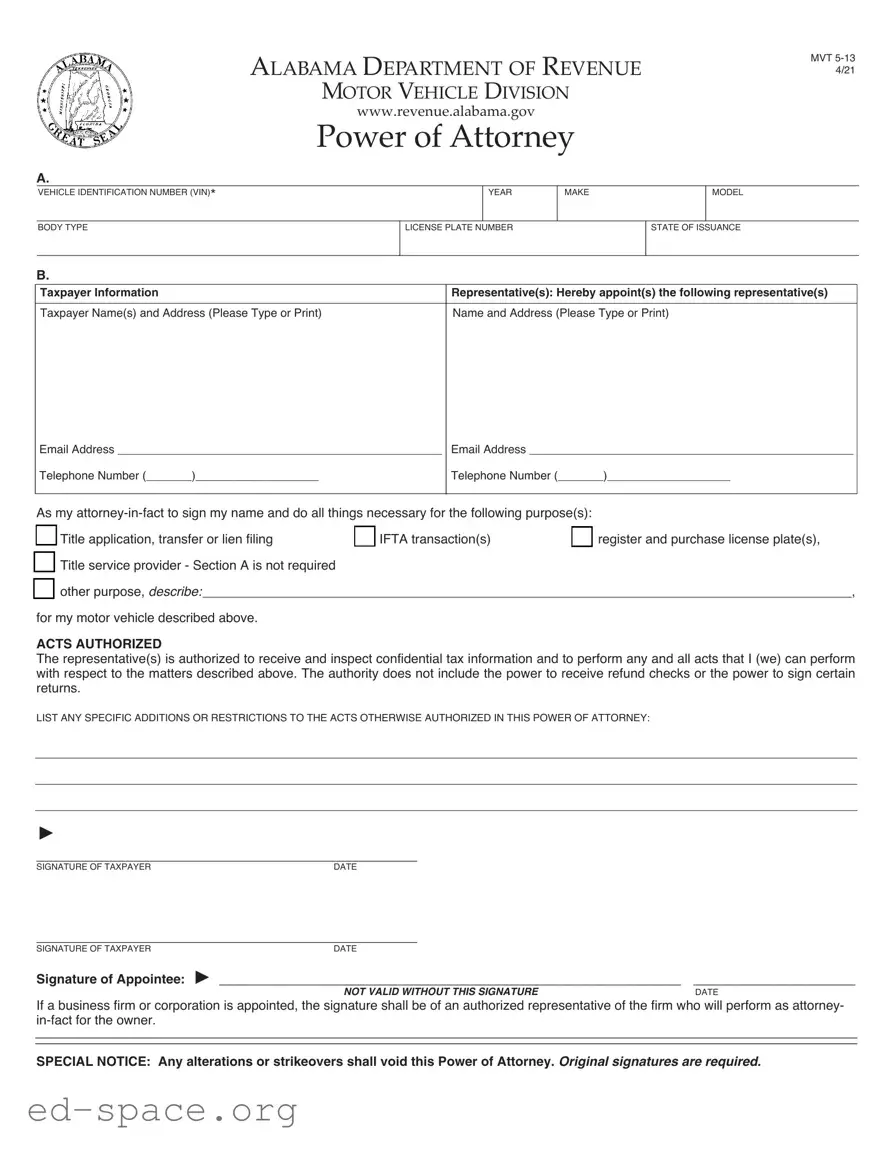
The Alabama Vehicle Power of Attorney (POA) MVT 5-13 (Rev 09-19) form serves as a crucial tool for vehicle owners in the state, enabling them to delegate specific powers related to their vehicles to another individual. This form is particularly useful in situations where the owner cannot be present to complete necessary transactions, such as selling a vehicle, transferring title, or registering a vehicle. By completing this form, the vehicle owner can authorize someone else to act on their behalf, ensuring that important tasks can proceed smoothly and efficiently. The form requires essential information, including the names and addresses of both the vehicle owner and the appointed agent, as well as details about the vehicle itself. It also outlines the specific powers granted to the agent, providing clarity and security for both parties involved. Understanding the nuances of this form is vital for anyone looking to navigate vehicle transactions in Alabama without the hassle of being physically present for every step.
ALABAMA DEPARTMENT OF REVENUE
MOTOR VEHICLE DIVISION
www.revenue.alabama.gov
Power of Attorney
MVT
A.
VEHICLE IDENTIFICATION NUMBER (VIN)* |
YEAR |
MAKE |
MODEL |
BODY TYPE |
LICENSE PLATE NUMBER |
|
STATE OF ISSUANCE |
B. |
|
|
|
Taxpayer Information |
Representative(s): Hereby appoint(s) the following representative(s) |
||
Taxpayer Name(s) and Address (Please Type or Print) |
Name and Address (Please Type or Print) |
||
Email Address __________________________________________________ Email Address __________________________________________________
Telephone Number (_______)___________________ |
Telephone Number (_______)___________________ |
|
As my |
||
6 Title application, transfer or lien filing |
6 IFTA transaction(s) |
6 register and purchase license plate(s), |
6Title service provider - Section A is not required
6other purpose, describe:_________________________________________________________________________________________, for my motor vehicle described above.
ACTS AUTHORIZED
The representative(s) is authorized to receive and inspect confidential tax information and to perform any and all acts that I (we) can perform with respect to the matters described above. The authority does not include the power to receive refund checks or the power to sign certain returns.
LIST ANY SPECIFIC ADDITIONS OR RESTRICTIONS TO THE ACTS OTHERWISE AUTHORIZED IN THIS POWER OF ATTORNEY:
V
_______________________________________________
SIGNATURE OF TAXPAYERDATE
_______________________________________________
SIGNATURE OF TAXPAYERDATE
Signature of Appointee: V _________________________________________________________ |
____________________ |
NOT VALID WITHOUT THIS SIGNATURE |
DATE |
If a business firm or corporation is appointed, the signature shall be of an authorized representative of the firm who will perform as attorney-
SPECIAL NOTICE: Any alterations or strikeovers shall void this Power of Attorney. Original signatures are required.
| Fact Name | Description |
|---|---|
| Purpose | The Alabama Vehicle POA MVT 5-13 (Rev 09-19) form is used to grant someone the authority to act on behalf of a vehicle owner for specific transactions related to the vehicle. |
| Governing Law | This form is governed by Alabama Code Title 32, Chapter 8, which outlines the regulations regarding vehicle powers of attorney in the state. |
| Usage | Commonly, this form is utilized for tasks such as transferring vehicle ownership, applying for a title, or registering a vehicle. |
| Validity | Once completed and signed, the authority granted through this form remains valid until revoked by the vehicle owner or until the specific transaction is completed. |
Filling out the Alabama Vehicle POA MVT 5-13 form is a straightforward process. Once completed, you can use it to authorize someone to act on your behalf regarding vehicle matters. Follow these steps to ensure the form is filled out correctly.
After completing the form, ensure that all information is accurate. You may need to submit it to the appropriate authorities or give it to the person you have authorized. Keep a copy for your records as well.
What is the Alabama Vehicle POA MVT 5-13 (Rev 09-19) form?
The Alabama Vehicle POA MVT 5-13 form is a Power of Attorney document specifically designed for vehicle transactions in Alabama. It allows an individual to authorize another person to act on their behalf regarding vehicle-related matters, such as registration, titling, and transfer of ownership.
Who can use this form?
This form can be used by any vehicle owner in Alabama who wishes to delegate authority to another person. This could include situations where the owner is unable to handle the transaction due to absence, illness, or other personal reasons.
How do I complete the form?
To complete the form, fill in the required fields with accurate information. This includes the names and addresses of both the vehicle owner and the appointed agent. Ensure that you provide details about the vehicle, such as the make, model, and Vehicle Identification Number (VIN). After filling out the form, both parties must sign it to validate the Power of Attorney.
Is the form required to be notarized?
No, the Alabama Vehicle POA MVT 5-13 form does not require notarization. However, it is advisable to keep a copy of the signed document for your records, as it may be requested during vehicle transactions.
What types of transactions can be authorized with this form?
This form can authorize a variety of vehicle-related transactions, including but not limited to, registering a vehicle, transferring ownership, obtaining a duplicate title, and handling any necessary paperwork with the Alabama Department of Revenue.
Can I revoke the Power of Attorney?
Yes, the Power of Attorney can be revoked at any time by the vehicle owner. It is recommended to provide written notice to the appointed agent and keep a record of the revocation for future reference.
Is there a fee associated with using this form?
There is no fee specifically for completing the Alabama Vehicle POA MVT 5-13 form itself. However, there may be fees associated with the vehicle transactions that the appointed agent undertakes on your behalf, such as registration or title transfer fees.
Where do I submit the completed form?
The completed form should be submitted to the appropriate Alabama Department of Revenue office or the local county licensing office where the vehicle transaction is taking place. Ensure that all required documents are included to avoid any delays.
What should I do if my agent does not fulfill their responsibilities?
If your agent fails to act in your best interest or does not fulfill their responsibilities, you may revoke the Power of Attorney. It is important to communicate your concerns directly and consider appointing a new agent if necessary.
Can I use this form for vehicles registered in other states?
No, the Alabama Vehicle POA MVT 5-13 form is specifically for vehicles registered in Alabama. For vehicles registered in other states, you should consult the respective state's regulations and forms for Power of Attorney documentation.
Failing to provide complete information. It's essential to fill in all required fields accurately. Missing information can lead to processing delays.
Not signing the form. A signature is necessary for the form to be valid. Without it, the document cannot be processed.
Using incorrect dates. Ensure that all dates are accurate and formatted correctly. An incorrect date can cause confusion and result in rejection.
Not including the vehicle identification number (VIN). The VIN is crucial for identifying the vehicle. Omitting it can lead to issues in the authorization process.
Providing outdated information. Always use current details for the vehicle and the person granting power of attorney. Outdated information can complicate matters.
Neglecting to check for errors. Review the form for any typos or mistakes before submission. Simple errors can lead to significant delays.
Not providing identification. Some forms may require a copy of the ID for verification. Failing to include this can result in processing issues.
Submitting the form without a witness or notarization, if required. Certain situations may necessitate additional verification. Make sure to follow the guidelines.
Ignoring state-specific requirements. Each state may have different rules regarding vehicle power of attorney forms. Familiarize yourself with Alabama's specific regulations.
The Alabama Vehicle POA MVT 5-13 (Rev 09-19) form allows individuals to designate someone else to handle vehicle-related matters on their behalf. When dealing with vehicle transactions, several other forms and documents may be required to ensure a smooth process. Below is a list of commonly used documents that often accompany the POA form in Alabama.
Having these documents ready can facilitate a smoother transaction when dealing with vehicle matters in Alabama. It’s always a good idea to consult with a professional if there are any uncertainties regarding the necessary paperwork.
The Alabama Vehicle POA MVT 5-13 (Rev 09-19) form is a specific type of document that allows an individual to designate another person to act on their behalf regarding vehicle-related matters. Several other documents serve similar purposes in various contexts. Here are five documents that share similarities with the Alabama Vehicle POA:
Each of these documents serves to empower an individual to act on behalf of another, whether in vehicle matters, financial decisions, or health care choices. Understanding these similarities can help in choosing the right document for your specific needs.
When filling out the Alabama Vehicle POA MVT 5-13 (Rev 09-19) form, it’s essential to approach the process with care. Here’s a list of things you should and shouldn’t do to ensure a smooth experience.
The Alabama Vehicle POA MVT 5-13 (Rev 09-19) form is often misunderstood. Below are some common misconceptions regarding this form, along with clarifications to provide accurate information.
Understanding these misconceptions can help individuals navigate the process of using the Alabama Vehicle POA MVT 5-13 (Rev 09-19) form more effectively.
When using the Alabama Vehicle POA MVT 5-13 (Rev 09-19) form, there are several important points to keep in mind. Here are the key takeaways:
Understanding these key points will help ensure a smooth process when using the Alabama Vehicle POA MVT 5-13 form.