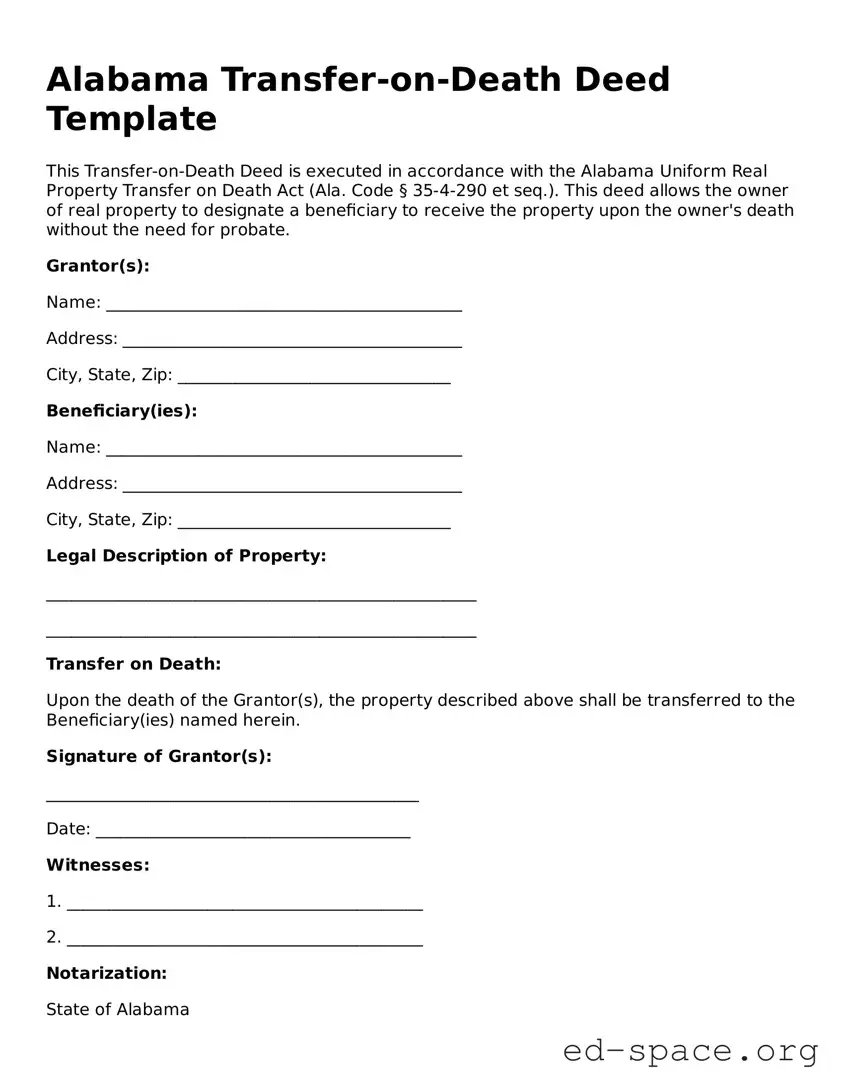
The Alabama Transfer-on-Death Deed form serves as a valuable estate planning tool, allowing property owners to transfer real estate to designated beneficiaries upon their death without the need for probate. This form provides a straightforward mechanism for individuals to ensure that their property is passed on according to their wishes, thereby simplifying the transfer process and potentially reducing associated costs. Key elements of the form include the identification of the property being transferred, the designation of beneficiaries, and the requirement for the deed to be signed and notarized. Importantly, the Transfer-on-Death Deed does not affect the owner's rights to the property during their lifetime, allowing for continued use and control. Additionally, this form must be recorded with the appropriate county office to be effective, ensuring that the transfer is legally recognized. Understanding these aspects is crucial for property owners looking to streamline their estate planning and secure their legacy for future generations.
Alabama Transfer-on-Death Deed Template
This Transfer-on-Death Deed is executed in accordance with the Alabama Uniform Real Property Transfer on Death Act (Ala. Code § 35-4-290 et seq.). This deed allows the owner of real property to designate a beneficiary to receive the property upon the owner's death without the need for probate.
Grantor(s):
Name: ___________________________________________
Address: _________________________________________
City, State, Zip: _________________________________
Beneficiary(ies):
Name: ___________________________________________
Address: _________________________________________
City, State, Zip: _________________________________
Legal Description of Property:
____________________________________________________
____________________________________________________
Transfer on Death:
Upon the death of the Grantor(s), the property described above shall be transferred to the Beneficiary(ies) named herein.
Signature of Grantor(s):
_____________________________________________
Date: ______________________________________
Witnesses:
1. ___________________________________________
2. ___________________________________________
Notarization:
State of Alabama
County of _____________________________________
Subscribed and sworn to before me this _____ day of ____________, 20__.
_______________________________________________
Notary Public
My Commission Expires: _________________________
This deed must be recorded in the office of the Judge of Probate in the county where the property is located to be effective.
| Fact Name | Details |
|---|---|
| Definition | An Alabama Transfer-on-Death Deed allows property owners to transfer real estate to a designated beneficiary upon their death, bypassing probate. |
| Governing Law | The law governing Transfer-on-Death Deeds in Alabama is found in the Alabama Code, specifically Title 35, Chapter 4. |
| Eligibility | Any individual who owns real property in Alabama can create a Transfer-on-Death Deed. |
| Beneficiary Designation | Property owners can designate one or more beneficiaries in the deed, allowing for flexibility in estate planning. |
| Revocation | A Transfer-on-Death Deed can be revoked at any time before the death of the property owner, provided a proper revocation document is filed. |
| Filing Requirement | While the deed must be signed and notarized, it must also be recorded with the county probate court to be effective. |
| Tax Implications | Beneficiaries typically do not incur taxes on the property until they sell it, allowing for potential tax advantages. |
| Limitations | This deed cannot be used for all types of property; for example, it cannot transfer property held in a trust or joint tenancy. |
After obtaining the Alabama Transfer-on-Death Deed form, you will need to complete it accurately to ensure it meets the necessary requirements. This process involves providing specific information about the property and the beneficiaries. Once filled out, the form must be signed and recorded to be effective.
What is a Transfer-on-Death Deed in Alabama?
A Transfer-on-Death Deed (TOD Deed) is a legal document that allows property owners in Alabama to transfer their real estate to a designated beneficiary upon their death. This type of deed bypasses the probate process, making it a straightforward way to ensure that your property goes directly to your chosen heir without the delays and costs associated with probate court. The property owner retains full control over the property during their lifetime, including the ability to sell or mortgage it without any restrictions.
How do I create a Transfer-on-Death Deed in Alabama?
To create a Transfer-on-Death Deed in Alabama, you must complete a specific form that includes details about the property and the beneficiary. The deed must be signed by the property owner in the presence of a notary public. After signing, it is essential to record the deed with the appropriate county probate court. This recording ensures that the deed is legally recognized and that your wishes regarding the transfer of property are honored upon your passing.
Can I change or revoke a Transfer-on-Death Deed after it is created?
Yes, you can change or revoke a Transfer-on-Death Deed at any time while you are still alive. To do this, you would need to create a new deed that specifies the changes or simply execute a revocation document. It is important to record any new or revoked deeds with the county probate court to ensure that your most current wishes are documented and enforceable.
Are there any limitations on who can be named as a beneficiary in a Transfer-on-Death Deed?
In Alabama, you can name an individual or multiple individuals as beneficiaries in a Transfer-on-Death Deed. However, there are some limitations. For instance, you cannot name an entity, such as a corporation or a trust, as a beneficiary. Additionally, if you name multiple beneficiaries and one of them predeceases you, their share may not automatically go to the remaining beneficiaries unless specified in the deed.
What happens if I do not have a Transfer-on-Death Deed?
If you do not have a Transfer-on-Death Deed, your property will likely go through the probate process after your death. This can be time-consuming and costly for your heirs. The court will determine how your property is distributed according to your will, if you have one, or according to state intestacy laws if you do not. Having a TOD Deed can simplify this process and provide peace of mind regarding the future of your property.
Incomplete Information: Failing to provide all required details can lead to complications. Ensure that all fields, such as the property description and the names of beneficiaries, are fully completed.
Incorrect Property Description: A vague or inaccurate description of the property may cause issues. Use the legal description from the property deed to avoid confusion.
Not Signing the Form: The deed must be signed by the property owner. Neglecting to sign can render the document invalid.
Failure to Notarize: In Alabama, the Transfer-on-Death Deed must be notarized. Skipping this step can lead to challenges in enforcing the deed.
Not Recording the Deed: After completing the form, it must be recorded with the appropriate county office. Failing to do so means the deed may not be recognized after the owner's death.
The Alabama Transfer-on-Death Deed is a useful tool for individuals looking to transfer property to beneficiaries without going through probate. However, several other forms and documents often accompany this deed to ensure a smooth transfer process. Below is a list of these related documents.
By utilizing these documents in conjunction with the Alabama Transfer-on-Death Deed, individuals can facilitate a more efficient and clear transfer of property to their chosen beneficiaries. Ensuring all paperwork is in order can help prevent complications during the transfer process.
When filling out the Alabama Transfer-on-Death Deed form, it is crucial to follow specific guidelines to ensure the document is completed correctly. Here are six important do's and don'ts to keep in mind:
Understanding the Transfer-on-Death Deed (TODD) in Alabama is essential for effective estate planning. However, several misconceptions can lead to confusion. Below are nine common misconceptions, along with clarifications.
By addressing these misconceptions, individuals can make informed decisions about using a Transfer-on-Death Deed in Alabama. It is always advisable to consult with a legal professional for personalized guidance.
When filling out and using the Alabama Transfer-on-Death Deed form, keep these key takeaways in mind: