In Alabama, managing the estate of a deceased loved one can be a daunting task, especially when it comes to navigating the legal requirements. The Alabama Small Estate Affidavit form serves as a helpful tool for individuals dealing with smaller estates, allowing them to bypass the lengthy and often complex probate process. This form is designed for estates valued at $50,000 or less, excluding certain assets like real estate. By utilizing this affidavit, heirs can claim the deceased’s property more efficiently, ensuring a smoother transition during a difficult time. The form requires specific information, including details about the deceased, the heirs, and a declaration affirming that the estate qualifies for small estate procedures. It is important to understand the requirements and implications of using this form, as it can significantly simplify the distribution of assets while adhering to Alabama law.
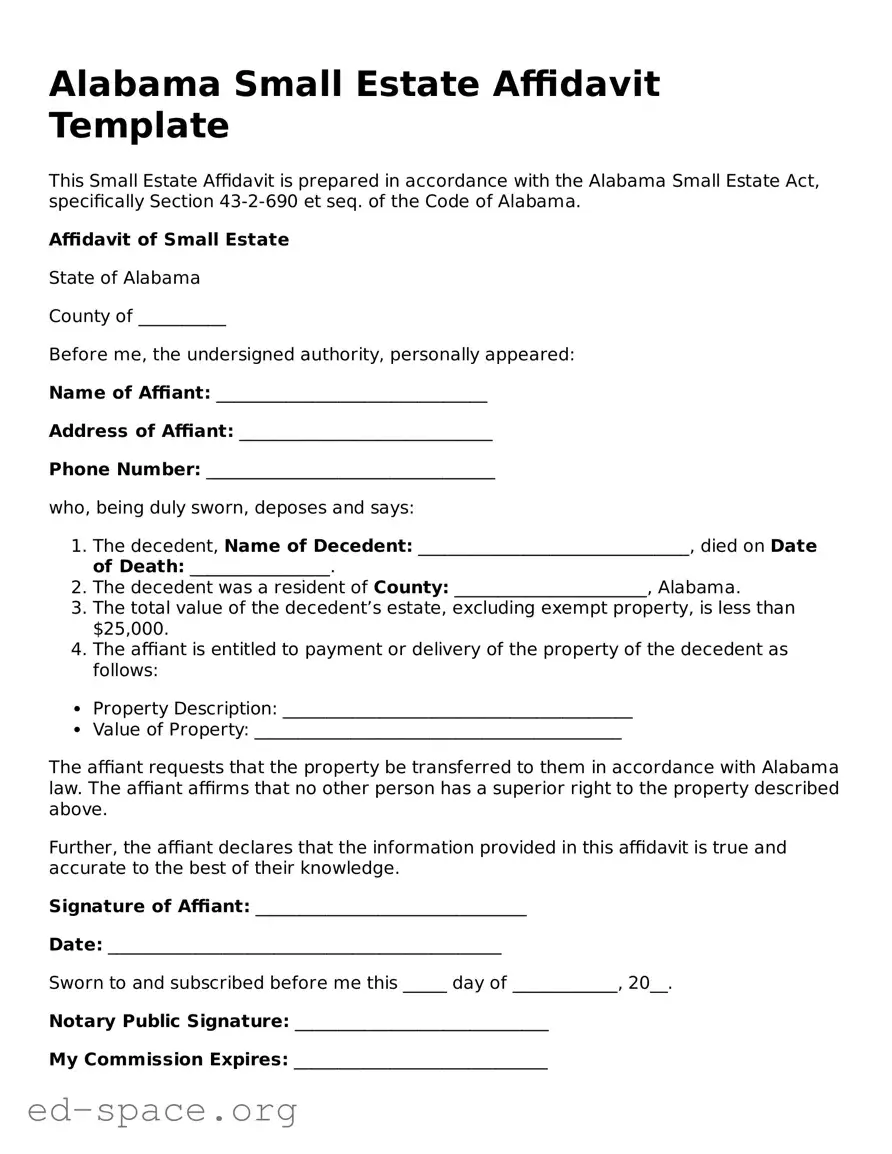
Alabama Small Estate Affidavit Template
This Small Estate Affidavit is prepared in accordance with the Alabama Small Estate Act, specifically Section 43-2-690 et seq. of the Code of Alabama.
Affidavit of Small Estate
State of Alabama
County of __________
Before me, the undersigned authority, personally appeared:
Name of Affiant: _______________________________
Address of Affiant: _____________________________
Phone Number: _________________________________
who, being duly sworn, deposes and says:
The affiant requests that the property be transferred to them in accordance with Alabama law. The affiant affirms that no other person has a superior right to the property described above.
Further, the affiant declares that the information provided in this affidavit is true and accurate to the best of their knowledge.
Signature of Affiant: _______________________________
Date: _____________________________________________
Sworn to and subscribed before me this _____ day of ____________, 20__.
Notary Public Signature: _____________________________
My Commission Expires: _____________________________
| Fact Name | Description |
|---|---|
| Purpose | The Alabama Small Estate Affidavit is used to simplify the process of settling small estates without going through formal probate. |
| Eligibility | To qualify, the total value of the estate must not exceed $25,000, excluding certain exempt property. |
| Governing Law | This form is governed by the Alabama Code, specifically Section 43-2-690 through 43-2-698. |
| Required Signatures | The affidavit must be signed by the heirs of the deceased, affirming their relationship and entitlement to the estate. |
| Filing Process | Once completed, the affidavit should be filed with the probate court in the county where the deceased resided. |
| Use of the Affidavit | This document allows heirs to collect assets such as bank accounts, vehicles, and personal property without lengthy legal procedures. |
After gathering the necessary information and documentation, you are ready to complete the Alabama Small Estate Affidavit form. This form serves as a means for individuals to claim assets from a deceased person's estate without going through the formal probate process. Follow the steps below to ensure that you fill out the form correctly.
What is the Alabama Small Estate Affidavit?
The Alabama Small Estate Affidavit is a legal document that allows individuals to settle the estate of a deceased person without going through the formal probate process. This form can be used when the total value of the estate is below a certain threshold, which simplifies the transfer of assets to heirs or beneficiaries. It provides a way for individuals to claim the deceased's property, such as bank accounts or personal belongings, more efficiently.
Who is eligible to use the Small Estate Affidavit in Alabama?
To be eligible to use the Small Estate Affidavit in Alabama, the estate must meet specific criteria. The total value of the estate must not exceed $25,000 for an individual or $50,000 for a couple. Additionally, the person filing the affidavit must be an heir or a beneficiary of the deceased. It is important to note that certain assets, such as real estate, may not qualify under this process.
How do I complete the Small Estate Affidavit?
Completing the Small Estate Affidavit involves gathering necessary information about the deceased and their assets. You will need to provide details such as the deceased's name, date of death, and a list of assets. After filling out the form, it must be signed in front of a notary public. Once notarized, you can present the affidavit to financial institutions or other entities holding the deceased's assets to facilitate the transfer.
What happens after I file the Small Estate Affidavit?
After filing the Small Estate Affidavit, the relevant institutions will review the document. If everything is in order, they will release the assets to the heirs or beneficiaries as indicated in the affidavit. It is advisable to keep copies of the affidavit for your records. If any disputes arise, or if the estate is more complicated than anticipated, it may be necessary to consult with a legal professional for further assistance.
Failing to meet the eligibility requirements. The Alabama Small Estate Affidavit is only applicable for estates valued at $25,000 or less, excluding real estate. Ensure that the total value of the estate qualifies.
Not including all necessary information. Each section of the form must be completed accurately. Missing information can lead to delays or rejection of the affidavit.
Incorrectly identifying the heirs. It is essential to list all heirs correctly, including their relationship to the deceased. Omitting an heir can cause legal complications.
Neglecting to sign the affidavit. The affidavit must be signed by the affiant. A missing signature renders the document invalid.
Forgetting to have the affidavit notarized. A notary public must witness the signing of the affidavit. Without notarization, the affidavit may not be accepted.
Using outdated forms. Always ensure that you are using the most current version of the Alabama Small Estate Affidavit form. Using an outdated form can lead to processing issues.
Failing to attach supporting documents. Relevant documents, such as a death certificate or proof of ownership of assets, should be included. Lack of supporting documentation can hinder the process.
When dealing with the Alabama Small Estate Affidavit, several other forms and documents may be necessary to ensure a smooth process. These documents help clarify the estate's details, establish ownership, and facilitate the transfer of assets. Below is a list of commonly used forms that accompany the Small Estate Affidavit.
Gathering these documents is crucial for a successful estate settlement. Each form plays a vital role in ensuring that the estate is administered according to Alabama law and the deceased's wishes. Proper preparation can significantly expedite the process.
The Small Estate Affidavit is a useful legal document that helps simplify the process of settling a deceased person's estate when the value is below a certain threshold. Several other documents serve similar purposes in estate management. Here are five such documents:
When filling out the Alabama Small Estate Affidavit form, it’s important to get it right. Here are some things to keep in mind:
Following these guidelines can help streamline your experience with the Small Estate Affidavit form. Make sure you double-check your work to avoid any delays.
The Alabama Small Estate Affidavit is a useful legal tool for settling small estates without the need for formal probate. However, several misconceptions surround its use. Below are seven common misunderstandings:
Understanding these misconceptions can help individuals navigate the process of settling small estates more effectively.
The Alabama Small Estate Affidavit is a useful tool for individuals dealing with the estate of a deceased person. This form simplifies the process of transferring property when the estate is small and can help avoid the lengthy probate process. Here are some key takeaways regarding its use: