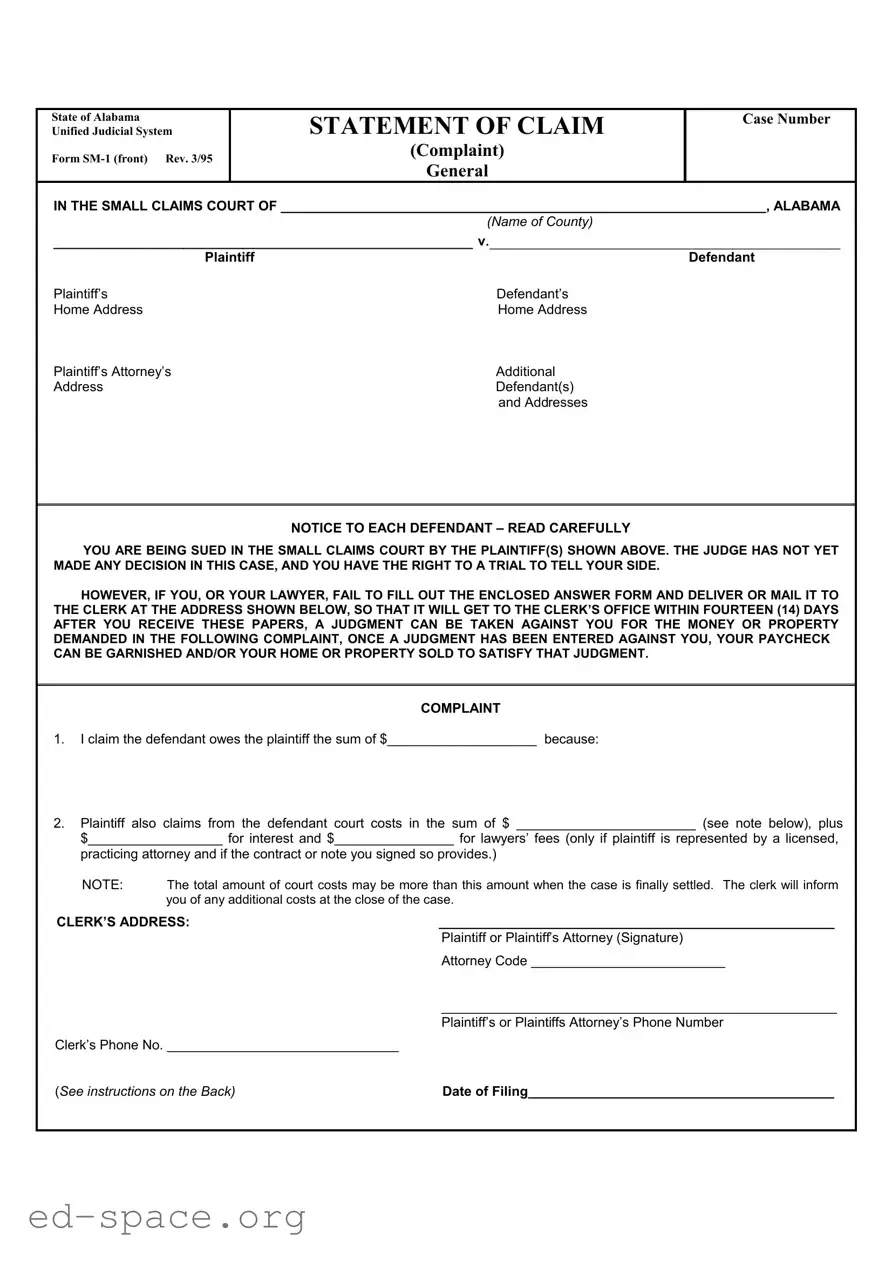
The Alabama SM 1 form plays a crucial role in the small claims court system, serving as the official Statement of Claim for individuals seeking to resolve disputes involving relatively modest amounts of money. This form outlines the essential details of the case, including the names and addresses of both the plaintiff and the defendant, as well as the specific monetary claims being made. It is imperative for the plaintiff to clearly articulate the basis of their claim, whether it be for unpaid debts, damages, or other financial grievances. The form also includes vital instructions for the defendants, emphasizing their rights to respond and the potential consequences of failing to do so. For instance, if a defendant does not file an answer within fourteen days, a judgment may be rendered against them, which could lead to garnishment of wages or the sale of property to satisfy the claim. Additionally, the form contains sections for court costs, interest, and attorney fees, providing a comprehensive overview of the financial implications of the dispute. By adhering to the guidelines set forth in the SM 1 form, individuals can navigate the small claims process more effectively, ensuring that their cases are presented accurately and efficiently.

State of Alabama |
STATEMENT OF CLAIM |
Case Number |
Unified Judicial System |
|
|
Form |
(Complaint) |
|
General |
|
|
|
|
|
IN THE SMALL CLAIMS COURT OF _________________________________________________________________, ALABAMA |
||
|
(Name of County) |
|
__________________________________________ v._______________________________________
Plaintiff |
Defendant |
Plaintiff’s |
Defendant’s |
Home Address |
Home Address |
Plaintiff’s Attorney’s |
Additional |
Address |
Defendant(s) |
|
and Addresses |
|
|
|
NOTICE TO EACH DEFENDANT – READ CAREFULLY |
YOU ARE BEING SUED IN THE SMALL CLAIMS COURT BY THE PLAINTIFF(S) SHOWN ABOVE. THE JUDGE HAS NOT YET MADE ANY DECISION IN THIS CASE, AND YOU HAVE THE RIGHT TO A TRIAL TO TELL YOUR SIDE.
HOWEVER, IF YOU, OR YOUR LAWYER, FAIL TO FILL OUT THE ENCLOSED ANSWER FORM AND DELIVER OR MAIL IT TO THE CLERK AT THE ADDRESS SHOWN BELOW, SO THAT IT WILL GET TO THE CLERK’S OFFICE WITHIN FOURTEEN (14) DAYS AFTER YOU RECEIVE THESE PAPERS, A JUDGMENT CAN BE TAKEN AGAINST YOU FOR THE MONEY OR PROPERTY DEMANDED IN THE FOLLOWING COMPLAINT, ONCE A JUDGMENT HAS BEEN ENTERED AGAINST YOU, YOUR PAYCHECK CAN BE GARNISHED AND/OR YOUR HOME OR PROPERTY SOLD TO SATISFY THAT JUDGMENT.
COMPLAINT
1. I claim the defendant owes the plaintiff the sum of $____________________ because:
2. Plaintiff also claims from the defendant court costs in the sum of $ ________________________ (see note below), plus
$__________________ for interest and $________________ for lawyers’ fees (only if plaintiff is represented by a licensed,
practicing attorney and if the contract or note you signed so provides.)
NOTE: |
The total amount of court costs may be more than this amount when the case is finally settled. The clerk will inform |
|
|
you of any additional costs at the close of the case. |
|
CLERK’S ADDRESS: |
_____________________________________________________ |
|
|
|
Plaintiff or Plaintiff’s Attorney (Signature) |
|
|
Attorney Code __________________________ |
|
|
_____________________________________________________ |
|
|
Plaintiff’s or Plaintiffs Attorney’s Phone Number |
Clerk’s Phone No. _______________________________ |
|
|
(See instructions on the Back) |
Date of Filing_________________________________________ |
|

Form
INSTRUCTIONS TO THE PLAINTIFF’S
This is your case, and if you are acting as your own lawyer, you are responsible in seeing that your claim is successfully presented at each stage of the procedure until it is concluded.
1.You must complete one of these forms for each defendant you wish to sue. Each defendant must be described by his/her correct legal name and address (not a post office box). Be as brief as possible but include every important name, date and place
2.To start your case you must file the completed form with the clerk assigned to Small Claims cases. The clerk will stamp a copy for you to show that the case has been filed and will insert the number of the case on the front of this form.
3.You are responsible for seeing that each defendant receives a copy of this form. If you haven’t heard from anyone about the case in about fourteen days, then check with the clerk’s office, to make sure that each defendant has been served.
4.If any of the defendants ask for a trial you will be notified of the place, the date, and the time. You must be present or your case will be dismissed. You may take a judgment by default fourteen (14) days after the defendant has received a copy of this form, if the defendant fails to file his/her Answer.
5.You are responsible to see to the enforcement of any judgment that is awarded to you. It is not the responsibility of the court or the clerk to collect the judgment for you.
ANY TIME YOU CONTACT THE CLERK ABOUT THIS CASE YOU MUST REFER TO THE CASE NUMBER ON THE FRONT.
INSTRUCTIONS TO SHERIFF OR PROCESS SERVER
To Any Sheriff or Any Person Authorized by Rule 4.1(b)(1) or 4.1(b)(2) of the Alabama Rules of Civil Procedure to Effect Service in the State of Alabama.
You are hereby commanded to serve this summons and a copy of the Statement of Claim in this action upon the defendant(s) named __________________________________________________________________________________________________
________________________________________________________________________________________________________
and make proper return to this court.
Date ________________________ |
_____________________________________ By__________ |
|
Clerk |
RETURN ON SERVICE:
Served on defendant(s) named _______________________________________________________________________________
________________________________________________________________________________________________________
by delivering a copy of the Summons and Statement of Claim to him/her in ____________________________________________
County, Alabama, on (Date) ______________________________________________________________________,
____________________________________________________
Process Server Signature
____________________________________________________
Title of Process Server
This service by certified mail of this Summons and Statement of Claim is initiated upon the request of _______________________
______________________________ pursuant to Rule 4.1.(c) of the Alabama Rules of Civil Procedure.
Date Requested ___________________________________ |
Date Mailed __________________________________________ |
Return Receipt Date _______________________________ |
______________________________ By___________________ |
|
Clerk |
| Fact Name | Details |
|---|---|
| Form Title | Statement of Claim (SM-1) |
| Governing Law | Alabama Rules of Civil Procedure |
| Purpose | This form is used to initiate a small claims lawsuit in Alabama. |
| Filing Requirement | The completed form must be filed with the clerk assigned to Small Claims cases. |
| Defendant's Rights | Defendants have the right to a trial and must respond within 14 days. |
| Judgment Consequences | If the defendant does not respond, a judgment can be entered against them. |
| Cost Recovery | Plaintiffs can claim court costs, interest, and attorney fees if applicable. |
| Service of Process | The form must be served to each defendant by a sheriff or authorized person. |
| Case Number | A unique case number will be assigned by the clerk upon filing. |
| Plaintiff Responsibility | It is the plaintiff's duty to ensure that the claim is properly presented and enforced. |
Completing the Alabama SM-1 form is an essential step in initiating a small claims case. This form requires specific information about both the plaintiff and the defendant, as well as the details of the claim being made. Following these steps will help ensure that the form is filled out correctly and submitted properly.
After submitting the form, it is crucial to ensure that each defendant receives a copy. If no response is received within fourteen days, check with the clerk to confirm that all defendants have been served. The next steps will depend on the responses received from the defendants.
What is the Alabama SM 1 form?
The Alabama SM 1 form is a legal document used in the Small Claims Court to initiate a lawsuit. It serves as a Statement of Claim, where the plaintiff outlines their case against the defendant, including the amount of money or property being claimed. This form must be completed and filed with the court to start legal proceedings.
How do I fill out the Alabama SM 1 form?
To fill out the Alabama SM 1 form, you need to provide specific information. Start by entering the name of the county where you are filing. Then, include your name as the plaintiff, the defendant's name, and their addresses. State the amount you are claiming and the reasons for the claim. Make sure to sign the form and include your contact information. Each defendant requires a separate form.
What happens after I file the SM 1 form?
Once you file the SM 1 form with the court clerk, the clerk will stamp your copy and assign a case number. You are then responsible for ensuring that each defendant receives a copy of the form. If you do not hear from the defendants within fourteen days, check with the clerk's office to confirm that they have been served.
What should I do if the defendant does not respond?
If the defendant fails to respond within fourteen days of receiving the SM 1 form, you may request a default judgment. This means you can ask the court to rule in your favor without the defendant's participation. However, you must be present in court if a trial is requested by the defendant.
Can I represent myself when filing the SM 1 form?
Yes, you can represent yourself when filing the SM 1 form. If you choose to do so, you are responsible for presenting your case effectively at every stage of the process. This includes filing the form correctly, serving the defendants, and attending any court hearings.
What are the potential outcomes of a small claims case?
The outcome of a small claims case can vary. If the court rules in your favor, you may receive the amount you claimed, plus any applicable court costs and interest. If the defendant wins, your claim will be dismissed. In either case, it is important to understand that the court does not enforce judgments; you must take steps to collect any awarded amount.
How do I enforce a judgment if I win?
If you win your case and receive a judgment, you are responsible for enforcing it. This may involve garnishing the defendant's wages or placing a lien on their property. You will need to follow specific legal procedures to collect the judgment, as the court does not handle this for you.
Where can I find additional information about the SM 1 form?
Additional information about the Alabama SM 1 form can typically be found on the official website of the Alabama Unified Judicial System. You may also contact the clerk's office in your county for guidance on filing procedures and requirements related to small claims cases.
Incorrect Names or Addresses: One common mistake is failing to provide the correct legal names and addresses for all defendants. Using nicknames or outdated addresses can lead to delays or dismissal of the case.
Missing Signatures: Many people forget to sign the form. Without a signature, the court will not accept the form, and the case cannot proceed.
Omitting Important Details: It’s crucial to include all relevant information about the claim. Leaving out key facts can weaken your case or result in a judge dismissing it.
Filing with the Wrong Clerk: Some individuals mistakenly file their forms with the wrong clerk or office. Make sure to file with the clerk assigned to Small Claims cases in your county.
Ignoring Deadlines: Failing to meet deadlines, especially for serving the defendants or filing responses, can have serious consequences. Always keep track of important dates to avoid losing your rights.
The Alabama Sm 1 form is essential for initiating a small claims case in Alabama. However, several other documents often accompany this form to ensure proper legal proceedings. Below is a list of these documents, each described briefly for clarity.
Understanding these accompanying documents can help individuals navigate the small claims process more effectively. Each plays a vital role in ensuring that the legal proceedings are conducted fairly and in accordance with the law.
The Alabama SM-1 form serves as a critical document in small claims court, allowing plaintiffs to initiate a legal claim against a defendant. There are several other documents that share similar purposes or functions. Here’s a look at eight of them:
When filling out the Alabama Sm 1 form, there are important guidelines to follow. Here’s a list of things you should and shouldn’t do to ensure your submission is correct and effective.
By following these guidelines, you can navigate the process more smoothly and increase your chances of a favorable outcome in your small claims case.
This form is designed for various types of claims, not just those involving money. It can also be used for property disputes or other small claims issues, depending on the circumstances.
Individuals can represent themselves when filing this form. It is not a requirement to have legal representation, although having a lawyer can provide guidance.
It is the responsibility of the plaintiff to ensure that each defendant receives a copy of the form. The court does not handle this notification automatically.
Filing the form initiates the legal process, but it does not guarantee that the plaintiff will win the case. The outcome depends on the evidence and arguments presented.
Ignoring the form can have serious consequences. If the defendant does not respond within the specified time, a judgment may be entered against them by default.
Once a judgment is awarded, it is the responsibility of the plaintiff to enforce it. The court does not collect the judgment on behalf of the winning party.
Providing correct legal names and addresses for all parties involved is crucial. Inaccurate information can lead to delays or dismissal of the case.
While the form itself initiates the claim, it may require additional documentation to support the case. Gathering relevant evidence and paperwork is important for a successful claim.
When filling out and using the Alabama Sm 1 form, there are several important considerations to keep in mind. Below are key takeaways that can help ensure the process is smooth and effective.