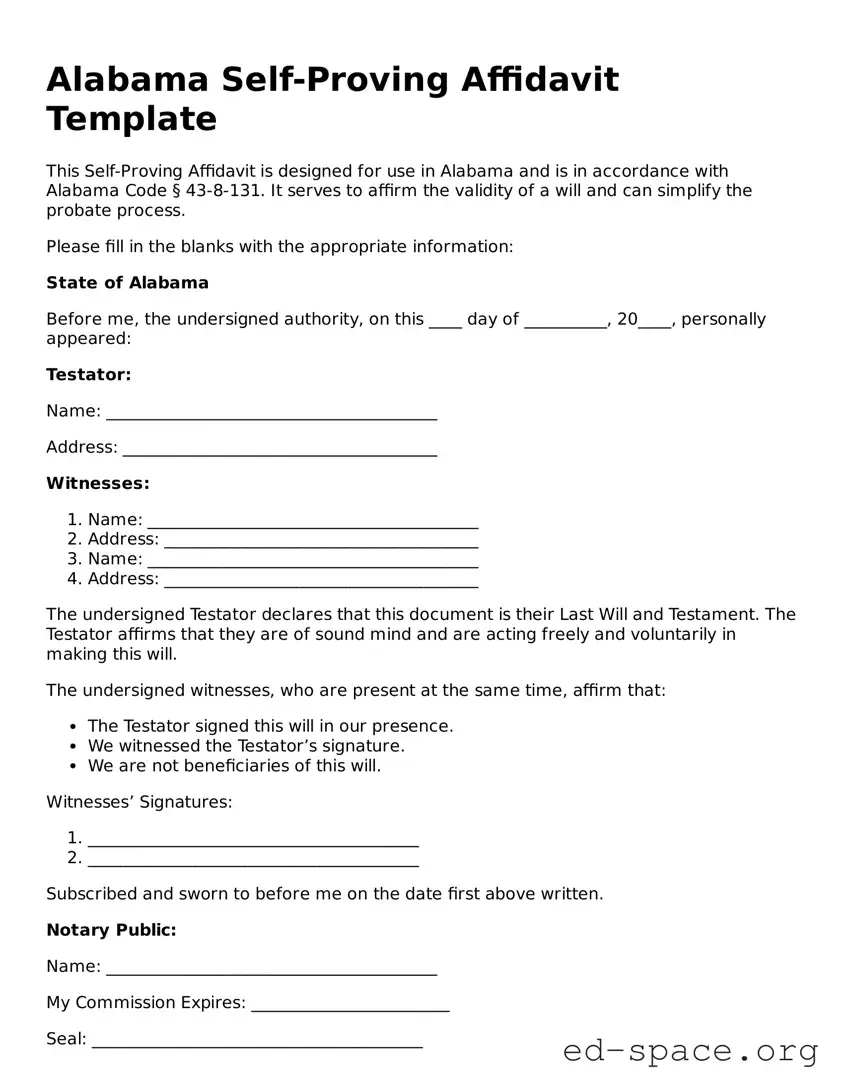
The Alabama Self-Proving Affidavit form plays a crucial role in the estate planning process, particularly when it comes to the validation of wills. This form allows a testator, or the individual creating the will, to affirm the authenticity of their signature and the voluntary nature of their will in the presence of witnesses. By completing this affidavit, the testator can streamline the probate process, eliminating the need for witnesses to testify in court about the will's legitimacy after the testator's passing. The form typically includes essential details such as the testator's name, the date of execution, and the signatures of both the testator and the witnesses. Additionally, the affidavit must be notarized, adding an extra layer of verification. Utilizing the Alabama Self-Proving Affidavit can provide peace of mind, ensuring that the testator's final wishes are honored without unnecessary delays or complications during probate.
Alabama Self-Proving Affidavit Template
This Self-Proving Affidavit is designed for use in Alabama and is in accordance with Alabama Code § 43-8-131. It serves to affirm the validity of a will and can simplify the probate process.
Please fill in the blanks with the appropriate information:
State of Alabama
Before me, the undersigned authority, on this ____ day of __________, 20____, personally appeared:
Testator:
Name: ________________________________________
Address: ______________________________________
Witnesses:
The undersigned Testator declares that this document is their Last Will and Testament. The Testator affirms that they are of sound mind and are acting freely and voluntarily in making this will.
The undersigned witnesses, who are present at the same time, affirm that:
Witnesses’ Signatures:
Subscribed and sworn to before me on the date first above written.
Notary Public:
Name: ________________________________________
My Commission Expires: ________________________
Seal: ________________________________________
| Fact Name | Description |
|---|---|
| Purpose | The Alabama Self-Proving Affidavit allows a testator's will to be validated without requiring witnesses to appear in court. |
| Governing Law | This form is governed by Alabama Code § 43-8-131, which outlines the requirements for self-proving wills. |
| Signatories | Both the testator and witnesses must sign the affidavit in the presence of a notary public to ensure its validity. |
| Benefits | Using this affidavit can expedite the probate process, reducing the time and costs associated with proving a will. |
Once you have the Alabama Self-Proving Affidavit form ready, you will need to complete it carefully. This form is important for validating a will without the need for witnesses to testify later. Follow these steps to ensure accurate completion.
Once the form is filled out, it will need to be notarized. This step is crucial as it adds an additional layer of validation to the document.
What is a Self-Proving Affidavit in Alabama?
A Self-Proving Affidavit is a legal document that allows a will to be validated without requiring witnesses to testify in court. In Alabama, this affidavit is signed by the testator (the person who created the will) and witnesses in front of a notary public. It simplifies the probate process by providing proof that the will was executed properly.
Why should I use a Self-Proving Affidavit?
Using a Self-Proving Affidavit can save time and reduce complications during the probate process. If your will includes this affidavit, it eliminates the need for witnesses to appear in court to confirm the will’s validity. This can make the process smoother for your loved ones during an already difficult time.
Who can sign the Self-Proving Affidavit?
The Self-Proving Affidavit must be signed by the testator and at least two witnesses. All parties should be present at the same time when signing. Additionally, a notary public must also sign the document to validate it. This ensures that all signatures are authentic and that the document holds up in court.
When should I create a Self-Proving Affidavit?
It’s best to create a Self-Proving Affidavit at the same time you draft your will. This way, you can ensure that all necessary parties are present to sign the document. However, if you already have a will without an affidavit, you can still create one later, as long as you follow the proper procedures.
Is a Self-Proving Affidavit required in Alabama?
No, a Self-Proving Affidavit is not required to create a valid will in Alabama. However, including one can significantly ease the probate process. If you want to avoid potential disputes or complications, it’s a good idea to consider adding this affidavit to your will.
Can I revoke a Self-Proving Affidavit?
Yes, you can revoke a Self-Proving Affidavit by creating a new will that explicitly states the previous will is revoked. Alternatively, you can destroy the affidavit or the will itself. It’s important to follow proper legal procedures to ensure that your wishes are clear and enforceable.
What happens if my Self-Proving Affidavit is not accepted?
If a Self-Proving Affidavit is not accepted during probate, the court may require witnesses to testify about the will’s validity. This can lead to delays and additional complications. To avoid this, ensure that the affidavit is properly executed and notarized.
Can I create a Self-Proving Affidavit without a lawyer?
While it’s possible to create a Self-Proving Affidavit without a lawyer, it’s wise to seek legal advice to ensure that all requirements are met. A legal professional can help you navigate the process and confirm that your will and affidavit comply with Alabama law.
What should I do with my Self-Proving Affidavit once it’s completed?
Once your Self-Proving Affidavit is completed and signed, keep it with your will in a safe place. Inform your loved ones about its location so they can easily access it when needed. This will help streamline the probate process when the time comes.
Can I update my Self-Proving Affidavit?
Yes, you can update your Self-Proving Affidavit whenever you make changes to your will. Just ensure that the updated affidavit is signed and notarized in the same manner as the original. Keeping your documents current is essential for reflecting your current wishes.
Not signing the affidavit in front of a notary public. The affidavit must be notarized to be valid.
Failing to include all required information. Ensure that all names, dates, and details are accurately filled in.
Using incorrect or outdated forms. Always use the most current version of the Alabama Self-Proving Affidavit form.
Neglecting to have witnesses present. Two witnesses must sign the affidavit along with the testator.
Not checking for legibility. Ensure that all handwriting is clear and easy to read.
Overlooking the date of signing. The date must be included to confirm when the affidavit was executed.
Failing to keep copies. Always make copies of the signed affidavit for personal records and future reference.
Not understanding the purpose of the affidavit. This document serves to validate a will, so clarity is crucial.
The Alabama Self-Proving Affidavit is an important document used in the estate planning process, particularly for wills. It allows a will to be validated without requiring witnesses to testify in court after the testator's death. In addition to this affidavit, several other forms and documents are commonly utilized to ensure a smooth legal process. Below is a list of these forms, along with brief descriptions of each.
These documents work together to facilitate the estate planning and probate processes. Ensuring that each form is completed accurately can help prevent complications and provide clarity during what can be a challenging time for families.
The Self-Proving Affidavit form is similar to several other legal documents that serve to confirm the authenticity of signatures and intentions. Here are five documents that share similarities:
When completing the Alabama Self-Proving Affidavit form, it is essential to follow certain guidelines to ensure that the document is valid and effective. Below is a list of things to do and avoid during this process.
By adhering to these guidelines, individuals can help ensure that the Self-Proving Affidavit is filled out correctly and meets the necessary legal standards.
The Alabama Self-Proving Affidavit is an important legal document, but several misconceptions surround its use and purpose. Here are five common misunderstandings:
Understanding these misconceptions can help individuals make informed decisions about their estate planning in Alabama.
When dealing with the Alabama Self-Proving Affidavit form, it’s important to understand its purpose and how to fill it out correctly. Here are some key takeaways to keep in mind: