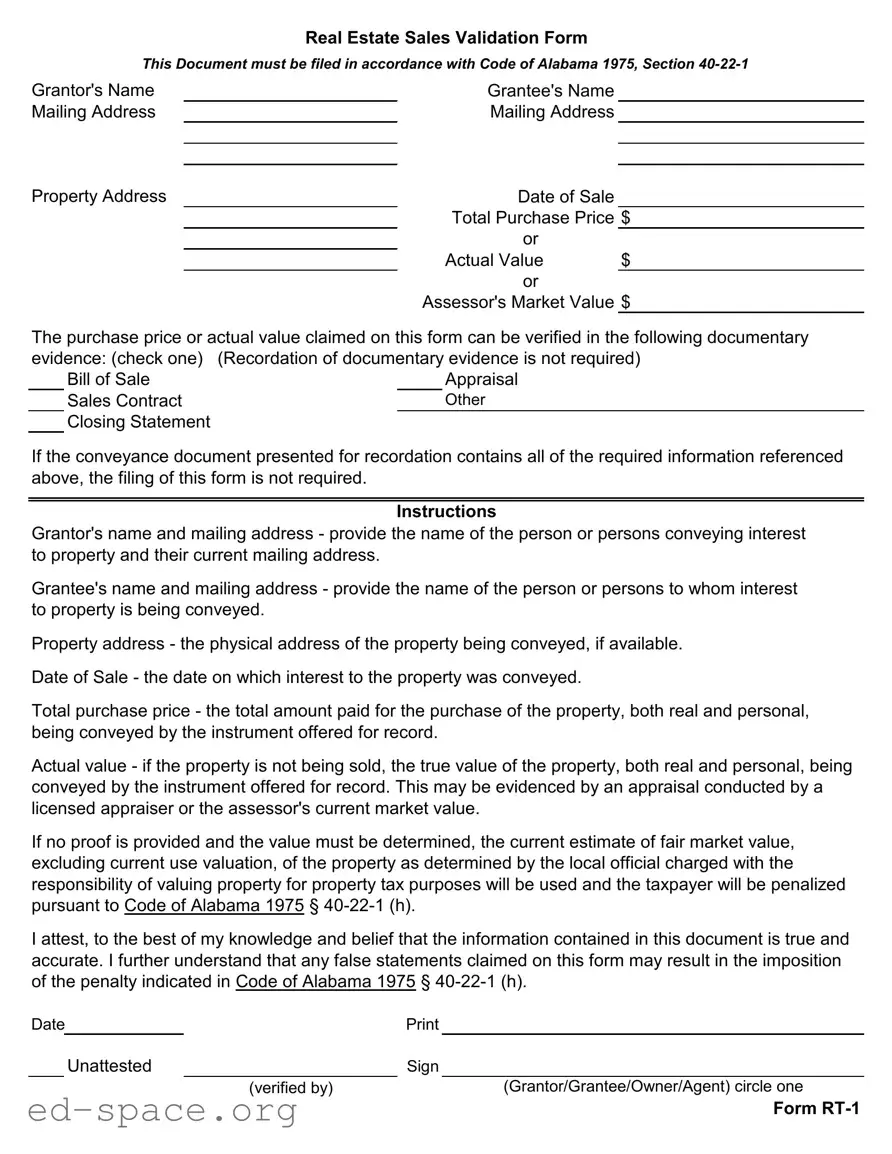
The Alabama Rt 1 form, formally known as the Real Estate Sales Validation Form, serves as a critical document in the real estate transaction process within the state. It is essential for recording the transfer of property ownership and ensuring compliance with state regulations as outlined in the Code of Alabama 1975, Section 40-22-1. This form requires specific information, including the names and mailing addresses of both the grantor and grantee, the physical address of the property being sold, the date of sale, and the total purchase price or actual value of the property. Additionally, the form allows for the verification of the claimed purchase price through various types of documentary evidence, such as a bill of sale, appraisal, sales contract, or closing statement. Notably, if the conveyance document already includes all necessary information, the filing of the Rt 1 form may not be required. However, accuracy is paramount, as any misrepresentation can lead to penalties as stipulated in the relevant code. The form concludes with an attestation statement, emphasizing the importance of truthful reporting in the real estate transaction process.

REAL ESTATE SALES VALIDATION FORM
THIS DOCUMENT MUST BE FILED IN ACCORDANCE WITH CODE OF ALABAMA 1975, SECTION
Grantor's Name |
|
Grantee's Name |
Mailing Address |
|
Mailing Address |
|
|
|
|
|
|
Property Address |
|
Date of Sale |
|
|
|
Total Purchase Price $ |
|
|
|
or |
|
|
|
Actual Value |
$ |
|
|
or |
|
|
|
Assessor's Market Value $ |
|
|
|
|
|
The purchase price or actual value claimed on this form can be verified in the following documentary
evidence: (check one) |
(Recordation of documentary evidence is not required) |
|||
|
Bill of Sale |
|
|
Appraisal |
|
Sales Contract |
|
|
Other |
|
Closing Statement |
|
|
|
If the conveyance document presented for recordation contains all of the required information referenced above, the filing of this form is not required.
INSTRUCTIONS
Grantor's name and mailing address - provide the name of the person or persons conveying interest to property and their current mailing address.
Grantee's name and mailing address - provide the name of the person or persons to whom interest to property is being conveyed.
Property address - the physical address of the property being conveyed, if available.
Date of Sale - the date on which interest to the property was conveyed.
Total purchase price - the total amount paid for the purchase of the property, both real and personal, being conveyed by the instrument offered for record.
Actual value - if the property is not being sold, the true value of the property, both real and personal, being conveyed by the instrument offered for record. This may be evidenced by an appraisal conducted by a licensed appraiser or the assessor's current market value.
If no proof is provided and the value must be determined, the current estimate of fair market value, excluding current use valuation, of the property as determined by the local official charged with the responsibility of valuing property for property tax purposes will be used and the taxpayer will be penalized pursuant to Code of Alabama 1975 §
I attest, to the best of my knowledge and belief that the information contained in this document is true and accurate. I further understand that any false statements claimed on this form may result in the imposition of the penalty indicated in Code of Alabama 1975 §
DatePrint
Unattested |
Sign |
||
|
(verified by) |
|
(Grantor/Grantee/Owner/Agent) circle one |
FORM
| Fact Name | Description |
|---|---|
| Governing Law | This form is governed by the Code of Alabama 1975, Section 40-22-1. |
| Purpose | The Real Estate Sales Validation Form is used to validate the sale of real estate in Alabama. |
| Required Information | The form requires the names and addresses of the grantor and grantee, property address, date of sale, and total purchase price or actual value. |
| Documentary Evidence | Verification of the purchase price or actual value can be provided through a bill of sale, appraisal, sales contract, or other closing statement. |
| Filing Requirement | If the conveyance document has all required information, filing this form is not necessary. |
| Penalties | Failure to provide accurate information may result in penalties as outlined in Code of Alabama 1975, Section 40-22-1 (h). |
Filling out the Alabama Rt 1 form is an important step in the property transfer process. Make sure you have all necessary information handy before you begin. After completing the form, you will need to submit it according to local guidelines.
What is the purpose of the Alabama Rt 1 form?
The Alabama Rt 1 form, also known as the Real Estate Sales Validation Form, is designed to provide essential information regarding the sale of real property. This form helps verify the purchase price or actual value of the property being transferred. It ensures compliance with Alabama law, specifically Code of Alabama 1975, Section 40-22-1, which mandates that certain details about the sale be documented. By completing this form, parties involved in the transaction can avoid potential penalties and ensure a smooth recording process.
Who needs to complete the Alabama Rt 1 form?
The form must be completed by the grantor, who is the person selling or conveying the property, and the grantee, who is the person receiving the property. Both parties should provide their names and current mailing addresses. If the conveyance document already contains all the required information, then filing the Rt 1 form is not necessary. However, if the information is incomplete, it is crucial to fill out this form accurately to avoid complications during the recording of the property transfer.
What information is required on the Alabama Rt 1 form?
When filling out the Alabama Rt 1 form, you will need to provide several key pieces of information. This includes the names and mailing addresses of both the grantor and grantee, the physical address of the property being sold, the date of the sale, and the total purchase price or actual value of the property. Additionally, you must indicate the type of documentary evidence that supports the claimed value, such as a bill of sale, appraisal, or sales contract. This information is vital for proper documentation and compliance with state law.
What happens if the information provided is inaccurate?
It is important to ensure that all information provided on the Alabama Rt 1 form is accurate and truthful. If any false statements are made, the individual responsible may face penalties as outlined in Code of Alabama 1975, Section 40-22-1 (h). This could include financial repercussions or other legal consequences. Therefore, it is advisable to review the information carefully before submission to avoid any issues that may arise from inaccuracies.
Missing Information: Failing to fill in all required fields, such as the names of the grantor and grantee, can lead to delays or rejections.
Incorrect Property Address: Providing an inaccurate or incomplete property address can cause confusion and may affect the validity of the form.
Wrong Date of Sale: Entering the incorrect date of sale can complicate the transaction and may lead to legal issues later.
Purchase Price Errors: Misstating the total purchase price or actual value can result in penalties or additional scrutiny from tax authorities.
Documentary Evidence Check: Not checking the appropriate box for the type of documentary evidence can lead to confusion about the valuation of the property.
Signature Issues: Forgetting to sign the form or having an unauthorized person sign can invalidate the submission.
Not Attesting: Failing to include the attestation statement may lead to questions about the accuracy of the information provided.
Ignoring Local Regulations: Overlooking specific local requirements can result in the form being rejected or delayed.
Inconsistent Information: Providing information that contradicts other documents can raise red flags and complicate the process.
Late Submission: Submitting the form after the required timeframe can lead to penalties or complications in the transaction.
The Alabama Rt 1 form is an essential document used in real estate transactions, specifically for validating the sale of property. When dealing with property transfers, several other forms and documents often accompany the Rt 1 form to ensure a smooth process. Here’s a brief overview of those documents:
In summary, the Alabama Rt 1 form is just one piece of the puzzle in real estate transactions. Understanding the other documents involved can help buyers and sellers navigate the process with confidence. Each form plays a crucial role in ensuring that the sale is legally sound and that both parties are protected.
The Alabama Rt 1 form, also known as the Real Estate Sales Validation Form, is used in real estate transactions to validate the sale of property. Several other documents serve similar purposes in real estate transactions. Here are seven documents that are comparable to the Alabama Rt 1 form:
When filling out the Alabama Rt 1 form, it is essential to approach the task with care and attention to detail. Below is a list of things to do and avoid in order to ensure accuracy and compliance.
By adhering to these guidelines, individuals can navigate the process of completing the Alabama Rt 1 form more effectively, minimizing the risk of errors and ensuring compliance with state requirements.
Understanding the Alabama Rt 1 form is essential for anyone involved in real estate transactions in the state. However, several misconceptions can lead to confusion. Here are four common misunderstandings:
By addressing these misconceptions, individuals can navigate the requirements of the Alabama Rt 1 form more effectively and ensure compliance with state regulations.
Filling out the Alabama Rt 1 form requires attention to specific details. Here are key takeaways to consider: