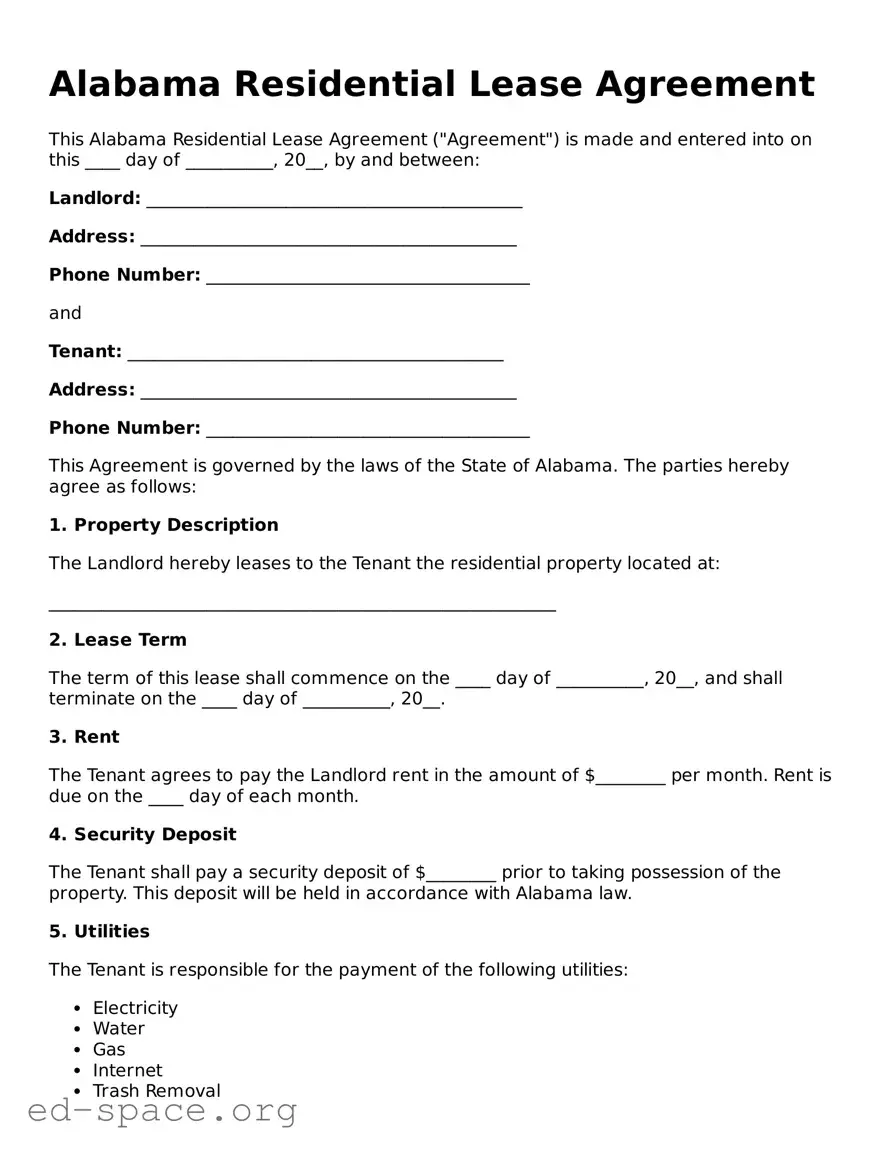
The Alabama Residential Lease Agreement is a crucial document that outlines the terms and conditions between landlords and tenants in the state of Alabama. This agreement serves as a legally binding contract, establishing the rights and responsibilities of both parties involved in a rental arrangement. Key aspects of the form include the duration of the lease, rental payment details, security deposit requirements, and maintenance obligations. Additionally, the document addresses rules regarding pets, utilities, and termination procedures, ensuring that both landlords and tenants have a clear understanding of their obligations. It is essential for both parties to thoroughly review and comprehend the terms outlined in the lease agreement to prevent misunderstandings and disputes in the future. By providing a structured framework for the rental relationship, the Alabama Residential Lease Agreement plays a vital role in fostering a positive living environment for tenants while protecting the interests of property owners.
Alabama Residential Lease Agreement
This Alabama Residential Lease Agreement ("Agreement") is made and entered into on this ____ day of __________, 20__, by and between:
Landlord: ___________________________________________
Address: ___________________________________________
Phone Number: _____________________________________
and
Tenant: ___________________________________________
Address: ___________________________________________
Phone Number: _____________________________________
This Agreement is governed by the laws of the State of Alabama. The parties hereby agree as follows:
1. Property Description
The Landlord hereby leases to the Tenant the residential property located at:
__________________________________________________________
2. Lease Term
The term of this lease shall commence on the ____ day of __________, 20__, and shall terminate on the ____ day of __________, 20__.
3. Rent
The Tenant agrees to pay the Landlord rent in the amount of $________ per month. Rent is due on the ____ day of each month.
4. Security Deposit
The Tenant shall pay a security deposit of $________ prior to taking possession of the property. This deposit will be held in accordance with Alabama law.
5. Utilities
The Tenant is responsible for the payment of the following utilities:
6. Maintenance and Repairs
The Tenant agrees to keep the premises in good condition and to notify the Landlord of any needed repairs. The Landlord shall be responsible for repairs that are not caused by the Tenant’s negligence.
7. Pets
Pets are allowed / not allowed (choose one). If allowed, the Tenant must pay a non-refundable pet deposit of $________.
8. Termination
Either party may terminate this Agreement by providing written notice at least ____ days prior to the end of the lease term.
9. Governing Law
This Agreement shall be governed by and construed in accordance with the laws of the State of Alabama.
10. Signatures
In witness whereof, the parties hereto have executed this Agreement as of the date first above written.
Landlord Signature: _______________________________
Date: __________________________________________
Tenant Signature: _______________________________
Date: __________________________________________
| Fact Name | Description |
|---|---|
| Governing Law | The Alabama Residential Lease Agreement is governed by Alabama state law, specifically the Alabama Uniform Residential Landlord and Tenant Act. |
| Parties Involved | The agreement involves two main parties: the landlord (lessor) and the tenant (lessee). |
| Lease Duration | The lease can be for a fixed term or a month-to-month arrangement, depending on the agreement between the parties. |
| Security Deposit | Landlords can require a security deposit, which is typically limited to one month's rent under Alabama law. |
| Notice Requirements | Both parties must provide written notice for termination of the lease, with specific time frames outlined in the agreement. |
| Maintenance Responsibilities | The lease should clearly outline maintenance responsibilities for both the landlord and tenant to avoid disputes. |
Filling out the Alabama Residential Lease Agreement form requires attention to detail to ensure all necessary information is accurately provided. Once completed, the form will serve as a binding contract between the landlord and tenant, outlining the terms of the lease.
What is an Alabama Residential Lease Agreement?
An Alabama Residential Lease Agreement is a legal document that outlines the terms and conditions between a landlord and tenant for renting residential property. It includes details such as the rental amount, lease duration, and responsibilities of both parties.
What should be included in the agreement?
The agreement should contain essential information such as the names of the landlord and tenant, property address, lease term, rent amount, payment due dates, security deposit details, maintenance responsibilities, and any rules or regulations specific to the property.
How long is a typical lease term?
A typical lease term in Alabama can range from six months to one year. However, landlords and tenants may agree to shorter or longer terms based on their needs. It’s important to clearly specify the lease duration in the agreement.
Can the lease be terminated early?
Yes, a lease can be terminated early, but it usually requires mutual consent from both parties. The agreement should outline the process for early termination, including any penalties or notice requirements. Tenants should review the lease for specific terms regarding this issue.
What happens if the tenant fails to pay rent?
If a tenant fails to pay rent, the landlord may initiate eviction proceedings after providing proper notice, as specified in the lease agreement and Alabama law. The lease should detail the consequences of non-payment, including late fees and the eviction process.
Is it necessary to have the lease agreement notarized?
No, it is not necessary to have the Alabama Residential Lease Agreement notarized for it to be valid. However, both parties should sign the document to acknowledge their agreement to the terms. It is advisable to keep a copy for personal records.
Failing to provide accurate personal information. Ensure that names, addresses, and contact details are correct to avoid future disputes.
Not specifying the lease term. Clearly outline the start and end dates of the lease to prevent misunderstandings.
Ignoring the security deposit section. Specify the amount and conditions for its return to protect both parties' interests.
Overlooking maintenance responsibilities. Clearly state who is responsible for repairs and maintenance to avoid conflicts later.
Neglecting to include pet policies. If pets are allowed, outline any restrictions or additional fees associated with them.
Failing to read the entire agreement. Each section is important; understanding all terms can prevent future issues.
Not keeping a copy of the signed lease. Retaining a copy for personal records is essential for reference throughout the lease term.
When entering into a rental agreement in Alabama, several other documents often accompany the Residential Lease Agreement. These forms help clarify the terms of the lease, outline responsibilities, and protect the rights of both landlords and tenants. Here are some commonly used forms and documents:
These forms and documents play a vital role in ensuring a smooth rental experience. They help establish clear expectations, protect both parties' interests, and provide a framework for resolving any issues that may arise during the tenancy.
When filling out the Alabama Residential Lease Agreement form, it is important to follow certain guidelines to ensure accuracy and clarity. Here are six essential do's and don'ts:
Understanding the Alabama Residential Lease Agreement form is essential for both landlords and tenants. However, several misconceptions can lead to confusion. Here are nine common misunderstandings about this important document:
By understanding these misconceptions, both landlords and tenants can navigate the leasing process more effectively and protect their rights.
When filling out and using the Alabama Residential Lease Agreement form, several key points should be considered to ensure clarity and compliance. Understanding these aspects can help both landlords and tenants navigate their responsibilities effectively.
By paying attention to these key takeaways, both landlords and tenants can foster a more harmonious rental experience while protecting their legal rights.